
Nicholas Fox Weber
Author of The Bauhaus Group: Six Masters of Modernism
About the Author
Nicholas Fox Weber is the director of the Josef and Anni Albers Foundation.
Image credit: Marion Ettlinger
Works by Nicholas Fox Weber
The Clarks of Cooperstown: Their Singer Sewing Machine Fortune, Their Great and Influential Art Collections, Their Forty-Year Feud (2007) 58 copies
Freud's Trip to Orvieto: The Great Doctor's Unresolved Confrontation with Antisemitism, Death, and Homoeroticism; His Passion for Paintings; and the Writer in His Footsteps (2017) 35 copies, 10 reviews
The Woven Art Of Anni Albers 1 copy
Bauhaus 1 copy
Associated Works
Albers and Moholy-Nagy: From the Bauhaus to the New World (2006) — Contributor — 83 copies, 1 review
Josef Albers : homage to the square paintings and photographs (1928-1938) (2005) — Introduction, some editions — 16 copies
Tagged
Common Knowledge
- Birthdate
- 1947-12-09
- Gender
- male
- Education
- Columbia College (BA|Art History|1969)
Yale University (MA|Art History|1972) - Occupations
- Director, Josef and Anni Albers Foundation, Bethany, Connecticut
Art historian - Organizations
- Josef and Anni Albers Foundation
- Relationships
- Weber, Katharine (wife)
- Nationality
- USA
- Birthplace
- Hartford, Connecticut, USA
- Places of residence
- Hartford, Connecticut, USA
- Associated Place (for map)
- Hartford, Connecticut, USA
Members
Reviews
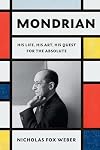
This is what Mondrian craved: to stop fear, to eradicate confusion, to obliterate dogma, and end the trauma of emotion. Their absence was essential to personal liberation. In his own way of life, and in the art he made, Mondrian achieved all of that to an extraordinary degree. His dream was for other people to undo their shackles and enjoy the same freedom he had found for himself. from Mondrian by Nicholas Fox Weber
I spent most of a month reading this biography of Mondrian. It is a massive show more book that shares everything knowable about the artist, and yet Mondrian remains, in essence, a mystery.
I have seen Mondrian’s work in life, perhaps at the Philadelphia Museum of Art but for sure at the Guggenheim, and I have seen plenty of photos, and remember when Pierre Cardin came out with the Mondrian inspired shift dresses in the early 1960s. But why did I read a massive biography of this artist? Even in the pages of a book, somehow he charms readers just as he charmed the people who met him in real life.
Mondrian held to restrictive beliefs about diet, art, music, and relationships. He was dependent on friends, but cut them off over ideas about art. And yet in late life he promoted unknown artists who didn’t conform to his long held standards. He loved the beauty of this world but considered it a siren call luring him from his quest to transcend the material and embrace the spiritual. He was an antisemite whose career was boosted by Jewish art sellers and friends.
Mondrian hated curves and loved jazz and boogie woogie, adored dancing although hard pressed to find partners because of his strange style. He embraced new techniques like using colored duct tape to plan his paintings but dressed in conservative suits, his stance straight and rigid. He loved Walt Disney’s Snow White!
He was the son of a conservative and strict Orthodox Protestant father. He studied art, supporting himself with paintings of flowers, scenery, and portraits while developing his style, inspired by Theosophy. His artist uncle didn’t want his work to be confused with his nephew’s Neo Plastic work, so Mondrian altered the spelling of his family name. Mondrian went to Paris but was forced to flee during WWII, settling in London during the Blitz. In his last years, he finally realized his dream of living in New York City.
The book is filled with detailed descriptions of Mondrian’s art and what the author’s critical interpretations. Even work that has disappeared, considered deviant by the Nazis and destroyed. When the work was not reproduced in the book I paused to look up the paintings online. There is a section of color prints included in the book.
Nicholas Fox Weber remarks on the joy found in Mondrian’s paintings. Mondrian struggled with mental health issues and health issues, and often struggled to pay his rent. Yet he found such joy in life, in his work, the friends who took care of him.
I found myself inspired by Mondrian’s work style, patiently moving a line or square of color until the work had the balance, or imbalance, that he desired.
I appreciated reading this masterful biography.
Thanks to the publisher for a free book. show less
I spent most of a month reading this biography of Mondrian. It is a massive show more book that shares everything knowable about the artist, and yet Mondrian remains, in essence, a mystery.
I have seen Mondrian’s work in life, perhaps at the Philadelphia Museum of Art but for sure at the Guggenheim, and I have seen plenty of photos, and remember when Pierre Cardin came out with the Mondrian inspired shift dresses in the early 1960s. But why did I read a massive biography of this artist? Even in the pages of a book, somehow he charms readers just as he charmed the people who met him in real life.
Mondrian held to restrictive beliefs about diet, art, music, and relationships. He was dependent on friends, but cut them off over ideas about art. And yet in late life he promoted unknown artists who didn’t conform to his long held standards. He loved the beauty of this world but considered it a siren call luring him from his quest to transcend the material and embrace the spiritual. He was an antisemite whose career was boosted by Jewish art sellers and friends.
Mondrian hated curves and loved jazz and boogie woogie, adored dancing although hard pressed to find partners because of his strange style. He embraced new techniques like using colored duct tape to plan his paintings but dressed in conservative suits, his stance straight and rigid. He loved Walt Disney’s Snow White!
He was the son of a conservative and strict Orthodox Protestant father. He studied art, supporting himself with paintings of flowers, scenery, and portraits while developing his style, inspired by Theosophy. His artist uncle didn’t want his work to be confused with his nephew’s Neo Plastic work, so Mondrian altered the spelling of his family name. Mondrian went to Paris but was forced to flee during WWII, settling in London during the Blitz. In his last years, he finally realized his dream of living in New York City.
The book is filled with detailed descriptions of Mondrian’s art and what the author’s critical interpretations. Even work that has disappeared, considered deviant by the Nazis and destroyed. When the work was not reproduced in the book I paused to look up the paintings online. There is a section of color prints included in the book.
Nicholas Fox Weber remarks on the joy found in Mondrian’s paintings. Mondrian struggled with mental health issues and health issues, and often struggled to pay his rent. Yet he found such joy in life, in his work, the friends who took care of him.
I found myself inspired by Mondrian’s work style, patiently moving a line or square of color until the work had the balance, or imbalance, that he desired.
I appreciated reading this masterful biography.
Thanks to the publisher for a free book. show less
Freud's Trip to Orvieto: The Great Doctor's Unresolved Confrontation with Antisemitism, Death, and Homoeroticism; His Passion for Paintings; and the Writer in His Footsteps by Nicholas Fox Weber
Beautifully rendered and uniquely insightful, this Freudian "side-trip" involves art, nakedness, sexuality and repression but in a strikingly unusual way. Even the loudest anti-Freudian (the fashionable position these days) will find something here to delight in and argue about.
 This review was written for LibraryThing Early Reviewers.
Freud's Trip to Orvieto: The Great Doctor's Unresolved Confrontation with Antisemitism, Death, and Homoeroticism; His Passion for Paintings; and the Writer in His Footsteps by Nicholas Fox Weber
Freud's Trip to Orvieto is an impressive book with thick, glossy pages, many beautiful color plates, and a heft that draws your attention. Unfortunately, I did not find it very readable. I would like to know more about Freud, but Nicholas Fox Weber's examination of this particular episode in Freud's life seemed too much about Weber and his reactions and not enough about Freud. I may try this book again since it's so well reviewed, but for now, it's not for me.
This review was written for LibraryThing Early Reviewers.Freud's Trip to Orvieto: The Great Doctor's Unresolved Confrontation with Antisemitism, Death, and Homoeroticism; His Passion for Paintings; and the Writer in His Footsteps by Nicholas Fox Weber
Freud’s Trip to Orvieto, written by Nicholas Fox Weber, is a beautiful book in design, illustration and feel. It is also a hard book to categorize and a delight to read. Weber recounts finding an offprint of an article when going through his parents’ home, which prompts a memory from his own youth when he experienced both a strong sexual memory and an observation of the authors of the article of the offprint. Weber weaves a beautiful web, discussing his own education, the trip Freud made show more to Orvieto and his memory loss, the homoerotic paintings of Signorelli’s Orvieto Frescos, anti-Semitism in Freud’s time and Weber’s academic study. Weber, a trained art historian with a passionate love of beauty, draws us into Freud’s trip to Orvieto and the art works Freud admired and studied. Freud’s Trip to Orvieto reads as if it were Weber’s memoir, an examination of psychoanalysis and thought with the authors of the offprint article, Freud, himself and others, Jewishness, antisemitism and Italian Renaissance art. Freud’s Trip to Orvieto is unique and easy to recommend for an interesting and informative read. show less
This review was written for LibraryThing Early Reviewers.Lists
Awards


You May Also Like


Associated Authors
Statistics
- Works
- 38
- Also by
- 4
- Members
- 812
- Popularity
- #31,426
- Rating
- 4.1
- Reviews
- 19
- ISBNs
- 53
- Languages
- 3
