
Raymond Z. Gallun (1911–1994)
Author of The Best of Raymond Z. Gallun
About the Author
Image credit: Raymond Z. Gallun c. 1953
Series
Works by Raymond Z. Gallun
Davy Jones' Ambassador 5 copies
Return Of A Legend 4 copies
Short Science Fiction Collection 010 3 copies
Eyes That Watch (short story) 3 copies
Extraños en la tierra 3 copies
Seeds Of The Dusk 3 copies
Terror out of the Past 2 copies
Mind Over Matter 2 copies
Invaders of the Forbidden Moon 2 copies
Dawn of the Demigods 2 copies
Give Back a World 2 copies
Starclimber: The Literary Adventures and Autobiography of Raymond Z. Gallun (Borgo Bioviews,) (2007) 2 copies
The Raiders of Saturn's Ring 2 copies
The Achilles Heel 1 copy
The Crystal Ray 1 copy
Guardian Angel 1 copy
L'ultimo marziano 1 copy
Dawn of the Demi-Gods [The Demi-Gods Saga] An SF Classic of Genetic Engineering and Nanotechnology (2005) 1 copy
The Guthrie method 1 copy
Double identity 1 copy
Quando esplose Selene 1 copy
Saturn's Ringmaster 1 copy
Associated Works
Analog Science Fiction/Science Fact: Vol. XCVII, No. 12 (December 1977) (1977) — Contributor — 28 copies, 1 review
Tagged
Common Knowledge
- Legal name
- Gallun, Raymond Zinke
- Other names
- Allport, Arthur
Callahan, William
Elstar, Dow
Raymond, E. V. - Birthdate
- 1911-03-22
- Date of death
- 1994-04-02
- Gender
- male
- Nationality
- USA
- Birthplace
- Beaver Dam, Wisconsin, USA
- Place of death
- Forest Hills, New York, USA
- Associated Place (for map)
- USA
Members
Reviews

Gallun may be one of the least-remembered (at the moment) SF authors to come out of the pulps of the 1930s, but he was likely the most mature, scientifically-savvy, and prescient; that the stories in this collection read very well in 2022 with only a patina of being dated is truly brilliant. I had read two of these before, anthologized elsewhere, and was pleased to see that they weren't radical outliers of his work. Many of these remain good, solid SF stories on their own without having to show more be reckoned as "classics of their time," though I really cannot say the same for the stories of Stanley Weinbaum or Murray Leinster.
Gallun had a good handle on biology and Darwinian evolution. Unlike much SF of the 1930s-'50s, he dove into bioengineering, biotechnology, and genetic modification for his alien species as well as humans. "Davy Jones' Ambassador" is a good example of this, as is "Seeds of the Dusk"; "Davy Jones' Ambassador" will be _very_ familiar to anyone who's seen the 1989 film "The Abyss" and I cannot understand how the latter did not cite the former. "Derelict" and "The Lotus-Engine" both struck me as very modern, contemporary takes on alien-artifact adventures that would make killer short films; they even have humanistic/ethical subtexts that don't preach too hard. "Return of a Legend," the latest story included here (1952) is a nifty, Mars-settling tale that should be as compulsory as "The Martian Chronicles" or "Red Mars".
Not all is equal here, though. Some stories never were as good as the others and some aged poorly. Though Gallun himself stated his fondness for "The Restless Tide," it is of debatable-at-best evolutionary or psychological merit and reads like a preachy essay. And warning must be served that "A Menace in Miniature" really is pulp dross with terrible science, mealy-mouthed dialogue, and WTF for WTF-sake nature. Those two clunkers and what dated nature there is in dialog, in pulpish presentation, and in scarcity of female characters are what hold the rating down.
But if you want to read some SF from the 1930s, read this. Freshness guaranteed. show less
Gallun had a good handle on biology and Darwinian evolution. Unlike much SF of the 1930s-'50s, he dove into bioengineering, biotechnology, and genetic modification for his alien species as well as humans. "Davy Jones' Ambassador" is a good example of this, as is "Seeds of the Dusk"; "Davy Jones' Ambassador" will be _very_ familiar to anyone who's seen the 1989 film "The Abyss" and I cannot understand how the latter did not cite the former. "Derelict" and "The Lotus-Engine" both struck me as very modern, contemporary takes on alien-artifact adventures that would make killer short films; they even have humanistic/ethical subtexts that don't preach too hard. "Return of a Legend," the latest story included here (1952) is a nifty, Mars-settling tale that should be as compulsory as "The Martian Chronicles" or "Red Mars".
Not all is equal here, though. Some stories never were as good as the others and some aged poorly. Though Gallun himself stated his fondness for "The Restless Tide," it is of debatable-at-best evolutionary or psychological merit and reads like a preachy essay. And warning must be served that "A Menace in Miniature" really is pulp dross with terrible science, mealy-mouthed dialogue, and WTF for WTF-sake nature. Those two clunkers and what dated nature there is in dialog, in pulpish presentation, and in scarcity of female characters are what hold the rating down.
But if you want to read some SF from the 1930s, read this. Freshness guaranteed. show less

This is another book that falls into the "Lost Classic" category. First, Gallun was a _really good writer_; while in the humanistic style characteristic of Simak, Pangborn, and Bradbury, Gallun used science and its consequences more clearly than they did, though it is more off-stage in this work than dynamic. It's true that this book is slow-paced, with a good deal of discourse and contemplation, but that ends up being a strength. There is lot worked over here about the nature of humanity, show more the "meaning of life," the durability of love, and the value of mortality. What a great book for a discussion group!
Something that really surprises me about this book is that it is neither dated nor tainted by senescence. Gallun was writing great stories in the 1930s and 40s, yet shows here that, in his own 60s, he was sympathetic to counter-cultures and social movements, unshocked by recreational drug use, and presciently aware of the implications of computer-based society. This book about immortality through a Matrix-like virtual reality was published in 1974, but reads very fresh today. The direction it takes at the end is something refreshing as well: a compromise rather than all-or-nothing. Let's see Hollywood do that. show less
Something that really surprises me about this book is that it is neither dated nor tainted by senescence. Gallun was writing great stories in the 1930s and 40s, yet shows here that, in his own 60s, he was sympathetic to counter-cultures and social movements, unshocked by recreational drug use, and presciently aware of the implications of computer-based society. This book about immortality through a Matrix-like virtual reality was published in 1974, but reads very fresh today. The direction it takes at the end is something refreshing as well: a compromise rather than all-or-nothing. Let's see Hollywood do that. show less
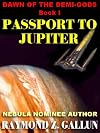
Lifted from the pulp science fiction magazine Startling Stories January 1951 this was Raymond Z Gallun's first published novel. He contributed many stories to the pulp magazines in the 1930's and later wrote six novels. Passport to Jupiter was a well written story that foresaw an age of technology that threatened the human race with extinction.
Anson Nord is a plump, genial, surburbanite on the trail of a rogue robot lawnmower, which he finds and starts to repair. A small crowd gathers round show more and tensions mount when one of the youths starts mouthing off about how people are reliant on new technology. The use of the sensipsych which allows people to tune into their own imagined world reliving adventures or contemporary events, nature programmes and yes illegal pornography has become an addiction. He warns that an underground movement will shock people out of their complacency. Anson himself loves following the adventures of Bob Harwell one of the stars of of the sensipsych who is exploring the planet Mercury. Later sitting at home a molotov cocktail is hurled through his sitting room window and a revolution of sorts has started. His wife who is a sensipsych addict is leaves Ansom to stay with her wealthy father in the country. Ansom heads downtown to Ajax house: headquarters of sensipsych where he hopes to warn his hero Bob Harwell and some of the executives of the company. Ansom gets caught up in the revolution and steals a spaceship in an attempt to track down Harwell who is on a mission to Jupiter.
This is a well paced story that has some interesting ideas. Bob Harwell's mission to Jupiter is to uncover the mystery of a rumoured advanced civilisation on the cloud enshrouded planet and his descent through the noxious gases is the climax of the story. The final chapter tying up the loose ends, feels a little unnecessary, but other than that this is a decent 1950's science fiction novel 3.5 stars. show less
Anson Nord is a plump, genial, surburbanite on the trail of a rogue robot lawnmower, which he finds and starts to repair. A small crowd gathers round show more and tensions mount when one of the youths starts mouthing off about how people are reliant on new technology. The use of the sensipsych which allows people to tune into their own imagined world reliving adventures or contemporary events, nature programmes and yes illegal pornography has become an addiction. He warns that an underground movement will shock people out of their complacency. Anson himself loves following the adventures of Bob Harwell one of the stars of of the sensipsych who is exploring the planet Mercury. Later sitting at home a molotov cocktail is hurled through his sitting room window and a revolution of sorts has started. His wife who is a sensipsych addict is leaves Ansom to stay with her wealthy father in the country. Ansom heads downtown to Ajax house: headquarters of sensipsych where he hopes to warn his hero Bob Harwell and some of the executives of the company. Ansom gets caught up in the revolution and steals a spaceship in an attempt to track down Harwell who is on a mission to Jupiter.
This is a well paced story that has some interesting ideas. Bob Harwell's mission to Jupiter is to uncover the mystery of a rumoured advanced civilisation on the cloud enshrouded planet and his descent through the noxious gases is the climax of the story. The final chapter tying up the loose ends, feels a little unnecessary, but other than that this is a decent 1950's science fiction novel 3.5 stars. show less
In the near future, mankind receives mysterious signals from space. When the messages are decoded, they prove an alien species exists, and they are willing to give away a massive amount of technology.
Logically, Earth is suspicious of such ostensibly altruistic motives despite the fact that the alien intelligences claim the knowledge is to maintain peace across the galaxy. The technology itself is of the high concept nature, incredibly outlandish. The technology allows man to be immortal but show more transfers their mind to a virtual reality node, a sensory experience simulator, while their bodies are tended below ground in vast caverns.
In the nodes, the mind can conjure many virtual scenarios and interact with billions of humans in the network, and even alien species which have integrated the technology into their own societies.
Slowly, humanity relents: no wars, no overpopulation, and happiness due to the technology’s capacity to fulfill every possible wish! Most of the population voluntarily allows their minds to be transferred to the virtual reality nodes.
Joey Martin and Jennioe Murray, his love interest, slowly come to realize the world they live in, small town Purdyville, is actually a simulation. Of course, they had voluntarily undergone mind wipes, allowing the nature of their existence to be slowly revealed to them. They move from world to world, sometimes together, sometimes apart. show less
Logically, Earth is suspicious of such ostensibly altruistic motives despite the fact that the alien intelligences claim the knowledge is to maintain peace across the galaxy. The technology itself is of the high concept nature, incredibly outlandish. The technology allows man to be immortal but show more transfers their mind to a virtual reality node, a sensory experience simulator, while their bodies are tended below ground in vast caverns.
In the nodes, the mind can conjure many virtual scenarios and interact with billions of humans in the network, and even alien species which have integrated the technology into their own societies.
Slowly, humanity relents: no wars, no overpopulation, and happiness due to the technology’s capacity to fulfill every possible wish! Most of the population voluntarily allows their minds to be transferred to the virtual reality nodes.
Joey Martin and Jennioe Murray, his love interest, slowly come to realize the world they live in, small town Purdyville, is actually a simulation. Of course, they had voluntarily undergone mind wipes, allowing the nature of their existence to be slowly revealed to them. They move from world to world, sometimes together, sometimes apart. show less
You May Also Like


Associated Authors
Statistics
- Works
- 52
- Also by
- 27
- Members
- 492
- Popularity
- #50,225
- Rating
- 3.8
- Reviews
- 11
- ISBNs
- 51
- Languages
- 1