
Quentin Fiore (1920–2019)
Author of The Medium is the Massage: An Inventory of Effects
About the Author
Image credit: Quentin Fiore
Works by Quentin Fiore
Paper 1 copy
The Prince 1 copy
Associated Works
The Great Tragedies of Aeschylus, Sophocles and Euripides (1982) — Illustrator, some editions — 65 copies, 2 reviews
Montesquieu and Rousseau Forerunners of Sociology (1960) — Cover designer, some editions — 45 copies, 1 review
Politics in Western Europe: An Introduction to the Politics of the United Kingdom, France, Germany, Italy, Sweden, and t (1993) — Designer, some editions — 17 copies
Tagged
Common Knowledge
- Birthdate
- 1920-02-12
- Date of death
- 2019-04-19
- Gender
- male
- Education
- Art Students League of New York
Illinois Institute of Technology - Occupations
- graphic designer
- Relationships
- McLuhan, Marshall (collaborator)
- Nationality
- USA
- Birthplace
- The Bronx, New York, USA
- Places of residence
- New York, New York, USA
- Place of death
- North Canaan, Connecticut, USA
- Associated Place (for map)
- New York, USA
Members
Reviews
I finally got around to reading McLuhan's The Medium is the Massage. It was enjoyable, and seems fairly forward-thinking for 1967. I can see why it is so heavily cited in new media composition studies, and I enjoyed its collage multimodal style. There were various points where I thought McLuhan was just plain wrong, but there were various moments of insight that I liked, particularly in regards to audience participants, electric cities, and challenges to the public/private dichotomy.
I finally got around to reading the classic last night, and what was I waiting for? It is witty, insightful, and very entertaining. Much credit must be given to graphic designer Quentin Fiore. His designs of the 1960s are mixed text and images, different sizes of type and other unconventional devices like mirror writing to create dynamic pages that reflect the tumultuous spirit of the time. In the words of critic Steven Heller, Fiore was "as anarchic as possible while still working within show more the constraints of bookmaking". McLuhan seems to be on a zealous mission to provoke the idea that conventional text ossifies the mind and these disruptive pages, many of which have little to no text, are as koans to break patterns of thought and challenge the reader. I especially like the quotes from John Cage and William Massey:
“Whence did the wond'rous mystic art arise, / Of painting SPEECH, and speaking to the eyes? / That we by tracing magic lines are taught, / How to embody, and to colour THOUGHT?”
Not just 18th Century poets, but even the seminal Socrates is on McLuhan's side seeing deadly rigidity in a line of text:
"The discovery of the alphabet will create forgetfulness in the learner’s souls, because they will not use their memories; they will trust to the external written characters and not remember of themselves. You give your disciples not truth but only the semblance of truth; they will be heroes of many things, and will have learned nothing; they will appear to be omniscient and will generally know nothing."
— Socrates, Phaedrus, cited by Marshall McLuhan here
McLuhan then sounded like someone railing against 24-hr cable news, unedited blogs, and face-down tweeting:
"The family circle has widened. The worldpool of information fathered by the electric media—movies, Telstar, flight—far surpasses any possible influence mom and dad can now bring to bear. Character no longer is shaped by only two earnest, fumbling experts. Now all the world's a sage."
And what he resisted in the 60s make me think his head would explode now, or maybe now we will listen?
"Electric circuitry has overthrown the regime of ‘time’ and ‘space’ and pours upon us instantly and continuously the concerns of all other men. It has reconstituted dialogue on a global scale. Its message is Total Change, ending psychic, social, economic, and political parochialism. The old civic, state, and national groupings have become unworkable. Nothing can be further from the spirit of the new technology than ‘a place for everything and everything in its place.’ You can’t go home again."
It seems, and appropriately enough, McLuhan's thesis was best summarized in a New Yorker cartoon presented here without comment near the very end with this quip:
"You see, Dad, Professor McLuhan says that the environment that man creates becomes his medium for defining his role in it. The invention of type created linear, or sequential thought, separating thought from action. Now, with TV and folk singing, thought and action are closer and social involvement is greater. We again live in a village. Get it?"
The New Yorker Magazine 1966 show less
“Whence did the wond'rous mystic art arise, / Of painting SPEECH, and speaking to the eyes? / That we by tracing magic lines are taught, / How to embody, and to colour THOUGHT?”
Not just 18th Century poets, but even the seminal Socrates is on McLuhan's side seeing deadly rigidity in a line of text:
"The discovery of the alphabet will create forgetfulness in the learner’s souls, because they will not use their memories; they will trust to the external written characters and not remember of themselves. You give your disciples not truth but only the semblance of truth; they will be heroes of many things, and will have learned nothing; they will appear to be omniscient and will generally know nothing."
— Socrates, Phaedrus, cited by Marshall McLuhan here
McLuhan then sounded like someone railing against 24-hr cable news, unedited blogs, and face-down tweeting:
"The family circle has widened. The worldpool of information fathered by the electric media—movies, Telstar, flight—far surpasses any possible influence mom and dad can now bring to bear. Character no longer is shaped by only two earnest, fumbling experts. Now all the world's a sage."
And what he resisted in the 60s make me think his head would explode now, or maybe now we will listen?
"Electric circuitry has overthrown the regime of ‘time’ and ‘space’ and pours upon us instantly and continuously the concerns of all other men. It has reconstituted dialogue on a global scale. Its message is Total Change, ending psychic, social, economic, and political parochialism. The old civic, state, and national groupings have become unworkable. Nothing can be further from the spirit of the new technology than ‘a place for everything and everything in its place.’ You can’t go home again."
It seems, and appropriately enough, McLuhan's thesis was best summarized in a New Yorker cartoon presented here without comment near the very end with this quip:
"You see, Dad, Professor McLuhan says that the environment that man creates becomes his medium for defining his role in it. The invention of type created linear, or sequential thought, separating thought from action. Now, with TV and folk singing, thought and action are closer and social involvement is greater. We again live in a village. Get it?"
The New Yorker Magazine 1966 show less
It is difficult to remember that this book was first published in 1967, as the message of the "massage" is as relevant today as it was then. The use of images to make its point should not detract from the prose, even though it is minimal. McLuhan's "allatonceness" and "global village" take on new resonance in the Internet age. Where it diverges is in thinking we privilege acoustic space--I don't believe that is true. I think we are still largely beholden to the visual, and when in 1967 show more McLuhan writes: "At the high speeds of electric communication, purely visual means of apprehending the world are no longer possible; they are just too slow to be relevant or effective..." we know that he could not have foreseen social media. But as many have noted, much of what McLuhan says holds up in our age.
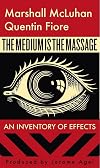
This edition is wonderful and beautifully produced, from the Shepard Fairey cover (probably the most apt choice), to the self-referential New Yorker cartoon on the last page. It is both a (brief) history of media, and a harbinger of the future. Quentin Fiore's contributions are stunning, particularly in retrospect, and seem far less counter-culture now than they did in the 1960s. The use of visual images, creative typesetting, and lack of regular pagination help drive home McLuhan's point in this "inventory of effects." We get pulled into the "electrically-configured whirl" no less now than we did then, even if the medium has changed. One wonders if we aren't still "march[ing] backwards into the future." Media continue to be "extensions of some human faculty"--and in that, we see both the frailty and fecundity of our ideas. show less
This edition is wonderful and beautifully produced, from the Shepard Fairey cover (probably the most apt choice), to the self-referential New Yorker cartoon on the last page. It is both a (brief) history of media, and a harbinger of the future. Quentin Fiore's contributions are stunning, particularly in retrospect, and seem far less counter-culture now than they did in the 1960s. The use of visual images, creative typesetting, and lack of regular pagination help drive home McLuhan's point in this "inventory of effects." We get pulled into the "electrically-configured whirl" no less now than we did then, even if the medium has changed. One wonders if we aren't still "march[ing] backwards into the future." Media continue to be "extensions of some human faculty"--and in that, we see both the frailty and fecundity of our ideas. show less
In one of the most interestingly presented books I have seen, socio-cultural theorist, Marshall McLuhan, and graphics designer and artist, Quentin Fiore, present The Medium is the Massage, a book that, while written in the 1960s, has more direct application to our contemporary times than it did during its inception. Taking its cue from the saying, "the medium is the message" and altering it to fit their own message, McLuhan and Fiore present the argument of how the electronic media is slowly show more lulling us into not realizing the dramatic changes and new perspectives this technology is creating. Their 'writing style', if it can be called such, is a provocative, visually-impacting array of photographs, unique texts, quotes, humorous cartoons, and other images to give the reader a better understanding of the ideas being presented. While there is a slight danger of their message being lost in its unorthodox presentation, (two pages, for example, are printed with the text upside-down), their argument is solid and restated in unique ways throughout. The book is revolutionary in the way it shows how electric technology is continually changing our government, our families, our jobs, and our social relationships. While the evidence and the way it is presented does reveal its origination in the earlier part of this technological movement, the words nonetheless show its relevance to our time period. show less
Lists
Awards


You May Also Like


Associated Authors
Statistics
- Works
- 6
- Also by
- 7
- Members
- 2,704
- Popularity
- #9,502
- Rating
- 3.7
- Reviews
- 41
- ISBNs
- 25
- Languages
- 7