
Karin Sagner
Author of Monet
About the Author
Image credit: Karin Sagner
Works by Karin Sagner
Tagged
Common Knowledge
- Canonical name
- Sagner, Karin
- Legal name
- Sagner-Düchting, Karin
- Birthdate
- 1955
- Gender
- female
- Occupations
- art historian
- Nationality
- Germany
- Birthplace
- Steinheidel-Erlabrunn, Germany
- Places of residence
- Munich, Bavaria, Germany
- Associated Place (for map)
- Germany
Members
Reviews

This book is a great follow-up to Women Who Read Are Dangerous. Women Walking specifically calls out that only images from the 18th-19th century in the Western world were considered for the book, and I appreciate having my expectations set. One of the issues I had with the Reading book was that there were a lot of Japanese prints that feature women reading that weren't included, and I would've been interested in the analysis applying to Mid, South, and East Asia, and I was disappointed that show more they were overlooked.
The images in this book were beautiful, and they sparked an interesting discussion about what kind of women walked at what time of day and whether they were alone. So much changed in just a couple centuries; yet, the conversation is still relevant today. I found it particularly interesting how the ideal time for a woman to walk out alone got later and later as time went on. I also loved hearing about the women who climbed mountains. Such heroines!
A couple of times, I thought Sagner was making a stretch in her argument, and a few other times I wished she would get to the point. I think this book can be enjoyed by a variety of people as it touches on women's rights, walking in general, and urbanization.
All in all, I thoroughly enjoyed this book, and I hope there's another installment in this subversive women in art series. show less
The images in this book were beautiful, and they sparked an interesting discussion about what kind of women walked at what time of day and whether they were alone. So much changed in just a couple centuries; yet, the conversation is still relevant today. I found it particularly interesting how the ideal time for a woman to walk out alone got later and later as time went on. I also loved hearing about the women who climbed mountains. Such heroines!
A couple of times, I thought Sagner was making a stretch in her argument, and a few other times I wished she would get to the point. I think this book can be enjoyed by a variety of people as it touches on women's rights, walking in general, and urbanization.
All in all, I thoroughly enjoyed this book, and I hope there's another installment in this subversive women in art series. show less
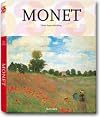
Monet by Karin Sagner provides a chronological account of Monet’s life and work, with perhaps the emphasis on the former. While his paintings are discussed in relation to his life and travels, and occasionally influences, there is only a little in the way of in depth discussion of the work itself. The book concludes with a Biographical Summary illustrated with black and white photographs; there is no bibliography.
This is a well produced and attractively presented book; the pictures run show more with the text, and appear on the same page or as close as is practical to their mention in the text. The text is printed in quite a large size, and the images vary from around postcard size to full page plates and are almost entirely in full colour. There are about 225 illustrations, all but a very few of the paintings in full colour, most of the black and white images being period photographs. The quality of the plates is excellent often revealing the bush work and texture of the painted surface. show less
This is a well produced and attractively presented book; the pictures run show more with the text, and appear on the same page or as close as is practical to their mention in the text. The text is printed in quite a large size, and the images vary from around postcard size to full page plates and are almost entirely in full colour. There are about 225 illustrations, all but a very few of the paintings in full colour, most of the black and white images being period photographs. The quality of the plates is excellent often revealing the bush work and texture of the painted surface. show less

"He was not so much a painter as a hunter" (128).

Oct 26, 2020Catalan
You May Also Like


Associated Authors
Statistics
- Works
- 21
- Members
- 586
- Popularity
- #42,791
- Rating
- 4.3
- Reviews
- 5
- ISBNs
- 64
- Languages
- 10