
Alfred Lansing (1921–1975)
Author of Endurance: Shackleton's Incredible Voyage
About the Author
Editor and author Alfred Lansing is best known for Endurance: Shackleton's Incredible Voyage, a historical account of Sir Ernest Shackleton's 1914 voyage to Antarctica, written for a young adult audience. Using diaries of expedition members and interviews with those still living, Lansing tells the show more story of the expedition, which met with disaster when their ship, the Endurance, was surrounded and eventually crushed by ice, leaving Shackleton and his crew trapped on the ice floes for five months before they were able to escape to open water in one of the lifeboats. In 1960, Lansing received both the Christopher Award and the Secondary Education Board's Book Award for Endurance: Shackleton's Incredible Voyage. Alfred Lansing was born in Chicago in 1921. He served in the U.S. Navy throughout World War II, receiving the Purple Heart. Upon leaving the Navy in 1946, he returned to school, attending North Park College for two years and then transferring to Northwestern University. He worked as a writer for United Press and for Collier's magazine, as a freelance writer, and later as an editor for Time, Inc. Books. Lansing died in 1975. He and his wife, Barbara, whom he married in 1955, had two children. (Bowker Author Biography) show less
Works by Alfred Lansing
Associated Works
Epic: Stories of Survival from the World's Highest Peaks (1997) — Contributor — 196 copies, 3 reviews
Tagged
Common Knowledge
- Legal name
- Lansing, Alfred Mark
- Birthdate
- 1921-07-21
- Date of death
- 1975-01-01
- Gender
- male
- Education
- Northwestern University
North Park College - Occupations
- journalist
- Organizations
- United Press
US Navy (WWII)
Reader's Digest
Time Magazine - Nationality
- USA
- Birthplace
- Michigan, USA
- Places of residence
- Chicago, Illinois, USA
Sea Cliff, Long Island, New York, USA
Bethel, Connecticut, USA - Place of death
- Bethel, Connecticut, USA
- Associated Place (for map)
- USA
Members
Reviews
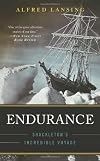
By August 1914, both the North and South Poles had been reached and neither one for proud Britain. For an empire that encircled the globe, it was a dissatisfying notion. Enter Sir Ernest Shackleton with a plan to undertake "the most striking of all journeys"; to cross the Antarctic Continent. They would start at the Weddell Sea, and then halfway, follow food caches left by a second ship waiting in the Ross Sea. The Endurance itself was a barkentine, made of wood stronger than iron. However, show more a"freak" northerly gale besets the Endurance after only 6 weeks. Far from their starting point, the crew must endure 70 mph winds, indescribable cold, attacks from sea leopards, starvation, and inconstant paths of the ice floes on the 346 mile trek to the first cache.
These kinds of expeditions always feel like you're watching a slow-moving train wreck. But I'm impressed with how well "Endurance" has held up. Usually nonfiction from the 1950s is either improbably heroic or overtly nationalistic. The descriptions of the sounds and pressure on the ship was terrifying! I do wish Lansing hadn't rushed straight into the expedition though. They dedicate only a few sentences to Shackleton's early life and only scant details of his previous expeditions. Being that some of the Endurance's crew had served with Shackleton before, it's missing that important context. Although Lansing rightfully criticizes Shackleton for his "whimsical" way of choosing the newest crew members, his almost pathological worry to maintain control and his unrealistic optimism. However, this is a great read for someone who typically doesn't read nonfiction. It's 280 pages, quick and easy, and Lansing never strays from their subject. Lansing knows just when to quote the men directly and when to clarify, so it doesn't feel like one long recitation of the journals. Very well done! show less
These kinds of expeditions always feel like you're watching a slow-moving train wreck. But I'm impressed with how well "Endurance" has held up. Usually nonfiction from the 1950s is either improbably heroic or overtly nationalistic. The descriptions of the sounds and pressure on the ship was terrifying! I do wish Lansing hadn't rushed straight into the expedition though. They dedicate only a few sentences to Shackleton's early life and only scant details of his previous expeditions. Being that some of the Endurance's crew had served with Shackleton before, it's missing that important context. Although Lansing rightfully criticizes Shackleton for his "whimsical" way of choosing the newest crew members, his almost pathological worry to maintain control and his unrealistic optimism. However, this is a great read for someone who typically doesn't read nonfiction. It's 280 pages, quick and easy, and Lansing never strays from their subject. Lansing knows just when to quote the men directly and when to clarify, so it doesn't feel like one long recitation of the journals. Very well done! show less
In 1914, an expedition led by Sir Ernest Shackleton set out on the ship Endurance with the aim of crossing Antarctica. But before ever reaching the continent, the ship became immobilized by ice, and months later it was finally crushed by the pressure and sank. Its crew then set out across ice, across some of the worst seas on Earth in open boats in horrifying weather, and overland across an island whose interior no one had ever successfully navigated before. All told, it was nearly two years show more before they made it back.
It is an absolutely incredible story. Almost literally incredible: if it were a work of fiction, you'd never believe it. It doesn't seem like something human beings ought to be capable of. And what do you mean, every single one of them survived? Seriously?
And yet, it's all true, and extremely well-documented, to boot, as a number of these mean kept careful diaries of their experiences.
This book covers it all in considerable detail. Lansing's prose, for the most part, isn't fancy, but it does precisely what it needs to do. He describes the moment-by-moment, wave-by-wave progress of those open boat voyages in a way that brought my heart repeatedly into my throat, making the frustration and weariness and uncertain hope of it all thrillingly palpable. And when, instead, the narrative is one of endless days of waiting and monitoring the winds and trying hard just to get some rest in miserably sodden sleeping bags, he captures all of that faithfully, too.
It's a hell of a story, told in a way that brings it vividly to life without any (utterly unnecessary) sensationalizing, and I'm very, very glad to have read it. It really is the sort of thing that helps you recalibrate your sense of what humans are capable of.
One can only admire these men's, well, endurance. But, I must say, while I imagine some might find it inspirational, it mostly sort of leaves me wondering why anyone with an ounce of sanity would ever leave home at all to go wandering through places that seem like they so desperately want to kill you. It also makes me stop for a moment to really, truly appreciate being warm and dry and fed, which is a very worthwhile thing to do once in a while. show less
It is an absolutely incredible story. Almost literally incredible: if it were a work of fiction, you'd never believe it. It doesn't seem like something human beings ought to be capable of. And what do you mean, every single one of them survived? Seriously?
And yet, it's all true, and extremely well-documented, to boot, as a number of these mean kept careful diaries of their experiences.
This book covers it all in considerable detail. Lansing's prose, for the most part, isn't fancy, but it does precisely what it needs to do. He describes the moment-by-moment, wave-by-wave progress of those open boat voyages in a way that brought my heart repeatedly into my throat, making the frustration and weariness and uncertain hope of it all thrillingly palpable. And when, instead, the narrative is one of endless days of waiting and monitoring the winds and trying hard just to get some rest in miserably sodden sleeping bags, he captures all of that faithfully, too.
It's a hell of a story, told in a way that brings it vividly to life without any (utterly unnecessary) sensationalizing, and I'm very, very glad to have read it. It really is the sort of thing that helps you recalibrate your sense of what humans are capable of.
One can only admire these men's, well, endurance. But, I must say, while I imagine some might find it inspirational, it mostly sort of leaves me wondering why anyone with an ounce of sanity would ever leave home at all to go wandering through places that seem like they so desperately want to kill you. It also makes me stop for a moment to really, truly appreciate being warm and dry and fed, which is a very worthwhile thing to do once in a while. show less

I knew, kinda vaguely, of Shackleton's expedition, but to read about it in the novelistic glory of narrative history is something else. Lansing's prose is tight and great, his storytelling entrancing, and his explanation is just right. My only gripes are few. (1) I wish that a lengthier epilogue would have given thumbnail sketches of the lives of the expedition member after 1916. (2) I wish there were far more images. (3) I wish there were far more detailed maps. But, the maps on the show more endpapers were sufficient and the scanty photographs and drawings were nice to have. I have the internet, I guess. I am reading a first edition, though. I wonder if modern editions of the book have more images, etc. But, the things that these men did, with the technology they had, was nothing short of miraculous. It was a testament to the grit of these men to suffer the way they did and still make it. That and a little early 1900s technology, which helped quite the much. show less
what — and i say this sincerely — the Fuck.
so Shackelton went to the Antarctic for the third time, because he had not yet managed to walk across the land and that made him mad. “FUCK THE ANTARCTIC,” i presume he said. “I DO WHAT I WANT.”
... and that was his motivation for literally everything afterwards, including traversing hurricanes in an open boat, stomping all over the worst damn island in the world (preciously thought impassable but Shackelton was NOT HAVING THAT), show more literally sliding down the side of a glacier, and getting all 28 men of his crew rescued after well over a year of living on ice floes and eating nothing but seal.
seriously, there about ten thousand times that these people should have died in a very predictable way (hunger, cold, navigation issues, weather, hunted by a sea leopard, an ice floe breaking beneath your feet in the dark so you plunge into the frozen sea, murdered by your shipmates). every day they should have died many many times. and none of them did! pretty much because Shackleton refused to let it happen and everyone, including THE ANTARCTIC ITSELF, just shrugged and let him have his way.
honestly, the most impressive thing is how bloody skilled the men were. every time something horrible happens they just kinda get on with things, and do it brilliantly. at one point they navigated 800+ miles to find a tiny island using medieval instruments during a sort of hurricane in a tiny open boat in the middle of the ocean — wearing mittens, because it’s 15° below freezing, and with maybe five minutes of sunlight a day to use for direction.
and they did it.
gosh, i feel lazy now. show less
so Shackelton went to the Antarctic for the third time, because he had not yet managed to walk across the land and that made him mad. “FUCK THE ANTARCTIC,” i presume he said. “I DO WHAT I WANT.”
... and that was his motivation for literally everything afterwards, including traversing hurricanes in an open boat, stomping all over the worst damn island in the world (preciously thought impassable but Shackelton was NOT HAVING THAT), show more literally sliding down the side of a glacier, and getting all 28 men of his crew rescued after well over a year of living on ice floes and eating nothing but seal.
seriously, there about ten thousand times that these people should have died in a very predictable way (hunger, cold, navigation issues, weather, hunted by a sea leopard, an ice floe breaking beneath your feet in the dark so you plunge into the frozen sea, murdered by your shipmates). every day they should have died many many times. and none of them did! pretty much because Shackleton refused to let it happen and everyone, including THE ANTARCTIC ITSELF, just shrugged and let him have his way.
honestly, the most impressive thing is how bloody skilled the men were. every time something horrible happens they just kinda get on with things, and do it brilliantly. at one point they navigated 800+ miles to find a tiny island using medieval instruments during a sort of hurricane in a tiny open boat in the middle of the ocean — wearing mittens, because it’s 15° below freezing, and with maybe five minutes of sunlight a day to use for direction.
and they did it.
gosh, i feel lazy now. show less
Lists
Awards


You May Also Like


Associated Authors
Statistics
- Works
- 4
- Also by
- 1
- Members
- 6,388
- Popularity
- #3,853
- Rating
- 4.4
- Reviews
- 155
- ISBNs
- 75
- Languages
- 13
- Favorited
- 1