

Roy Peter Clark
Author of Writing Tools: 50 Essential Strategies for Every Writer
About the Author
Roy Peter Clark was born in 1948 in New York City and raised on Long Island. He graduated from Providence College in Rhode Island with a degree in English and earned a PhD from the State University of New York at Stony Brook. He was hired by St. Petersburg Times in 1977 to become a writing coach. show more He worked with the American Society of Newspaper Editors to improve newspaper writing nationwide. He was soon elected a distinguished service member which was a rare honor for a journalist who has never edited a newspaper. He has nurtured Pulitzer Prize winning writers such as Thomas French and Diana Sugg. He has worked full-time at The Poynter Institute starting in 1979 as director of the writing center, dean of the faculty, senior scholar and vice president. He has authored or edited several books on journalism and writing such as: Free to Write: A Journalist Teaches Young Writers; Coaching Writers: Editors and Reporters Working Together Across Media Platforms and Glamour of Grammar. (Bowker Author Biography) show less
Image credit: By Larry D. Moore, CC BY-SA 3.0, https://commons.wikimedia.org/w/index.php?curid=17323896
Works by Roy Peter Clark
The Glamour of Grammar: A Guide to the Magic and Mystery of Practical English (2010) 544 copies, 23 reviews
The Art of X-Ray Reading: How the Secrets of 25 Great Works of Literature Will Improve Your Writing (2016) 232 copies, 12 reviews
Murder Your Darlings: And Other Gentle Writing Advice from Aristotle to Zinsser (2020) 142 copies, 3 reviews
The Changing South of Gene Patterson: Journalism and Civil Rights, 1960-1968 (Southern Dissent) (2002) 12 copies
Best Newspaper Writing 1982: Winners of the American Society of Newspaper Editors Competition (1982) 3 copies
Writing Tools for the College Admissions Essay: Write Your Way into the School of Your Dreams (2025) 1 copy
Associated Works
Tagged
Common Knowledge
- Birthdate
- 1948
- Gender
- male
- Education
- Providence College
State University of New York, Stony Brook (PhD) - Occupations
- academic (The Poynter Institute)
editor (St. Petersburg Times) - Organizations
- Director, National Writers' Workshop
American Society of Newspaper Editors
St. Petersburg Times - Awards and honors
- American Society of Newspaper Editors, Distinguished Service Member
- Short biography
- Clark was born in 1948 on the Lower East Side of New York City and raised on Long Island, where he attended Catholic schools. He graduated from Providence College in Rhode Island with a degree in English and earned a Ph.D. from the State University of New York at Stony Brook. In 1977 Clark was hired by the St. Petersburg Times to become one of America's first writing coaches. He worked with the American Society of Newspaper Editors to improve newspaper writing nationwide. Because of his work with ASNE, Clark was elected as a distinguished service member, a rare honor for a journalist who has never edited a newspaper. Clark is the author or editor of 14 books on journalism and writing.
- Nationality
- USA
- Birthplace
- Manhattan, New York, USA
- Places of residence
- Long Island, New York, USA
St. Petersburg, Florida, USA - Associated Place (for map)
- New York, USA
Members
Discussions
The Glamour of Grammar by Roy Peter Clark (July 2010 ER) in Reviews of Early Reviewers Books (September 2012)
Reviews
The Art of X-Ray Reading: How the Secrets of 25 Great Works of Literature Will Improve Your Writing by Roy Peter Clark
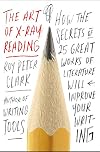
This is, hands down, one of the best books on digging in-depth into how and why good writing works I may have ever read. And for me, that's saying a lot, because I've read a shit-ton of them.
That being said, I will say I was very close to putting it down after having gone through only a handful of pages. First of all, I will say right up front, while it's an appropriate term, I really hate (for some weird unknowable reason) the term "X-ray reading". Just sounds dumb to me.
But the bigger show more reason I almost set it down was because I thought I was in for a long, boring, protracted autopsy of books like I suffered through in high school English classes (Classes, I might add, where I frequently clashed with the teachers' interpretations of the novels we studied, and classes that completely turned me against Shakespeare's works for the next three decades).
But, I thought, give it a couple of chapters. If I still felt the same way then, then I'd put down the book, and walk away guilt-free.
I'm so glad I made that bargain. By the end of the second chapter, Clark had me hooked, and I was learning a lot, and beginning to understand both what I'd missed in my own readings of some of the works he discussed, but also filling with a better understanding of how to improve my own work.
You can't ask for more than that from a "how to write" book.
Absolutely highly recommended. show less
That being said, I will say I was very close to putting it down after having gone through only a handful of pages. First of all, I will say right up front, while it's an appropriate term, I really hate (for some weird unknowable reason) the term "X-ray reading". Just sounds dumb to me.
But the bigger show more reason I almost set it down was because I thought I was in for a long, boring, protracted autopsy of books like I suffered through in high school English classes (Classes, I might add, where I frequently clashed with the teachers' interpretations of the novels we studied, and classes that completely turned me against Shakespeare's works for the next three decades).
But, I thought, give it a couple of chapters. If I still felt the same way then, then I'd put down the book, and walk away guilt-free.
I'm so glad I made that bargain. By the end of the second chapter, Clark had me hooked, and I was learning a lot, and beginning to understand both what I'd missed in my own readings of some of the works he discussed, but also filling with a better understanding of how to improve my own work.
You can't ask for more than that from a "how to write" book.
Absolutely highly recommended. show less
The Art of X-Ray Reading: How the Secrets of 25 Great Works of Literature Will Improve Your Writing by Roy Peter Clark
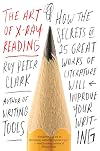
I must admit that Roy Peter Clark got me hooked very early in the piece.....in fact, with his first example of x-ray analysis of the Great Gatsby. I had seen the movie but never read the book. He got me so hooked that I went out and bought Gatsby and read it very fast. And, found it more or less as Clark describes....a great book. I like the way that he has developed the book with bite sized chunks. None of them long enough to be boring; with each chunk introducing a new technique and new show more material. I especially liked his analysis of Hemingway. Because, like him, I never really got Hemingway. Found him a bit predictable...maybe even a bit boring. But Clark pulls out just one example of the text and brings the laser-like focus (x-Ray?) to just one word: "the" that appears to have been left out....but what a positive difference that omission of one word makes.
I really bought the book for my son who is about to go into year 11 with advanced English ... because i thought that he could really use some help with analysing text. Can I actually get him to read Clark's book? Not sure. But I AM sure that he would benefit greatly from reading it. In many ways, it seems the book is really written for writers to give them clues about how they might improve their writing. But, in the process, one learns an enormous amount about clever techniques for "grabbing" the reader. He does not confine himself to novels but branches out into Shakespearean sonnets, WB Yeat's poetry,...even a recipe book. I especially like the way that each self-contained chapter has a summary of the key points at the end. I guess one could just read these and think that you had extracted the "meat" from the chapter.....but I don't think so. Clark writes well himself. (I guess one has to when this is your livelihood)....but it's actually quite a pleasure to read his analysis and descriptions ..and personal asides.
Bottom line is that I think it's an excellent book and I give it 5 stars. show less
I really bought the book for my son who is about to go into year 11 with advanced English ... because i thought that he could really use some help with analysing text. Can I actually get him to read Clark's book? Not sure. But I AM sure that he would benefit greatly from reading it. In many ways, it seems the book is really written for writers to give them clues about how they might improve their writing. But, in the process, one learns an enormous amount about clever techniques for "grabbing" the reader. He does not confine himself to novels but branches out into Shakespearean sonnets, WB Yeat's poetry,...even a recipe book. I especially like the way that each self-contained chapter has a summary of the key points at the end. I guess one could just read these and think that you had extracted the "meat" from the chapter.....but I don't think so. Clark writes well himself. (I guess one has to when this is your livelihood)....but it's actually quite a pleasure to read his analysis and descriptions ..and personal asides.
Bottom line is that I think it's an excellent book and I give it 5 stars. show less
The Art of X-Ray Reading: How the Secrets of 25 Great Works of Literature Will Improve Your Writing by Roy Peter Clark
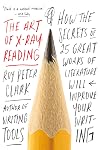
It's always fun to accompany Roy Peter Clark as he works his way through the world of literature, but this book might be slightly less helpful to writers compared to readers by dint of the texts that Clark selects. Sure, it's good to see how Nabokov got the ball rolling in his stories, or how Rachel Carson made your heart ache with her descriptions of the natural world, but the problem is that none of the likely readership of Clark's book will ever come close to achieving what Nabokov and show more Carson and all the other greats achieved in their work.
For me, the 'perfect' book for learning how to write has yet to be written. Focus should rather fall on the quotidian than on the singular. I want to know how to write the transition that takes my character out of their car and into the house, say, or how to write dinner-date dialogue better than that found in the Jack Reacher novels when the attention is away from Reacher's omnipotence. That book would be well worth reading, and would help enormously. As it is, I fear for the number of would-be writers, myself included, who might be tempted to emulate Nabokov or Harper Lee or Fitzgerald, but who will fail because there is such a fine line between homage and pastiche. show less
For me, the 'perfect' book for learning how to write has yet to be written. Focus should rather fall on the quotidian than on the singular. I want to know how to write the transition that takes my character out of their car and into the house, say, or how to write dinner-date dialogue better than that found in the Jack Reacher novels when the attention is away from Reacher's omnipotence. That book would be well worth reading, and would help enormously. As it is, I fear for the number of would-be writers, myself included, who might be tempted to emulate Nabokov or Harper Lee or Fitzgerald, but who will fail because there is such a fine line between homage and pastiche. show less
Writing in "Reading as a Writer," Francine Prose says she taught creative writing classes using rules until she realized the best writers broke those same rules on their way to creating masterpieces. Anton Chekhov's classic short story "The Lady with the Dog" is famous for breaking rules.
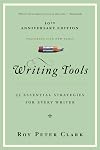
Another writing teacher, Roy Peter Clark of the Poynter Institute in St. Petersburg, puts the focus not on rules but rather on tools. His valuable guidebook for writers of all kinds, amateurs and show more professionals alike, is "Writing Tools: 50 Essential Strategies for Every Writer," published in 2006. The word essential in the subtitle is unfortunate, for it implies something mandatory, and thus a rule. A tool, on the other hand, is something that may be useful sometimes, but not always. A handyman doesn't necessarily use both a hammer and a screwdriver on every project.
In St. Petersburg I once heard Clark speak on the subject of writing, and he spoke at length on a six-word sentence written by William Shakespeare in "Macbeth" and discussed early in this book: "The Queen, my lord, is dead." He noted that Shakespeare might have ordered the same six words differently, "The Queen is dead, my lord" or "My lord, the Queen is dead." So what makes Shakespeare's order the best one? Because it places the subject of the sentence near the front, where it usually works best in a clear sentence, and saves the key word, dead, for the end, where it will have the most impact.
"Order words for emphasis" is the second tool in Clark's toolbox. Others include "Activate your verbs" (but notice Shakespeare chose a passive verb for his sentence), "Fear not the long sentence," "Vary the length of paragraphs," "Work from a plan" and "Learn from your critics."
Clark advises against reading his book in one sitting, although it may be short enough for some readers to accomplish this. A carpenter in training cannot master all the tools in the toolbox at the same time, and neither can a writer in training, and that includes anyone who opens this book. I took his advice and read one chapter a day, but that still may be too quickly to master many of these tools. Many take time both to digest and to implement, such as that one about learning from one's critics. Even the best writers may never master that one. show less
Another writing teacher, Roy Peter Clark of the Poynter Institute in St. Petersburg, puts the focus not on rules but rather on tools. His valuable guidebook for writers of all kinds, amateurs and show more professionals alike, is "Writing Tools: 50 Essential Strategies for Every Writer," published in 2006. The word essential in the subtitle is unfortunate, for it implies something mandatory, and thus a rule. A tool, on the other hand, is something that may be useful sometimes, but not always. A handyman doesn't necessarily use both a hammer and a screwdriver on every project.
In St. Petersburg I once heard Clark speak on the subject of writing, and he spoke at length on a six-word sentence written by William Shakespeare in "Macbeth" and discussed early in this book: "The Queen, my lord, is dead." He noted that Shakespeare might have ordered the same six words differently, "The Queen is dead, my lord" or "My lord, the Queen is dead." So what makes Shakespeare's order the best one? Because it places the subject of the sentence near the front, where it usually works best in a clear sentence, and saves the key word, dead, for the end, where it will have the most impact.
"Order words for emphasis" is the second tool in Clark's toolbox. Others include "Activate your verbs" (but notice Shakespeare chose a passive verb for his sentence), "Fear not the long sentence," "Vary the length of paragraphs," "Work from a plan" and "Learn from your critics."
Clark advises against reading his book in one sitting, although it may be short enough for some readers to accomplish this. A carpenter in training cannot master all the tools in the toolbox at the same time, and neither can a writer in training, and that includes anyone who opens this book. I took his advice and read one chapter a day, but that still may be too quickly to master many of these tools. Many take time both to digest and to implement, such as that one about learning from one's critics. Even the best writers may never master that one. show less
Lists
Writing (1)
Awards


You May Also Like


Associated Authors
Statistics
- Works
- 27
- Also by
- 1
- Members
- 3,201
- Popularity
- #7,990
- Rating
- 4.0
- Reviews
- 70
- ISBNs
- 73
- Languages
- 5
