

Kalli Dakos
Author of If You're Not Here, Please Raise Your Hand: Poems About School
About the Author
Kalli Dakos is known for her many books of poetry about school, including DON'T READ THIS BOOK, WHATEVER YOU DO: More Poems About School and IF YOU'RE NOT HERE, PLEASE RAISE YOUR HAND: Poems About School, both illustrated by G. Brian Karas. She is a reading specialist who regularly visits schools show more to teach poetry workshops. This is her first collection for beginning readers. Ms. Dakos lives in Ontario, Canada. Mike Reed owned an animation studio for several years before devoting his time to illustration. His pictures have appeared in SHAKE DEM HALLOWEEN BONES by W. Nikola-Lisa. He lives in Minneapolis, Minnesota with his family. show less
Works by Kalli Dakos
If You're Not Here, Please Raise Your Hand: Poems About School (1990) — Author — 657 copies, 19 reviews
The Bug in Teacher's Coffee: And Other School Poems (I Can Read Level 2) (1999) 323 copies, 5 reviews
Poems for Teachers 3 copies
I'm in Another Dimension 1 copy
You're an Author Now 1 copy
What's There to Write About 1 copy
Dakos, Kalli 1 copy
Tagged
Common Knowledge
- Canonical name
- Dakos, Kalli
- Birthdate
- 1950-06-16
- Gender
- female
- Education
- Queen's University (BAH and BEd)
University of Nevada at Reno (MA)
University of Alberta at Edmonton
Syracuse University - Occupations
- teacher
writer - Nationality
- Canada
USA - Places of residence
- Ottawa, Ontario, Canada
Kingston, Ontario, Canada
Reno, Nevada, USA
Edmonton, Alberta, Canada
Syracuse, New York, USA - Associated Place (for map)
- Canada
Members
Reviews
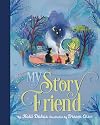
What happens when you have something sad or desolate to share, and you can’t find someone willing to listen?
This beautiful little picture book explores this very theme, handling the story with such charm and grace that the overall messaging, far from being sad, instead becomes a lovely and hopeful lesson.
The book begins with some definitions. The people who tell stories, we learn, are storytellers. The people who listen to stories, on the other hand, are story friends. (I have to admit, my show more heart was captured immediately when I read this).
Our hero is a child who is deeply unhappy, longing to tell his tale to someone who can help him see a way out. But no-one wants to hear his sad story, and he is sent on his way - again and again - until at last, he finds a story friend.
Our story friend, with her gentle compassion, is willing to listen to any story, any time. As he comes to depend on her support, our hero (and the reader) see that telling our stories releases an act of healing, not only in the telling itself and the support we get back, but “like butter melting in the sun” our stories themselves become softer with sharing - expanding and pooling to allow us to see broader and more inclusive nuances which in themselves comfort and heal.
This book is published by the American Psychological Association, and although I’m not sure I’ve heard it phrased quite this way before , I can see how powerful the idea of being (and having) a story friend could be in working emotional intelligence concepts into the conversation with very young children.
On a final note, the illustrations in this book are absolutely gorgeous - page after page of watercolor swirls in bright colors, evoking a fairy-tale-like feel to woodlands stacked with lollipop trees, populated by bustling rosy-cheeked families.
This elegant book would be a wonderful addition to any child’s picture-book library.
A great big thank you to NetGalley, the publisher, the author (and the illustrator), for an advance review copy of this book, in exchange for an honest review. All thoughts presented are my own. show less
This beautiful little picture book explores this very theme, handling the story with such charm and grace that the overall messaging, far from being sad, instead becomes a lovely and hopeful lesson.
The book begins with some definitions. The people who tell stories, we learn, are storytellers. The people who listen to stories, on the other hand, are story friends. (I have to admit, my show more heart was captured immediately when I read this).
Our hero is a child who is deeply unhappy, longing to tell his tale to someone who can help him see a way out. But no-one wants to hear his sad story, and he is sent on his way - again and again - until at last, he finds a story friend.
Our story friend, with her gentle compassion, is willing to listen to any story, any time. As he comes to depend on her support, our hero (and the reader) see that telling our stories releases an act of healing, not only in the telling itself and the support we get back, but “like butter melting in the sun” our stories themselves become softer with sharing - expanding and pooling to allow us to see broader and more inclusive nuances which in themselves comfort and heal.
This book is published by the American Psychological Association, and although I’m not sure I’ve heard it phrased quite this way before , I can see how powerful the idea of being (and having) a story friend could be in working emotional intelligence concepts into the conversation with very young children.
On a final note, the illustrations in this book are absolutely gorgeous - page after page of watercolor swirls in bright colors, evoking a fairy-tale-like feel to woodlands stacked with lollipop trees, populated by bustling rosy-cheeked families.
This elegant book would be a wonderful addition to any child’s picture-book library.
A great big thank you to NetGalley, the publisher, the author (and the illustrator), for an advance review copy of this book, in exchange for an honest review. All thoughts presented are my own. show less
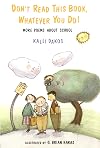
Don't Read This Book, Whatever You Do! would be a perfect introductory poetry book for elementary English students as it is filled with poems all about the trials of elementary school life. It reminds me of the "Diary of a Wimpy Kid" series but for even younger students! This book pokes fun at teachers, students, friendships, and everyday life situations they might be experiencing which makes this a wonderful book to make a connection with your students.
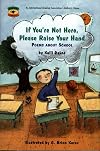
"If You're Not Here, Please Raise Your Hand" is full of silly, exaggerative poems and rhymes. From "They don't do math in Texas" to "A lifetime in third grade", Kalli Dakos' childlike voice and imagination really shines in this poem book about school.
It is great for teaching a lesson on finding meaning in the text, because some of the poems use metaphors to describe how the students feel.
It is great for teaching a lesson on finding meaning in the text, because some of the poems use metaphors to describe how the students feel.
"If You're Not Here, Please Raise Your Hand" is a book of short poems. The author has delivered colorful photos of students at school with short poems about different events that happen while at school. She is showing the life of elementary students at school through their excitement as well as their challenges they go through.
I thought this would be a book that would be of interest to children. I think that seeing through the eyes of a student will draw the children in. Children seem to go show more through so many emotions in school that sometimes they cannot express.
One extension idea would be to do a group reading. Sit with the children in a circle and as you move around the circle let each child read one of the short poem sections. This will help with reading skills.
Another extension idea would be to have a group discussion. Discuss some of the things that happen in the book, like not bringing milk money, and then talk about ways to change the situation. show less
I thought this would be a book that would be of interest to children. I think that seeing through the eyes of a student will draw the children in. Children seem to go show more through so many emotions in school that sometimes they cannot express.
One extension idea would be to do a group reading. Sit with the children in a circle and as you move around the circle let each child read one of the short poem sections. This will help with reading skills.
Another extension idea would be to have a group discussion. Discuss some of the things that happen in the book, like not bringing milk money, and then talk about ways to change the situation. show less
Lists
Awards


You May Also Like


Associated Authors
Statistics
- Works
- 26
- Members
- 1,892
- Popularity
- #13,595
- Rating
- 4.0
- Reviews
- 48
- ISBNs
- 79
- Languages
- 1