
Sam Fink (1916–2011)
Author of The Declaration of Independence
About the Author
Works by Sam Fink
Constitution of the United States: To Honor the Two-Hundredth Anniversary, Septmeber 17, 1987 (1985) 31 copies
THE CONSTITUTION OF THE UNITED STATES OF AMERICA with Benjamin Franklin's Address to the Delegates Upon the Signing of the Constitution (2006) 18 copies
The Gettysburgh Address and the Thirteenth Amendment to the Constitution of the United States of America (2007) 9 copies
The Illustrated Gettysburg Address 6 copies
Declaration Of Independence 2 copies
Tagged
Common Knowledge
- Birthdate
- 1916-05-27
- Date of death
- 2011-11-01
- Gender
- male
- Nationality
- USA
- Birthplace
- Bronx, New York, USA
- Place of death
- Jerusalem, Israel
- Associated Place (for map)
- USA
Members
Reviews
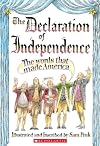
Really interesting concept: the Declaration of Independence is broken down into phrases and illustrated in an engaging manner, somewhat representative of classic 18th-19th century political cartooning. Readers should be aware that the Declaration contains controversial ideas and an unfounded slur against Native Americans. That page's illustration is handled thoughtfully (King George bribing a man whose indigenous identity is revealed in his hairstyle, though he wears European style frontier show more clothing rather than stereotyped native dress). The book is worthwhile because it will make it much easier for students to understand what the (rather dense) Declaration actually said beyond "life, liberty, and the pursuit of happiness." Rather a lot of slamming King George as it turns out! show less
Apart from a short forward and introduction, this book is composed almost entirely of the words of the Declaration of Independence. Each page contains an often opaque phrase, such as "For Quartering large bodies of armed troops among us", written in large, hand-engraved type. The opposite page contains an old-fashioned political cartoon of the sort popular at the time of the writing of the Declaration of Independence. These pen-and-ink drawings are made to look like colored woodcut show more engravings, with dense cross-hatching to represent shading and thin, curling word bubbles issuing from the figures mouths like ribbons. The drawings attempt to illuminate the meaning behind the words; for example, the picture opposite the "For Quartering large troops" page depicts a tall house with British soldiers hanging out of every window. Another picture, spreading across two pages with the text beneath it, shows King George and Benjamin Franklin engaged in a tug-of-war over a piece of paper marked "Charter". George is saying, "Its mine! I can take it back!" while Franklin admonishes, "George... you're going to regret this..."
While the concept of this book is indeed creative, and it seems to be largely effective in making the Declaration of Independence more accessible to younger readers, some readers may still have a few reservations about the formatting. Political cartoons, no matter how bland or instructional, have never been especially good at showing nuance or presenting a balanced perspective. In all the frames, King George is portrayed as a weak, greedy man, sometimes fat, sometimes old and senile, but always the Big Bad. While the idea of justified rebellion is an essential part of our national creation myth, these illustrations present an incredibly self-righteous and one-dimensional story. On top of the fact that few elementary schoolers will get the creative visual pun of using a contemporaneous illustrative technique to illustrate such a text, even fewer will have opened a newspaper to the Opinion page in order to see a political cartoon. What is most troubling about this book is the fact that the author (though he describes himself as illustrator and inscriber), makes it seem as though the text of the Declaration is standing on its own when in fact he is putting his own accusatory spin on things. This book would be much better served with explanatory and contextual passages than pictures of the sort he provides. Written (although not recommended) for children in 3-6 grade. show less
While the concept of this book is indeed creative, and it seems to be largely effective in making the Declaration of Independence more accessible to younger readers, some readers may still have a few reservations about the formatting. Political cartoons, no matter how bland or instructional, have never been especially good at showing nuance or presenting a balanced perspective. In all the frames, King George is portrayed as a weak, greedy man, sometimes fat, sometimes old and senile, but always the Big Bad. While the idea of justified rebellion is an essential part of our national creation myth, these illustrations present an incredibly self-righteous and one-dimensional story. On top of the fact that few elementary schoolers will get the creative visual pun of using a contemporaneous illustrative technique to illustrate such a text, even fewer will have opened a newspaper to the Opinion page in order to see a political cartoon. What is most troubling about this book is the fact that the author (though he describes himself as illustrator and inscriber), makes it seem as though the text of the Declaration is standing on its own when in fact he is putting his own accusatory spin on things. This book would be much better served with explanatory and contextual passages than pictures of the sort he provides. Written (although not recommended) for children in 3-6 grade. show less

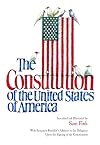
It's the Consitution - so, I'm not going to review "the book." My review focuses on the $500 retail deluxe illustrated edition. I received this book a few days ago, and it is absolutley stunning! First, it is HUGE: 23.5" by 16" by 2". I have uploaded photos, which include a regular size hardcover book for size comparison. Second, the Constitution is unbound. The document is broken into sections and amendments, with one or two sections, or one amendment, per page. Each one is written out in show more large font, calligraphy-style script, and embellished with colorful artwork. It is printed on archival, very thick high, quality paper (looks a bit like parchment/vellum). Each sheet is like an artprint, and would be suitable for framing. These are inset in a dark blue cloth covered traycase, with satin ribbon for easy removal. Under the traycase lid is an included limited edition art-print, signed by the artist. My included print has the entire Constitution written out in a smaller font, in non-linear style, with an American Eagle embellishing the page.
Overall, this truly is a work of art! If I had the space, I would love to frame each print and display them in sequence on a wall. Highly recommended to book collectors, or Americana collectors. show less
Overall, this truly is a work of art! If I had the space, I would love to frame each print and display them in sequence on a wall. Highly recommended to book collectors, or Americana collectors. show less
The USA PATRIOT ACT was signed in October 2001, over eleven years ago now. Soon, the first generation of Americans to grow up without the Constitution will enter high school. I imagine textbooks will need to be re-written, to adjust to their perspective. Some of you out there will probably wonder “Why even bother to teach about the Constitution, now that it’s no longer relevant to American life?”, but I think there is value to talking about this old bygone paper. It was once a big part show more of our national character and mindset. People even died defending it, back before we collectively shrugged our shoulders when it was discarded one October morning. Looking back, I wonder what would have happened if we would have been more outraged at its passing. I mean, what if angry patriots had taken to the streets? What if there had been a general strike to stop the wheels of commerce until our defining document was restored? It’s one of those great "what if’s" historians will ponder and alt-history novelists will write bad books about in centuries to come, I suppose.
This book not only contains the full text of the U.S. Constitution, it also furnishes beautiful drawings on almost every page, illustrating the principles of the Constitution, and some of the historical persons connected to it.
The U.S. Constitution (September 17, 1787 - October 26, 2001) was one of the most extraordinary documents in history. It extended the notion of personal liberties brought to prominence by the Magna Carta (1215 A.D.), and placed political power in the hands of the governed. Most of it outlines our tripartite Judicial-Legislative-Executive structure of government, which was the framework for American political life in the first 225 years of the Republic. During this period, our constitution was used around the world as a model for numerous other liberal democracies. It is probably too simplistic to say that the Constitutional was swept away and replaced by the Doctrine of the Unitary Executive purely in a fit of post-traumatic national hysteria, following the terror attacks of September 11, 2001. In truth, undeclared wars, Executive signing statements and other anti-Constitutional practices had been signaling the end of the Constitutional Age (C.A.) for decades. The signing of the USA PATRIOT ACT, is merely a convenient place to mark the end of the end of the C.A., but our leaders must have had a sense long before we did that we were no longer interested in living under or defending the Constitution, as it is now known that the USA PATRIOT ACT had been written long before 9/11.
The most remarkable aspect of the Constitution is the Bill of Rights, which comprise its first ten amendments. These amendments were submitted by James Madison to the first Congress, and were approved into law in August of 1789. As clarified in the American Declaration of Independence, the liberties protected in the Bill are not created by the Bill, but are endowed by the Divine Creator, and are inalienable from all human beings. The Bill of Rights only represents a legal recognition that these rights exist, and attempts to safeguard them within the structure of the law. The Bill of Rights appears as follows.
Amendment I
Congress shall make no law respecting an establishment of religion, or prohibiting the free exercise thereof; or abridging the freedom of speech, or of the press; or the right of the people peaceably to assemble, and to petition the Government for a redress of grievances.
This is the spirit of the old First Amendment:
During the Constitutional Age, American citizens enjoyed the exercise of free speech. Although the judiciary placed some restrictions on this, most notably Oliver Wendell Holmes Jr’s famous "shouting fire in a crowded theatre" opinion (Schenck v. United States in 1919), it seemed to be an easily-understood standard. Under the USA PATRIOT ACT, any speech -even peaceful conflict resolution- could be illegal, if it was with groups or persons on government watch lists. Following passage of the PATRIOT ACT, use of "free speech zones" proliferated in public areas. The Bush II administration also infringed free speech with the issuance of over 30,000 National Securities Letters, most of which were accompanied by gag orders prohibiting the receiver from telling anybody he had received the letter. The full extent of how National Securities Letters are used in the Age of the Unitary Executive is not publicly known, but apparently many have been used to solicit from librarians information about what books citizens read.
This is the spirit of the New First Amendment:
The entire country used to be a “First Amendment Area”.
Amendment II
A well regulated Militia, being necessary to the security of a free State, the right of the people to keep and bear Arms, shall not be infringed.
I know this part will be the most divisive. A lot of people are quite correctly concerned about the role of guns in violent crime. There’s no denying that, and I don’t think every person should have a gun; much the way not every person should have a license to drive. On the other hand, it seems clear that a sufficiently armed citizenry is more secure from governmental abuses. It seems obvious that if the average Cambodian family had firearms in 1974, Pol Pot’s government would have had far less success implementing their program of genocide on the population. This little poster may be trite, but it’s also got an element of truth to it:
So anyway, The Second Amendment had been controversial in America for a long time before 2001. As the nation moved from a sparsely-populated agrarian rural society to a more populous urban industrialized one, gun-related crime increased dramatically. The public came to regard the legal issues surrounding gun ownership to be purely a matter related to domestic crime. The notion of widespread gun ownership as a safeguard against tyranny was gradually forgotten, or came to be thought of as a "fringe" belief. The PATRIOT ACT did not itself eradicate the Second Amendment, but did signal an a tightening of administrative restrictions on gun sales and ammunition production.
Amendment III
No Soldier shall, in time of peace be quartered in any house, without the consent of the Owner, nor in time of war, but in a manner to be prescribed by law.
The realities of the twenty-first century did not require quartering of the military in private homes, so this right -only because it was so irrelevant- was left unmolested by the USA PATRIOT ACT.
Amendment IV
The right of the people to be secure in their persons, houses, papers, and effects, against unreasonable searches and seizures, shall not be violated, and no Warrants shall issue, but upon probable cause, supported by Oath or affirmation, and particularly describing the place to be searched, and the persons or things to be seized.
Here is the Fourth Amendment at work: a warrant being served.
Here is the Fourth Amendment, as gutted by the USA PATRIOT ACT
Of the entire Bill of Rights, the Fourth Amendment was probably worst damaged by the USA PATRIOT ACT. As with other rights, safeguards against unreasonable search and seizures began eroding long before 2001, but it was the USA PATRIOT ACT which allowed law enforcement agents to conduct searches without warrants issued by judges, and which specifically allowed evidence obtained contrary to the Fourth Amendment to be nevertheless used in legal proceedings. Section 215 of the PATRIOT ACT contains provisions allowing for "warrantless wiretapping", in which private voice communications can be intercepted, recorded, and used against a citizen without a warrant. The Act's "sneak and peak" provisions allow police and other law agents to search homes without serving warrants, and/or to delay notification of the warrant for 90 days or more after the actual search. In the Age of the Unitary Executive (A.U.E.), an anonymous tip is enough to get a citizen categorized as “suspicious”, which in turn is sufficient cause to trample his rights. The label "Suspicious" in the A.U.E. is akin to the label "witch" in the Middle Ages.
Reference 1
Reference 2
Reference 3
Reference 4
Amendments V and VI go so well together, since they have to do with trials and criminal justice, so I’ll combine them in the discussion here.
Amendment V
No person shall be held to answer for a capital, or otherwise infamous crime, unless on a presentment or indictment of a Grand Jury, except in cases arising in the land or naval forces, or in the Militia, when in actual service in time of War or public danger; nor shall any person be subject for the same offence to be twice put in jeopardy of life or limb; nor shall be compelled in any criminal case to be a witness against himself, nor be deprived of life, liberty, or property, without due process of law; nor shall private property be taken for public use, without just compensation.
Amendment VI
In all criminal prosecutions, the accused shall enjoy the right to a speedy and public trial, by an impartial jury of the State and district wherein the crime shall have been committed, which district shall have been previously ascertained by law, and to be informed of the nature and cause of the accusation; to be confronted with the witnesses against him; to have compulsory process for obtaining witnesses in his favor, and to have the Assistance of Counsel for his defense.
Without the Fifth and Sixth Amendments, this could be you:
These are the Amendments which protected citizens from being deprived of life, liberty or property without due process of the law. After the 2001 attacks on the World Trade Center, it was deemed too risky to let citizens have due process, because then The Terrorists would also get due process. The PATRIOT ACT streamlined law enforcement substantially, allowing the Unitary Executive to forgo the time-consuming bureaucratic steps our Fifth and Sixth Amendments entailed. By merely by designating any citizen as an "enemy combatant" or "suspected terrorist", the Executive could move directly to indefinite detention, questioning without defense council present, or filing of charges.
No guidance or restrictions are in place to specify who can be designated as "suspicious", and there is no oversight for how the Executive chooses to use this power. (that’s why he’s the “Unitary Executive”). Evidence obtained by coercion, or torture is admissible in trials against suspect citizens, who may not excercise the right to attorney-client privilege. This streamlined process is great for catching The Terrorists, yet even today the idea that anyone may legally be locked away forever with no trial, even with no suspicion of wrongdoing, and no chance to clear his name, merely at the President's whim, doesn’t sit well with some people, who would like to go back to the dangerous old Constitutional system. Unfortunately, that outmoded document doesn’t recognize the realities of the twenty-first century- namely that if Americans want to preserve our freedoms from The Terrorists who would destroy us, "due process" is simply a luxury we can no longer afford. The USA PATRIOT ACT was just the first of many laws stripping away the old system of due process. Certainly Section 1031 of the 2012 National Defense Appropriations Act (NDAA) also went a long way in clarifying that U.S. citizens no longer enjoyed due process as it existed under the Fifth and Sixth Amendments.
Reference 5
Amendment VII
In Suits at common law, where the value in controversy shall exceed twenty dollars, the right of trial by jury shall be preserved, and no fact tried by a jury, shall be otherwise re-examined in any Court of the United States, than according to the rules of the common law.
I am not aware of any examples in which the USA PATRIOT ACT or other legislation in the A.U.E. has abridged the Seventh Amendment, but if you have any, please comment on this review’s thread. I’d be interested to hear about it.
Amendment VIII
Excessive bail shall not be required, nor excessive fines imposed, nor cruel and unusual punishments inflicted.
Now this will be an interesting discussion. I don’t honestly know how waterboarding fits into this discussion, because the Eighth Amendment addresses punishment, which seems to imply something which follows a trial and conviction. Waterboarding, while certainly cruel and unusual, is a technique used to gather information from suspects, not convicts. Of course in an age where being a suspect is enough to get you a life prison sentence, fussing over the difference between suspects and convicts really seems like hair-splitting, doesn't it? Under the Unitary Executive, being a suspect is effectively a punishable crime. There is not presumption of innocence, which leads us to Amendment #9...
Who says there’s been a militarization of our culture?
Amendment IX
The enumeration in the Constitution, of certain rights, shall not be construed to deny or disparage others retained by the people.
show less
The Ninth Amendment was supposed to clarify that the Bill of Rights was not intended to be a complete list of citizens’ rights. Just because something isn’t in the Bill of Rights, doesn’t mean it isn’t a right. Take the presumption of innocence, for example. It isn’t specifically mentioned in the Bill of Rights, but it was a foundational principle in American law during the Constitutional Age. Obviously involuntary detention based on suspicion runs counter to the idea of a presumption of innocence, so the 2012 NDAA represents a violation of the Ninth Amendment. Hope you don’t miss it too much. I think the Unitary Executive would tell you that if you aren’t doing anything wrong, you don’t need a presumption of innocence; only terrorists need a presumption of innocence.
Reference 6
Amendment X
The powers not delegated to the United States by the Constitution, nor prohibited by it to the States, are reserved to the States respectively, or to the people.Even though we are barely a decade into the A.U.E., there have already been some bold legislative proposals to keep us all safe from The Terrorists. One of the more controversial ones has been the REAL ID ACT. This was to be a federal law mandating standardization of state drivers’ licenses throughout the nation, effectively creating a sort of "national I.D. card", which would supposedly be more difficult for The Terrorists to copy. The thing is, the federal government isn’t supposed to get into the states’ business over stuff like this, and if you read this link, or this one, or maybe this one, you can begin to see why people in different states might want to keep their own local laws, and not have federal standards forced on them.
Awards


You May Also Like


Associated Authors
Statistics
- Works
- 13
- Members
- 907
- Popularity
- #28,274
- Rating
- 4.6
- Reviews
- 6
- ISBNs
- 33