
Miles Hoffman
Author of The NPR Classical Music Companion: Terms and Concepts from A to Z
Works by Miles Hoffman
Tagged
Common Knowledge
- Gender
- male
Members
Reviews
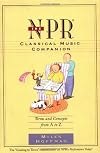
It's an OK little guide for novices and experts, alike, but it's really trying to take on too wide a sweep of information for such a compact paperback. I definitely learned some things about some instruments, composers, and various musical terms--particularly as far as etymology goes. But it had some glaring gaps. As far as composers go, it leaned heavily on well-known masters, like Mozart, Bach, Beethoven, Handel, etc. My favorite era, personally is the late Romantic-early Modernist era, show more roughly from Chopin to Cage. Well, Cage and Glass weren't mentioned once. Gershwin got short-shrifted. No mention of his groundbreaking genre twisting opera, "Porgy and Bess" and in the clarinet piece, the author doesn't mention the famous glissando at the beginning of "Rhapsody in Blue." The French Impressionists don't get much airtime, either. Debussy and Ravel get a few sentences here and there, but there isn't a separate entry for "Impressionism." (I should mention that the book goes alphabetical by categories.) Nowhere is the Debussy mind-blowing opera, "Pelleas et Melisande" mentioned. Erik Satie does not get a single sentence. Rimsky-Korsakov and Mussorgsky get brief mentions, but there's no entry for the "Russian Five." Scirabin gets a sentence or two, but little about his innovations. On the other hand, Schoenberg gets about two pages, despite the author, himself, believing that 12-tone rows aren't particularly influential. Overall, though, it's a handy reference despite some obvious omissions. Oh--one other omission--the great Hollywood composers, mostly immigrants from Eastern Europe--Rozsa, Tiomkin, Steiner, Herrmann, Waxman, etc. show less
It's an OK little guide for novices and experts, alike, but it's really trying to take on too wide a sweep of information for such a compact paperback. I definitely learned some things about some instruments, composers, and various musical terms--particularly as far as etymology goes. But it had some glaring gaps. As far as composers go, it leaned heavily on well-known masters, like Mozart, Bach, Beethoven, Handel, etc. My favorite era, personally is the late Romantic-early Modernist era, show more roughly from Chopin to Cage. Well, Cage and Glass weren't mentioned once. Gershwin got short-shrifted. No mention of his groundbreaking genre twisting opera, "Porgy and Bess" and in the clarinet piece, the author doesn't mention the famous glissando at the beginning of "Rhapsody in Blue." The French Impressionists don't get much airtime, either. Debussy and Ravel get a few sentences here and there, but there isn't a separate entry for "Impressionism." (I should mention that the book goes alphabetical by categories.) Nowhere is the Debussy mind-blowing opera, "Pelleas et Melisande" mentioned. Erik Satie does not get a single sentence. Rimsky-Korsakov and Mussorgsky get brief mentions, but there's no entry for the "Russian Five." Scirabin gets a sentence or two, but little about his innovations. On the other hand, Schoenberg gets about two pages, despite the author, himself, believing that 12-tone rows aren't particularly influential. Overall, though, it's a handy reference despite some obvious omissions. Oh--one other omission--the great Hollywood composers, mostly immigrants from Eastern Europe--Rozsa, Tiomkin, Steiner, Herrmann, Waxman, etc. show less
You May Also Like


Statistics
- Works
- 1
- Members
- 183
- Popularity
- #118,258
- Rating
- 2.8
- Reviews
- 2
- ISBNs
- 7
- Languages
- 1