
James K. Galbraith
Author of The Predator State: How Conservatives Abandoned the Free Market and Why Liberals Should Too
About the Author
James K. Galbraith holds the Lloyd M. Renisen Jr. Chair in Government/Business Relations at the Lyndon R. Johnson School of Public Affairs at the University of Texas at Austin. He lives in Austin, Texas.
Works by James K. Galbraith
The Predator State: How Conservatives Abandoned the Free Market and Why Liberals Should Too (2008) 310 copies, 5 reviews
Inequality and Instability: A Study of the World Economy Just Before the Great Crisis (2012) 58 copies, 1 review
Welcome to the Poisoned Chalice: The Destruction of Greece and the Future of Europe (2016) 38 copies, 2 reviews
Associated Works
Galbraith: The Affluent Society & Other Writings, 1952-1967: American Capitalism / The Great Crash, 1929 / The Affluent Society / The New Industrial State (2010) — Editor — 170 copies, 1 review
Seduced and Betrayed: Exposing the Contemporary Microfinance Phenomenon (2017) — Foreword, some editions — 2 copies
Tagged
Common Knowledge
- Legal name
- Galbraith, James Kenneth
- Birthdate
- 1952-01-29
- Gender
- male
- Education
- Harvard University (BA - Economics, PhD - Economics)
University of Cambridge (King's College) - Occupations
- economist
professor
public servant - Organizations
- University of Texas at Austin
Lyndon B. Johnson School of Public Affairs
Levy Economics Institute
World Economics Association
Economists for Peace and Security - Awards and honors
- Marshall Scholarship (1974|1975)
- Relationships
- Galbraith, John Kenneth (father)
Galbraith, Peter W. (brother)
Atwater, Catherine Merriam (mother)
Bringa, Tone (sister-in-law) - Nationality
- USA
- Associated Place (for map)
- USA
Members
Reviews
Welcome to the Poisoned Chalice: The Destruction of Greece and the Future of Europe by James K. Galbraith
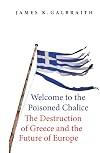
A world-class lesson in counterproductivity
James K. Galbraith is a self-described dissident in economics, banished to the University of Texas at Austin. This is somewhat ironic considering his father was the iconic establishment economist of his era. The younger Galbraith is highly respected around the world, just not so much in the USA. It reminds me of Noam Chomsky, who is similarly held in the highest esteem everywhere but at home.
Galbraith was in Athens for the Greek elections that show more brought Syriza to power. He was an unpaid advisor to the new government all through its negotiations with the Eurozone, the European Bank and the IMF. This book is a collection of his articles, e-mails, speeches and other communications to various players in the State Department, the European Union and the Greek government – from that precise time. It is a blow by blow description of how Europe went wrong and how that path would damage both Greece and the EU. And it’s not over.
Galbraith quickly realized that Europe was not out to save Greece, but to cripple it permanently. They apparently thought this would keep it subservient and prevent it ever rattling their gilded cages again. It was obvious to him that the path of least resistance for Greece was not austerity. Shrinking the GDP, increasing unemployment and loading up on new debt was not the way to reduce debt and restore stability and prosperity. But that is exactly the path demanded Merkel, Schauble and the rest of the Germans, the leading economic power at the table. They even required Greece to run a huge surplus, which is as self-defeating a policy (in a time of 25% unemployment) as could be imagined, Galbraith says.
One thing I had not read before was Galbraith’s ideas if Grexit came to pass. He recommended a 1:1 valuation for the New Drachma at the start, and stamping the 19 billion in paper euros stored at the Bank of Greece to provide cash in the country. This would have had the effect of relaxing the need to hoard euros, while giving the country time to order new currency notes and reprogram ATMs to accept them.
Galbraith dissects the final Brussels memorandum itself in no uncertain terms, showing how each paragraph is a lie, a cynical, hypocritical and misleading contradiction of what would actually happen, and a shameful crippling of a fellow Eurozone country. Like everything he writes, it is clear, cogent, accessible and depressing. This whole affair was handled the precise opposite of the way it should have been. The book documents it realtime.
David Wineberg show less
James K. Galbraith is a self-described dissident in economics, banished to the University of Texas at Austin. This is somewhat ironic considering his father was the iconic establishment economist of his era. The younger Galbraith is highly respected around the world, just not so much in the USA. It reminds me of Noam Chomsky, who is similarly held in the highest esteem everywhere but at home.
Galbraith was in Athens for the Greek elections that show more brought Syriza to power. He was an unpaid advisor to the new government all through its negotiations with the Eurozone, the European Bank and the IMF. This book is a collection of his articles, e-mails, speeches and other communications to various players in the State Department, the European Union and the Greek government – from that precise time. It is a blow by blow description of how Europe went wrong and how that path would damage both Greece and the EU. And it’s not over.
Galbraith quickly realized that Europe was not out to save Greece, but to cripple it permanently. They apparently thought this would keep it subservient and prevent it ever rattling their gilded cages again. It was obvious to him that the path of least resistance for Greece was not austerity. Shrinking the GDP, increasing unemployment and loading up on new debt was not the way to reduce debt and restore stability and prosperity. But that is exactly the path demanded Merkel, Schauble and the rest of the Germans, the leading economic power at the table. They even required Greece to run a huge surplus, which is as self-defeating a policy (in a time of 25% unemployment) as could be imagined, Galbraith says.
One thing I had not read before was Galbraith’s ideas if Grexit came to pass. He recommended a 1:1 valuation for the New Drachma at the start, and stamping the 19 billion in paper euros stored at the Bank of Greece to provide cash in the country. This would have had the effect of relaxing the need to hoard euros, while giving the country time to order new currency notes and reprogram ATMs to accept them.
Galbraith dissects the final Brussels memorandum itself in no uncertain terms, showing how each paragraph is a lie, a cynical, hypocritical and misleading contradiction of what would actually happen, and a shameful crippling of a fellow Eurozone country. Like everything he writes, it is clear, cogent, accessible and depressing. This whole affair was handled the precise opposite of the way it should have been. The book documents it realtime.
David Wineberg show less
Welcome to the Poisoned Chalice: The Destruction of Greece and the Future of Europe by James K. Galbraith
This book was a dangerous but small dose of self-affirmation. I'm even more convinced now of the folly of the Eurozone (the common currency, not the Union necessarily), the corruption of the ECB and IMF (and the ineptitude of their leaders), and the criminality of their attacks on Greek sovereignty on behalf of creditors.
Many of the principles Graeber outlines in Debt are live in color here in Galbraith's insider account of the crisis, including the fact that markets can only be sustained show more when the state, which formed the market in the first place, is stronger than the market and its participants. The Eurozone does not meet this essential criterion and is therefore destined to change materially - smaller, weaker financial sector; unified tax system that facilitates flows from surplus to deficit areas; a strong central bank focused on prosperity rather than servitude to the financial sector, etc. In short, its leaders will, in Galbraith's words, come to understand "that the goal of economic policy cannot be to satisfy the gods of the bond market. It is to provide economic opportunity-full employment, education, health care, and decent pensions-to the people," or it will continue to collapse. show less
Many of the principles Graeber outlines in Debt are live in color here in Galbraith's insider account of the crisis, including the fact that markets can only be sustained show more when the state, which formed the market in the first place, is stronger than the market and its participants. The Eurozone does not meet this essential criterion and is therefore destined to change materially - smaller, weaker financial sector; unified tax system that facilitates flows from surplus to deficit areas; a strong central bank focused on prosperity rather than servitude to the financial sector, etc. In short, its leaders will, in Galbraith's words, come to understand "that the goal of economic policy cannot be to satisfy the gods of the bond market. It is to provide economic opportunity-full employment, education, health care, and decent pensions-to the people," or it will continue to collapse. show less
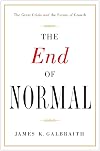
Staggering Indictment
In year five after the financial crisis, when the economic models said everything would be back to normal, James Galbraith examines the sorry state – of economics. The concept of normal is actually recent. It was only developed in the 1950s. The Kennedy Administration was the first to give it credence. And that’s when the rot set in.
The theory of growth implies there is a natural upward curve, and while events might skew it, we always return to the normal path and show more keep growing from there. This was of course based on the experience of the post war era, and like all such theories, extrapolates from the present as if it were valid for all time. It’s absurd to the point where economists (Galbraith calls them crackpots) backcast to other times. This has led to the startling conclusion that FDR’s New Deal (where he employed millions to pull the USA out of the Depression) not only didn’t help at all, it actually prevented the return to normal. We would have been much farther ahead without it, according to the model and the economists who believe in it.
Galbraith dissects the models and dismisses them all. They include only the factors economists want. None of them accounts for the complexity of life in our economy. In the ever changing mix of history and circumstances, that cannot work, even in theory. Yet succeeding governments continue to use these disproven models and continue to make useless predictions based on them. In emergencies like the financial crisis, Galbraith says they are worse than useless; they are counterproductive.
For starters, the models fail to account for the financial sector, fail to account for fraud, (the biggest component of the crisis) and fail to account for technology. Galbraith says “There is no mechanism in mainstream theory for understanding how financial events affect the economy, except momentarily… Rather it is built on the foundation of equilibrium.” He then destroys the concept of equilibrium on the fairly astounding grounds that it contravenes the second law of thermodynamics. According to economist Georgescu-Roegen (backwater), entropy is always increasing, heat flows from hotter to colder, time moves forward and never back, and economies can't be in a state of equilibrium forever. But that’s precisely the model Alan Greenspan lived by. He’s the one who encouraged homeowners to buy adjustable rate mortgages, and invest their pension contributions in the stockmarket, where efficient markets would safeguard their life savings. Galbraith calls Greenspan the crackpot-in-chief. This is all very similar to another book I reviewed, GDP: A Brief but Affectionate History, in which economists take incomplete and incorrect figures at face value, to make invalid forecasts, based on a concept most of them do not understand.
There are three schools of economists, Galbraith says. The freshwater and the saltwater argue constantly about whose model is right. Yet not one of them predicted the financial collapse of 2009. It was the third group, which he calls backwater, where several economists pointed and warned correctly and precisely, to no effect or recognition whatsoever.
Galbraith dismisses all the gloom and doom Tea Party talk of US debt and deficits. He says bankruptcy is impossible, because the USA is in the privileged position of always being able to pay with cash. He says the country has a unique product, the dollar, which is in demand all over the world. In fact, the country must run a deficit in order to fill the demand for dollar denominated treasury bills and bonds. The country is fortunate to have product in such demand, that costs absolutely nothing to produce, and is usually not even produced – it is just an entry in an electronic account. Profit margin – 100%. So here again, there is no return to “normal,” deficit or not.
He sees four obstacles preventing a return to the post-war pattern of growth:
-energy markets are high cost and uncertain
- the world economy is no longer under the control of Washington because of the impotence of the US military
-radical labor-saving technology makes employment uncertain and less rewarding
-the financial sector is no longer behind growth. It is out for its own leverage and profit without getting its hands dirty in real ventures.
None of these factors existed when the models were drawn up, and none of the models take them into account.
He ends with a visit to the fall of the USSR: crackpot economic theories fed by bad data and erroneous assumptions. He sees it all over Washington today.
This is powerful, controversial, and divisive stuff. Far more than Piketty, The End of Normal deserves to be the most talked about economics book of the year.
David Wineberg show less
In year five after the financial crisis, when the economic models said everything would be back to normal, James Galbraith examines the sorry state – of economics. The concept of normal is actually recent. It was only developed in the 1950s. The Kennedy Administration was the first to give it credence. And that’s when the rot set in.
The theory of growth implies there is a natural upward curve, and while events might skew it, we always return to the normal path and show more keep growing from there. This was of course based on the experience of the post war era, and like all such theories, extrapolates from the present as if it were valid for all time. It’s absurd to the point where economists (Galbraith calls them crackpots) backcast to other times. This has led to the startling conclusion that FDR’s New Deal (where he employed millions to pull the USA out of the Depression) not only didn’t help at all, it actually prevented the return to normal. We would have been much farther ahead without it, according to the model and the economists who believe in it.
Galbraith dissects the models and dismisses them all. They include only the factors economists want. None of them accounts for the complexity of life in our economy. In the ever changing mix of history and circumstances, that cannot work, even in theory. Yet succeeding governments continue to use these disproven models and continue to make useless predictions based on them. In emergencies like the financial crisis, Galbraith says they are worse than useless; they are counterproductive.
For starters, the models fail to account for the financial sector, fail to account for fraud, (the biggest component of the crisis) and fail to account for technology. Galbraith says “There is no mechanism in mainstream theory for understanding how financial events affect the economy, except momentarily… Rather it is built on the foundation of equilibrium.” He then destroys the concept of equilibrium on the fairly astounding grounds that it contravenes the second law of thermodynamics. According to economist Georgescu-Roegen (backwater), entropy is always increasing, heat flows from hotter to colder, time moves forward and never back, and economies can't be in a state of equilibrium forever. But that’s precisely the model Alan Greenspan lived by. He’s the one who encouraged homeowners to buy adjustable rate mortgages, and invest their pension contributions in the stockmarket, where efficient markets would safeguard their life savings. Galbraith calls Greenspan the crackpot-in-chief. This is all very similar to another book I reviewed, GDP: A Brief but Affectionate History, in which economists take incomplete and incorrect figures at face value, to make invalid forecasts, based on a concept most of them do not understand.
There are three schools of economists, Galbraith says. The freshwater and the saltwater argue constantly about whose model is right. Yet not one of them predicted the financial collapse of 2009. It was the third group, which he calls backwater, where several economists pointed and warned correctly and precisely, to no effect or recognition whatsoever.
Galbraith dismisses all the gloom and doom Tea Party talk of US debt and deficits. He says bankruptcy is impossible, because the USA is in the privileged position of always being able to pay with cash. He says the country has a unique product, the dollar, which is in demand all over the world. In fact, the country must run a deficit in order to fill the demand for dollar denominated treasury bills and bonds. The country is fortunate to have product in such demand, that costs absolutely nothing to produce, and is usually not even produced – it is just an entry in an electronic account. Profit margin – 100%. So here again, there is no return to “normal,” deficit or not.
He sees four obstacles preventing a return to the post-war pattern of growth:
-energy markets are high cost and uncertain
- the world economy is no longer under the control of Washington because of the impotence of the US military
-radical labor-saving technology makes employment uncertain and less rewarding
-the financial sector is no longer behind growth. It is out for its own leverage and profit without getting its hands dirty in real ventures.
None of these factors existed when the models were drawn up, and none of the models take them into account.
He ends with a visit to the fall of the USSR: crackpot economic theories fed by bad data and erroneous assumptions. He sees it all over Washington today.
This is powerful, controversial, and divisive stuff. Far more than Piketty, The End of Normal deserves to be the most talked about economics book of the year.
David Wineberg show less
This book really annoyed me, and I loved it. I have long understood the Chicago School of Econ to be utterly bankrupt of ideas about the real world, and while I felt that Galbraith made strawmen out of other complex ideas with which he disagrees, I fundamentally agree with the arguments here.
The book is an easy read and should be read by anyone that cares about the present and future state of the US economy.
The book is an easy read and should be read by anyone that cares about the present and future state of the US economy.
Lists
You May Also Like


Associated Authors
Statistics
- Works
- 23
- Also by
- 4
- Members
- 676
- Popularity
- #37,361
- Rating
- 4.0
- Reviews
- 12
- ISBNs
- 55
- Languages
- 5
- Favorited
- 1