

Nigel Tranter (1909–2000)
Author of The Bruce Trilogy
About the Author
Image credit: The Wee Web
Series
Works by Nigel Tranter
Children of the Mist: The Dramatic 16th Century Story of Alastair MacGregor of Glenstrae (1992) 50 copies, 1 review
The James V Trilogy: The Riven Realm James, by the Grace of God Rough Wooing (1995) 43 copies, 2 reviews
The Stewart Trilogy: Lords of Misrule; A Folly of Princes; The Captive Crown (Coronet Books) (1998) 38 copies, 1 review
The MacGregor Trilogy: MacGregor's Gathering, The Clansman, Gold for Prince Charlie (1988) 34 copies
The Montrose Omnibus: The Young Montrose and Montrose : The Captain General (Coronet Books) (1987) 29 copies
The Fortified House in Scotland: Volume Five: North and West Scotland and Miscellaneous (1970) 9 copies
The Fortified House in Scotland 5 copies
The Man Behind the Curtain 3 copies
The deer poachers 3 copies
Border riding 2 copies
Watershed 2 copies
Spaniards Isle 2 copies
Pursuit 2 copies
Flight of Dutchmen 2 copies
Trespass 1 copy
The Wisest Fool, 2nd edition 1 copy
The Wisest Fool 1 copy
Birds of a Feather 1 copy
Delayed Action 1 copy
Heartbreak Valley 1 copy
Eagles Feather 1 copy
Dynamite Trail 1 copy
Ducks and Drakes 1 copy
Dessert Double Cross 1 copy
Dead Reckoning 1 copy
Mammon's Daughter 1 copy
Colours Flying 1 copy
Cloven Hooves 1 copy
Cheviot Chase 1 copy
Bloodstone Trail 1 copy
Big Corral 1 copy
Masters of Gray Trilogy 1 copy
High Spirits 1 copy
Thirsty Range 1 copy
The Master of Gray 1 copy
Paxton House 1 copy
Trailing Trouble 1 copy
Trail Herd 1 copy
Tidewrack 1 copy
Outlaw of the Highlands 1 copy
The Night Riders 1 copy
Spanish Galleon 1 copy
Root and Branch 1 copy
Rio D'oro 1 copy
Rancher Renegade 1 copy
The James V Trilogy 1 copy
Associated Works
Tagged
Common Knowledge
- Other names
- Tredgold, Nye (pseudonym)
Tranter, Nigel Godwin (birth name) - Birthdate
- 1909-11-23
- Date of death
- 2000-01-09
- Gender
- male
- Education
- George Heriot's School, Edinburgh, Scotland, UK
- Occupations
- accountant
historian
historical novelist - Awards and honors
- Officer of the Order of the British Empire
BBC Scotland Scot of the Year (1989 ) - Nationality
- Scotland
- Birthplace
- Glasgow, Scotland, UK
- Map Location
- Scotland, UK
Members
Reviews
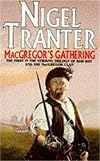
In the time of Queen Anne in England, with the Act of Union looming, the MacGregor clan has been outlawed and proscribed. They make their living through a sort of protection scheme, taking cattle from landowners in exchange for ensuring that other clans don’t harry the landowners. Then comes a time when there’s a possibility of putting a Jacobite king on the throne of Scotland. Rob Roy and his nephew Gregor are set to join the adventure, rally the clans and support this first rising (the show more 1715 one).
This was a relatively breezy read for a historical novel. It clocks in at just over 250 pages in my edition and has more funny moments than I would otherwise have expected. Gregor, as the main character in the story, is young and impulsive and has a zest for life, and his relationship with his uncle provides many instances of affectionate joking. The setting is described beautifully and the dialogue, although written in English, to me captures the flavour of Gàidhlig in its sentence structure and use of interjections.
I recommend this book if you’re looking to read about Scotland in the 1700s. It might also make a manageable introduction to Nigel Tranter’s work. show less
This was a relatively breezy read for a historical novel. It clocks in at just over 250 pages in my edition and has more funny moments than I would otherwise have expected. Gregor, as the main character in the story, is young and impulsive and has a zest for life, and his relationship with his uncle provides many instances of affectionate joking. The setting is described beautifully and the dialogue, although written in English, to me captures the flavour of Gàidhlig in its sentence structure and use of interjections.
I recommend this book if you’re looking to read about Scotland in the 1700s. It might also make a manageable introduction to Nigel Tranter’s work. show less

Trigger warning: rape
It’s 1715. Rob Roy MacGregor has been declared an outlaw for his cattle thieving and his support of the Jacobite cause. He leaves his clan lands to avoid having his clansmen targeted by association, but the government men don’t seem to follow such niceties. They burn down his house and attack his family because they think the family are hiding something. When Rob returns and hears of this, he swears revenge on those who wronged his family. At the same time, the show more Jacobite cause is coming to a head. Will the Stuart king finally come back and try to claim the throne from Anne or from her successor, George?
Like the first book in the trilogy, this book is told well and moves at a rattling pace. The subject matter, however, is much harder to deal with, particularly Mary’s rape and the psychological aftermath for her. It’s post-traumatic stress in the 1700s and Rob is so unequipped to deal with it that Mary doesn’t even tell him that she was raped. He just thinks the factor hit her (but that’s enough for him to want revenge).
As for the Jacobite rebellion, there’s a crisis of confidence in the clan: a divide between people who want to die recklessly for glory and people who would prefer to save the clan from total destruction. The conflict plays out interestingly and fits in nicely with all the history I’ve been reading about this period. I’m tempted to put the third book on the to-read pile right away! show less
It’s 1715. Rob Roy MacGregor has been declared an outlaw for his cattle thieving and his support of the Jacobite cause. He leaves his clan lands to avoid having his clansmen targeted by association, but the government men don’t seem to follow such niceties. They burn down his house and attack his family because they think the family are hiding something. When Rob returns and hears of this, he swears revenge on those who wronged his family. At the same time, the show more Jacobite cause is coming to a head. Will the Stuart king finally come back and try to claim the throne from Anne or from her successor, George?
Like the first book in the trilogy, this book is told well and moves at a rattling pace. The subject matter, however, is much harder to deal with, particularly Mary’s rape and the psychological aftermath for her. It’s post-traumatic stress in the 1700s and Rob is so unequipped to deal with it that Mary doesn’t even tell him that she was raped. He just thinks the factor hit her (but that’s enough for him to want revenge).
As for the Jacobite rebellion, there’s a crisis of confidence in the clan: a divide between people who want to die recklessly for glory and people who would prefer to save the clan from total destruction. The conflict plays out interestingly and fits in nicely with all the history I’ve been reading about this period. I’m tempted to put the third book on the to-read pile right away! show less

This is the conclusion to the House of Stewart trilogy, chronicling the final days of Robert III, the rule of the Governor (acting as regent for his brother and later his nephew), and the threat posed to Scotland by Henry Bolingbroke (here sometimes confusingly referred to as “Henry Plantagenet”). This was my favourite of the three books—there’s a lot of sword-fighting and adventure, and Jamie Douglas is consistently the pragmatic voice of reason. I also liked having assertive women show more appear in the story, such as Mary Stewart and Isobel Countess of Mar. The historical note at the end of the book made me want to read the “sequel” ASAP. Tranter has constructed an excellent trilogy that ends at just the right moment to make the reader want more. Recommended for those with an interest in Scottish history.
A note on my cover: I polled some online acquaintances to ask who they thought the bearded man on the cover resembled, and one of the suggestions was of Theoden from The Lord of the Rings. Interestingly, Robert III was a bit of a Theoden figure, with Albany (the Governor) being a Grima Wormtongue... show less
A note on my cover: I polled some online acquaintances to ask who they thought the bearded man on the cover resembled, and one of the suggestions was of Theoden from The Lord of the Rings. Interestingly, Robert III was a bit of a Theoden figure, with Albany (the Governor) being a Grima Wormtongue... show less

The third and final book in Nigel Tranter's Robert the Bruce trilogy, this covers events after the Battle of Bannockburn up to (spoiler alert!) the Bruce's death. Along the way we get excursions into Ireland, invasions of England and the famous Declaration of Arbroath. Once it became clear that the Declaration of Arbroath was happening I actually almost cheered aloud in public. "Yay! A historical event I recognize!" Such is the enthusiasm that this book can generate. It is a consistently show more interesting book: thrilling battle scenes, tense strategy sessions, and a fair few tears at the end. The trilogy as a whole is very much recommended if you have an interest in Scottish history. show less
Lists
You May Also Like


Associated Authors
Statistics
- Works
- 175
- Also by
- 1
- Members
- 3,720
- Popularity
- #6,808
- Rating
- 3.7
- Reviews
- 67
- ISBNs
- 272
- Languages
- 2
- Favorited
- 15