
Edgar J. Goodspeed (1871–1962)
Author of The Apocrypha: An American Translation
About the Author
Works by Edgar J. Goodspeed
The Goodspeed Parallel New Testament, The American Translation and The King James Version (1943) 24 copies
Greek papyri from the Cairo Museum : together with papyri of Roman Egypt from American collections (1902) 13 copies
A Full History of the Wonderful Career of Moody and Sankey in Great Britain and America (1973) 11 copies
The Translators to the Reader: Preface to the King James Version 1611: Updated Spelling and Introduction (2017) 3 copies
The Curse in the Colophon 3 copies
Children's half-hours with Jesus, containing a full narrative of His life: Written for young people 2 copies
Famous Biblical Hoaxes 2 copies
The four pillars of democracy 2 copies
Index apologeticus, sive, Clavis Iustini Martyris operum: aliorumque apologetarum pristinorum (1912) 2 copies
Volume I - A Life of Jesus 1 copy
The Synoptic Gospels 1 copy
The Complete bible, an American translation, The Old Testament, the Apocrypha and the New Testament (1964) 1 copy
D. L. Moody In The South 1 copy
Associated Works
A Descriptive Catalogue of Greek New Testament Manuscripts in America (1937) — Introduction — 3 copies
Tagged
Common Knowledge
- Legal name
- Goodspeed, Edgar Johnson
- Birthdate
- 1871-10-23
- Date of death
- 1962-01-13
- Gender
- male
- Education
- Denison University (BA ∙ 1890)
University of Chicago (BD ∙ 1892 ∙ PhD ∙ 1898) - Occupations
- professor (Greek and New Testament)
lecturer - Organizations
- University of Chicago (professor)
University of California, Los Angeles (lecturer) - Relationships
- Goodspeed, Thomas Wakefield (father)
Harper, William Rainey (mentor) - Nationality
- USA
- Birthplace
- Quincy, Illinois, USA
- Places of residence
- Quincy, Illinois, USA (birth)
Chicago, Illinois, USA
Los Angeles, California, USA (death) - Place of death
- Los Angeles, California, USA
- Burial location
- Forest Lawn Cemetery, Glendale, California, USA
- Associated Place (for map)
- California, USA
Members
Reviews
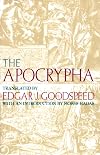
This is a very readable, modern-feeling translation of the Apocrypha even today. Each work has a a preface summarizing the text and giving context. The work's introduction by Moses Hadas feels insightful on the inter-testament works as a whole as trying to make sense of the Chosen People understanding why they suffered so much. Generally, these works do much to set the scene and give exposition to the New Testament events.
Aside from purported history, there's a lot of sound wisdom here, as show more in Sirach:
Sirach 11:8-10 New Revised Standard Version, Anglicised (aka NRSVA, can't find Goodspeed's readable translation online, so I am lazily pasting in quotes from other modern translations)
The Book of the All-Virtuous Wisdom of Yeshua ben Sira, commonly called the Wisdom of Sirach or simply Sirach, and also known as the Book of Ecclesiasticus or Ben Sira, is a work of ethical teachings and I learned from the preface here that it is believed by some Jesus of Nazareth was named after this "Jesus the son of Sirach of Jerusalem", as may have been commonly done in that time and place. Maybe it even meant as much as to say my name "Thomas" derives from the Disciple Thomas.
Generally, Sirach (which stuck with me about evenly with the bloody battles of Maccabees and the apocalyptic pieces derivative of Daniel), seems like a crotchety old man leery of anything smacking of risk:
Also from Chapter 9, Sirach warns about hookers and the bad parts of town!
Yet the crotchety Sirach knows about staying up late when a daughter is out:
Finally, the rich lode of Ch. 9 ends with advice I can follow as someone who often regrets speaking inappropriately: "A man full of words is a dread to his city, but one who speaks rashly will be hated for his word."
Lots of material here showing a Wisdom personified as a woman, practicaly as a co-deity. The Wisdom of Solomon or Book of Wisdom is included in the canon of Deuterocanonical books by the Roman Catholic Church and the anagignoskomenona (meaning "that which is to be read") of the Eastern Orthodox Church. Such religions seems to have co-opted much that could be considered idolatry, so it has a tinge of hypocrisy to me to see the canonize a work that includes such observations:
(Chapter 13) show less
Aside from purported history, there's a lot of sound wisdom here, as show more in Sirach:
Sirach 11:8-10 New Revised Standard Version, Anglicised (aka NRSVA, can't find Goodspeed's readable translation online, so I am lazily pasting in quotes from other modern translations)
8 Do not answer before you listen,
and do not interrupt when another is speaking.
9 Do not argue about a matter that does not concern you,
and do not sit with sinners when they judge a case.
10 My child, do not busy yourself with many matters;
if you multiply activities, you will not be held blameless.
If you pursue, you will not overtake,
and by fleeing you will not escape.
The Book of the All-Virtuous Wisdom of Yeshua ben Sira, commonly called the Wisdom of Sirach or simply Sirach, and also known as the Book of Ecclesiasticus or Ben Sira, is a work of ethical teachings and I learned from the preface here that it is believed by some Jesus of Nazareth was named after this "Jesus the son of Sirach of Jerusalem", as may have been commonly done in that time and place. Maybe it even meant as much as to say my name "Thomas" derives from the Disciple Thomas.
Generally, Sirach (which stuck with me about evenly with the bloody battles of Maccabees and the apocalyptic pieces derivative of Daniel), seems like a crotchety old man leery of anything smacking of risk:
2 Do not put yourself in a woman's hands
or she may come to dominate you completely.
3 Do not keep company with a prostitute,
in case you get entangled in her snares.
4 Do not dally with a singing girl,
in case you get caught by her wiles.
Also from Chapter 9, Sirach warns about hookers and the bad parts of town!
6 Do not give your heart to whores,
or you will ruin your inheritance.
7 Keep your eyes to yourself in the streets of a town,
do not prowl about its unfrequented quarters.
Yet the crotchety Sirach knows about staying up late when a daughter is out:
9 Unknown to her, a daughter keeps her father awake,
the worry she gives him drives away his sleep: in her youth,
in case she never marries, married, in case she should be disliked,
10 as a virgin, in case she should be defiled and found with child in her father's house,
having a husband, in case she goes astray, married, in case she should be sterile!
11 Your daughter is headstrong?
Keep a sharp look-out that she does not make you the laughing-stock of your enemies,
the talk of the town, the object of common gossip, and put you to public shame.
Finally, the rich lode of Ch. 9 ends with advice I can follow as someone who often regrets speaking inappropriately: "A man full of words is a dread to his city, but one who speaks rashly will be hated for his word."
Lots of material here showing a Wisdom personified as a woman, practicaly as a co-deity. The Wisdom of Solomon or Book of Wisdom is included in the canon of Deuterocanonical books by the Roman Catholic Church and the anagignoskomenona (meaning "that which is to be read") of the Eastern Orthodox Church. Such religions seems to have co-opted much that could be considered idolatry, so it has a tinge of hypocrisy to me to see the canonize a work that includes such observations:
11 Take a woodcutter.
He fells a suitable tree, neatly strips off the bark all over
and then with admirable skill works the wood into an object useful in daily life.
12 The bits left over from his work he uses for cooking his food, then eats his fill.
13 There is still a good-for-nothing bit left over, a gnarled and knotted billet:
he takes it and whittles it with the concentration of his leisure hours,
he shapes it with the skill of experience, he gives it a human shape
14 or perhaps he makes it into some vile animal, smears it with ochre,
paints its surface red, coats over all its blemishes.
15 He next makes a worthy home for it, lets it into the wall, fixes it with an iron clamp.
16 Thus he makes sure that it will not fall down --
being well aware that it cannot help itself,
since it is only an image, and needs to be helped.
17 And yet, if he wishes to pray for his goods, for his marriage, for his children,
he does not blush to harangue this lifeless thing --
for health, he invokes what is weak,
18 for life, he pleads with what is dead, for help,
he goes begging to total inexperience,
for a journey, what cannot even use its feet,
19 for profit, an undertaking, and success in pursuing his craft,
he asks skill from something whose hands have no skill whatever.
(Chapter 13) show less

Goodspeed’s New Testament
The translation of the New Testament in this version was conceived by an editor at the University of Chicago Press, who at an academic conference in 1920 had heard Edgar Goodspeed speak about the deficiencies of the already existing modern-speech versions of the New Testament done by Moffatt and Weymouth. The editor (Guy M. Crippen) invited Goodspeed to make a translation to be published by the University Press.
Goodspeed (1871–1962) was at that time a professor show more of New Testament at the University of Chicago, where he had received a doctorate in Greek in 1898. He was the son of a Baptist minister. Early in his career he had edited some scholarly volumes in which recently discovered papyrus documents were published, but after 1912 he turned to the writing of popular-level books, such as The Story of the New Testament (1916). After the publication of his translation of the New Testament (1923) he continued to write books chiefly for laymen (e.g. The Story of the Old Testament in 1934, The Story of the Bible in 1936, An Introduction to the New Testament in 1937, The Story of the Apocrypha in 1939, How to Read the Bible in 1946). His translation of the New Testament should be seen as part of his continued efforts to provide up-to-date books for the education of laymen.
In his day, Goodspeed would be described as a 'liberal.' His views of the inspiration and authority of the Bible were typical of the liberal wing of Protestantism of the early twentieth century. This may be seen in his Story of the New Testament (1916, revised 1928) and in his Introduction to the New Testament (Chicago, 1937), popular-level books in which he approaches the Bible in the same critical and liberal spirit as did Harry Emerson Fosdick, the most well-known Northern Baptist author of the day (c.f. Fosdick's A Guide to Understanding the Bible, 1938).
For example, in his Introduction to the New Testament Goodspeed writes that the Gospel of John "cannot reasonably be considered the original work of a Galilean fishermen ... or the translation of such a work" (p. 326). He maintains that the apostle Paul was the author of the epistle to the Colossians but was not the author of Ephesians. He also concludes that the Pastoral Epistles (1 and 2 Timothy, Titus) were not written by Paul. Against the more radical school of criticism, he argues for the authenticity of 2 Thessalonians, but in a way that is not likely to commend itself to conservatives:
Two objections have been brought against the authenticity of II Thessalonians. One is the apocalyptic objection. It is pointed out that in I Thessalonians Paul declares that the Day is coming without any warning at all; it will be like a thief in the night. Everyone will be saying "What peace and safety!" when suddenly destruction will be upon them. All anyone can do is to be vigilant and composed. But now, in II Thessalonians, he declares that there will be some warning, in the coming of the Antichrist with his pretended signs and wonders and his claim of being God himself. Some scholars feel that the inconsistency between these two positions is so great that they cannot have been held by the same man. If we were to view Paul's writings dogmatically and to assume that he could never alter his position under the stress of circumstances, but must always and everywhere have agreed with himself, this objection might be valid. But if we view Paul historically, as a man of great power and sincerity and strength, grappling vigorously with immediate personal conditions that were constantly changing, we shall find no difficulty here. Paul's letters are not to be viewed like a textbook on mathematics or even dogmatics. And it is precisely the best and wisest of men who honestly and sincerely shift their ground as circumstances may demand. Moreover, this is simply another piece of that same Jewish apocalyptic messianism—the Messiah coming on the clouds of heaven to execute judgment and usher in the Day of the Lord—with which Paul was clearly saturated. (1)
In the Preface to his New Testament translation Goodspeed says that his aim is to make more widely known "the great, living messages of the New Testament," but in view of his teachings in the Introduction to the New Testament it is hard to tell what messages—or parts of messages—he considered true and relevant enough to be called "living." We might suppose that, along with most liberal religious writers of his day, he would reduce the teaching of the New Testament to some notable passages that were useful in preaching upon favorite themes, like "the fatherhood of God and the brotherhood of man." Again, he tells the reader that simple and colloquial language is used in his translation (despite its limitations) because "It is the meaning, not the dress, of the New Testament that is of principal importance" — but it seems rather problematic to insist upon the urgent need to convey the basic "meaning" of the text to the uneducated masses of today if the text presents obsolete "Jewish apocalyptic" delusions written by men who "shift their ground as circumstances may demand," as Goodspeed puts it. Strange indeed, that anyone with such an apparent zeal to convey "the message" would take this view of it. But next to Goodspeed in this respect we may mention Moffatt, Phillips, Bratcher, and a number of other modern translators. It seems that these men advocated colloquial translations not so much out of evangelical zeal, but rather out of a desire to make the text seem more recognizably "human" and less "sacred" than it was formerly held to be.
In the final chapter of his Story of the New Testament, Goodspeed disagrees with the idea that in his day Christians needed a collection of "authoritative" writings. He complains that this concept of the canon of the New Testament "put fetters upon the free Christian spirit which could not always remain," and he approves of the more enlightened attitude shown by modern Christians who have left behind "the dogmatic values of the past." And yet he declares "they will never cease to prize" the New Testament "for its inspiring and purifying power, and for its simple and moving story of the ministry of Jesus," and he expresses the hope that "historically understood, the New Testament will still kindle in us the spirit which animated the men who wrote it, who aspired to be not the lords of our faith but the helpers of our joy." (2)
Also in his Preface we see the opinion about the language of the New Testament that prevailed in some circles during his generation. He asserts that it was written in the "common language of everyday life," and not in any "biblical" style comparable to the Greek of the Septuagint. He lays stress upon this in his Introduction to the New Testament also, in which he asserts that "the Greek papyri discovered in the sands of Egypt in the last forty years have abundantly proved" that Paul wrote "simply and directly in the plain speech of everyday life" (p. 41). From this he argues in his Preface that "the most appropriate English form for the New Testament is the simple, straightforward English of everyday expression." Yet it is far from true that this view of the language of the New Testament had been "fully established" or "abundantly proved" by the non-literary Greek papyrus discoveries, as he claims. It was a view which prevailed briefly during the first two decades of the twentieth century, but by the middle of the cenutry it was again generally acknowledged by New Testament scholars that, for the most part, the authors of the New Testament used a style of Greek which owes much to the influence of the Septuagint and to Jewish literary habits in general. In other words, the Greek New Testament was written in the sort of religious or sacred idiom that Goodspeed deliberately tries to avoid in his English translation. This fact, which has always been acknowledged to some extent by careful scholars, had been minimized by some of Goodspeed's generation, who exaggerated the importance of the non-literary papyri discovered at the end of the nineteenth century. show less
The translation of the New Testament in this version was conceived by an editor at the University of Chicago Press, who at an academic conference in 1920 had heard Edgar Goodspeed speak about the deficiencies of the already existing modern-speech versions of the New Testament done by Moffatt and Weymouth. The editor (Guy M. Crippen) invited Goodspeed to make a translation to be published by the University Press.
Goodspeed (1871–1962) was at that time a professor show more of New Testament at the University of Chicago, where he had received a doctorate in Greek in 1898. He was the son of a Baptist minister. Early in his career he had edited some scholarly volumes in which recently discovered papyrus documents were published, but after 1912 he turned to the writing of popular-level books, such as The Story of the New Testament (1916). After the publication of his translation of the New Testament (1923) he continued to write books chiefly for laymen (e.g. The Story of the Old Testament in 1934, The Story of the Bible in 1936, An Introduction to the New Testament in 1937, The Story of the Apocrypha in 1939, How to Read the Bible in 1946). His translation of the New Testament should be seen as part of his continued efforts to provide up-to-date books for the education of laymen.
In his day, Goodspeed would be described as a 'liberal.' His views of the inspiration and authority of the Bible were typical of the liberal wing of Protestantism of the early twentieth century. This may be seen in his Story of the New Testament (1916, revised 1928) and in his Introduction to the New Testament (Chicago, 1937), popular-level books in which he approaches the Bible in the same critical and liberal spirit as did Harry Emerson Fosdick, the most well-known Northern Baptist author of the day (c.f. Fosdick's A Guide to Understanding the Bible, 1938).
For example, in his Introduction to the New Testament Goodspeed writes that the Gospel of John "cannot reasonably be considered the original work of a Galilean fishermen ... or the translation of such a work" (p. 326). He maintains that the apostle Paul was the author of the epistle to the Colossians but was not the author of Ephesians. He also concludes that the Pastoral Epistles (1 and 2 Timothy, Titus) were not written by Paul. Against the more radical school of criticism, he argues for the authenticity of 2 Thessalonians, but in a way that is not likely to commend itself to conservatives:
Two objections have been brought against the authenticity of II Thessalonians. One is the apocalyptic objection. It is pointed out that in I Thessalonians Paul declares that the Day is coming without any warning at all; it will be like a thief in the night. Everyone will be saying "What peace and safety!" when suddenly destruction will be upon them. All anyone can do is to be vigilant and composed. But now, in II Thessalonians, he declares that there will be some warning, in the coming of the Antichrist with his pretended signs and wonders and his claim of being God himself. Some scholars feel that the inconsistency between these two positions is so great that they cannot have been held by the same man. If we were to view Paul's writings dogmatically and to assume that he could never alter his position under the stress of circumstances, but must always and everywhere have agreed with himself, this objection might be valid. But if we view Paul historically, as a man of great power and sincerity and strength, grappling vigorously with immediate personal conditions that were constantly changing, we shall find no difficulty here. Paul's letters are not to be viewed like a textbook on mathematics or even dogmatics. And it is precisely the best and wisest of men who honestly and sincerely shift their ground as circumstances may demand. Moreover, this is simply another piece of that same Jewish apocalyptic messianism—the Messiah coming on the clouds of heaven to execute judgment and usher in the Day of the Lord—with which Paul was clearly saturated. (1)
In the Preface to his New Testament translation Goodspeed says that his aim is to make more widely known "the great, living messages of the New Testament," but in view of his teachings in the Introduction to the New Testament it is hard to tell what messages—or parts of messages—he considered true and relevant enough to be called "living." We might suppose that, along with most liberal religious writers of his day, he would reduce the teaching of the New Testament to some notable passages that were useful in preaching upon favorite themes, like "the fatherhood of God and the brotherhood of man." Again, he tells the reader that simple and colloquial language is used in his translation (despite its limitations) because "It is the meaning, not the dress, of the New Testament that is of principal importance" — but it seems rather problematic to insist upon the urgent need to convey the basic "meaning" of the text to the uneducated masses of today if the text presents obsolete "Jewish apocalyptic" delusions written by men who "shift their ground as circumstances may demand," as Goodspeed puts it. Strange indeed, that anyone with such an apparent zeal to convey "the message" would take this view of it. But next to Goodspeed in this respect we may mention Moffatt, Phillips, Bratcher, and a number of other modern translators. It seems that these men advocated colloquial translations not so much out of evangelical zeal, but rather out of a desire to make the text seem more recognizably "human" and less "sacred" than it was formerly held to be.
In the final chapter of his Story of the New Testament, Goodspeed disagrees with the idea that in his day Christians needed a collection of "authoritative" writings. He complains that this concept of the canon of the New Testament "put fetters upon the free Christian spirit which could not always remain," and he approves of the more enlightened attitude shown by modern Christians who have left behind "the dogmatic values of the past." And yet he declares "they will never cease to prize" the New Testament "for its inspiring and purifying power, and for its simple and moving story of the ministry of Jesus," and he expresses the hope that "historically understood, the New Testament will still kindle in us the spirit which animated the men who wrote it, who aspired to be not the lords of our faith but the helpers of our joy." (2)
Also in his Preface we see the opinion about the language of the New Testament that prevailed in some circles during his generation. He asserts that it was written in the "common language of everyday life," and not in any "biblical" style comparable to the Greek of the Septuagint. He lays stress upon this in his Introduction to the New Testament also, in which he asserts that "the Greek papyri discovered in the sands of Egypt in the last forty years have abundantly proved" that Paul wrote "simply and directly in the plain speech of everyday life" (p. 41). From this he argues in his Preface that "the most appropriate English form for the New Testament is the simple, straightforward English of everyday expression." Yet it is far from true that this view of the language of the New Testament had been "fully established" or "abundantly proved" by the non-literary Greek papyrus discoveries, as he claims. It was a view which prevailed briefly during the first two decades of the twentieth century, but by the middle of the cenutry it was again generally acknowledged by New Testament scholars that, for the most part, the authors of the New Testament used a style of Greek which owes much to the influence of the Septuagint and to Jewish literary habits in general. In other words, the Greek New Testament was written in the sort of religious or sacred idiom that Goodspeed deliberately tries to avoid in his English translation. This fact, which has always been acknowledged to some extent by careful scholars, had been minimized by some of Goodspeed's generation, who exaggerated the importance of the non-literary papyri discovered at the end of the nineteenth century. show less

Readable, sensibly argued study of the disciples listed in the four gospels.
The Apocrypha consists of 14 "books" that were part of the Septuagint, the Greek translation of the Hebrew Bible together with Greek works on biblical themes. They were part of the canon for all Christians from the fifth century on, but fell into disrepute with Protestants because they weren't part of the original Hebrew scripture--yet they were part of the original King James Version of the Bible and was only dropped later. And they're still considered canonical by Catholics and Greek show more Orthodox.
So that means whatever your beliefs, they were a huge part of Western culture for well over a millennium. That's why I think anyone of whatever faith (or no faith) should have a copy--just as they should have the Hebrew Bible, The New Testament, the Koran, the Upanishads, the Tao Te Ching, etc. I'm not sure how Jews view the Apocrypha. I understand they're not included in Jewish Bibles, but you won't find the basis for Chanukah in the Hebrew Bible, but in The Books of the Maccabees that are in the Apocrypha. It's funny, I was raised a Catholic, but these stories weren't really familiar to me before reading this. Maybe because American culture is of a Protestant stamp and they disfavor them. My copy is subtitled "An American Translation" and reads as colloquial and flowing rather than some attempt to be archaic. On that regard I found a fascinating and very useful review of this book on Amazon that gives a lot of the context of this translation of the book you can't find within it. Link below:
http://www.amazon.com/review/R152944Q9DY6VO/ref=cm_cr_pr_perm?ie=UTF8&ASIN=0... show less
So that means whatever your beliefs, they were a huge part of Western culture for well over a millennium. That's why I think anyone of whatever faith (or no faith) should have a copy--just as they should have the Hebrew Bible, The New Testament, the Koran, the Upanishads, the Tao Te Ching, etc. I'm not sure how Jews view the Apocrypha. I understand they're not included in Jewish Bibles, but you won't find the basis for Chanukah in the Hebrew Bible, but in The Books of the Maccabees that are in the Apocrypha. It's funny, I was raised a Catholic, but these stories weren't really familiar to me before reading this. Maybe because American culture is of a Protestant stamp and they disfavor them. My copy is subtitled "An American Translation" and reads as colloquial and flowing rather than some attempt to be archaic. On that regard I found a fascinating and very useful review of this book on Amazon that gives a lot of the context of this translation of the book you can't find within it. Link below:
http://www.amazon.com/review/R152944Q9DY6VO/ref=cm_cr_pr_perm?ie=UTF8&ASIN=0... show less
Awards


You May Also Like


Associated Authors
Statistics
- Works
- 60
- Also by
- 2
- Members
- 2,539
- Popularity
- #10,114
- Rating
- 3.4
- Reviews
- 9
- ISBNs
- 75
- Languages
- 2