
Clarence Raymond Wylie
Author of 101 Puzzles in Thought and Logic
About the Author
Image credit: via engineering.wayne.edu
Works by Clarence Raymond Wylie
Calculus 1 copy
Tagged
Common Knowledge
- Canonical name
- Wylie, Clarence Raymond
- Legal name
- Wylie, Clarence Raymond, Jr.
- Other names
- Wylie, Ray
- Birthdate
- 1911-09-09
- Gender
- male
- Education
- Cornell University (PhD|Mathematics|1934)
- Occupations
- mathematician
university professor - Nationality
- USA
- Birthplace
- Cincinnati, Ohio, USA
- Associated Place (for map)
- Ohio, USA
Members
Reviews
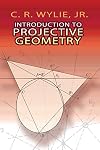
This introductory 1970 text offers two broad paths by which to discover the theoretical realm of plane projective geometry. A profusion of over 800 exercises are present with answers to the odd-numbered ones in the back. Combine this with thorough presentation of preliminary material for chapters well-seasoned with worked proofs and examples and you have a self-contained book that is ideal for self-study. Or, either of the two major portions of the book could serve as the text for an show more undergraduate course.
Initially, the reader encounters a historical review of the development of elementary ideas of three-dimensional perspective geometry and the development of basic plane perspective geometry through such steps as the image and object planes suggested by rabattement. Then, the first major portion of the book occurs over three chapters. This is a development of analytic projective geometry by extending planar Euclidean geometry through such ideas as ideal points and lines. In order to provide the underpinnings to conics, cross ratios, perspectivities, and more this portion includes the basics of matrix theory and linear algebra. This analytical approach concludes with linear transformations and a group theory introduction to support investigation of the projective group and its subgroups. Completing this portion covers for the reader fundamentals of projective geometry, including Theorems of Desargues and Pappus.
The next three chapters are the second and final, major portion of the book. This portion presents the same ideas as the first, but by through an axiomatic approach. Augmenting this portion is an introduction to field theory which allows, among other topics, the discussion of an isomorphism between the field of the complex plane and the points of an arbitrary line. The final two chapters introduce the concept of a metric into the projective plane in order to obtain elliptic and hyperbolic geometries. (Interesting to me, I would have expected based on earlier chapters an introduction to measure theory in order to motivate the definition of point-to-point distance as a theoretically sound starting point.)
Adding to this complete, two-part introduction to projective geometry is one appendix on determinant fundamentals and another supporting investigation of an alternative geometry for which the Theorem of Desargues does not hold. This makes for an intriguing and illustrative conclusion to a classic text. show less
Initially, the reader encounters a historical review of the development of elementary ideas of three-dimensional perspective geometry and the development of basic plane perspective geometry through such steps as the image and object planes suggested by rabattement. Then, the first major portion of the book occurs over three chapters. This is a development of analytic projective geometry by extending planar Euclidean geometry through such ideas as ideal points and lines. In order to provide the underpinnings to conics, cross ratios, perspectivities, and more this portion includes the basics of matrix theory and linear algebra. This analytical approach concludes with linear transformations and a group theory introduction to support investigation of the projective group and its subgroups. Completing this portion covers for the reader fundamentals of projective geometry, including Theorems of Desargues and Pappus.
The next three chapters are the second and final, major portion of the book. This portion presents the same ideas as the first, but by through an axiomatic approach. Augmenting this portion is an introduction to field theory which allows, among other topics, the discussion of an isomorphism between the field of the complex plane and the points of an arbitrary line. The final two chapters introduce the concept of a metric into the projective plane in order to obtain elliptic and hyperbolic geometries. (Interesting to me, I would have expected based on earlier chapters an introduction to measure theory in order to motivate the definition of point-to-point distance as a theoretically sound starting point.)
Adding to this complete, two-part introduction to projective geometry is one appendix on determinant fundamentals and another supporting investigation of an alternative geometry for which the Theorem of Desargues does not hold. This makes for an intriguing and illustrative conclusion to a classic text. show less
The book provides 100 puzzles in logic and basic mathematics, the sort you might find in an algebra class. They are overly simplistic, perhaps suited for the high-schooler.

Excellent text on undergraduate differential equations.
This book explores the principles of Euclidean and non-Euclidean geometry.
Jan 20, 2026Spanish
You May Also Like


Statistics
- Works
- 11
- Members
- 465
- Popularity
- #52,882
- Rating
- 3.8
- Reviews
- 4
- ISBNs
- 22
- Languages
- 1