

Marilyn McCord Adams
Author of The Problem of Evil
About the Author
Marilyn McCord Adams is Regius Professor of Divinity at Oxford University, Canon at Christ Church Cathedral, and an ordained Episcopal priest
Image credit: Credit: Kaihsu Tai, 2006
Series
Works by Marilyn McCord Adams
Some Later Medieval Theories of the Eucharist: Thomas Aquinas, Gilles of Rome, Duns Scotus, and William Ockham (2010) 24 copies
What Sort of Human Nature?: Medieval Philosophy and the Systematics of Christology (The Aquinas Lecture; 1999) (1999) 18 copies
William Ockham: Volume 1 1 copy
William Ockham: Volume 2 1 copy
Associated Works
God and the Philosophers: The Reconciliation of Faith and Reason (1994) — Contributor — 306 copies, 1 review
Predestination, God's Foreknowledge, and Future Contingents (1969) — Translator, some editions — 117 copies
The Cambridge History of Later Medieval Philosophy: From the Rediscovery of Aristotle to the Disintegration of Scholasticism, 1100-1600 (1982) — Contributor — 115 copies
Equal Rites: Lesbian and Gay Worship, Ceremonies and Celebrations (1995) — Contributor — 112 copies, 1 review
Our Selves, Our Souls and Bodies: Sexuality and the Household of God (1996) — Contributor — 96 copies
Gays and the Future of Anglicanism: Responses to the Windsor Report (2005) — Contributor — 44 copies
Oxford Readings in Philosophical Theology: Volume 1: Trinity, Incarnation, and Atonement (2009) — Contributor — 35 copies
Rationality, Religious Belief, and Moral Commitment: New Essays in the Philosophy of Religion (1986) — Contributor — 31 copies
Philosophy and the Christian Faith (University of Notre Dame Studies in the Philosophy of Religion, No. 5) (1988) — Contributor — 27 copies
Christian Holiness & Human Sexuality: A Study Guide for Episcopalians (2011) — Contributor — 12 copies
Aristotle and His Medieval Interpreters (Canadian Journal of Philosophy Supplementary Volume) (1992) — Contributor — 10 copies
Studies in Medieval Philosophy (Studies in Philosophy and the History of Philosophy) (1987) — Contributor — 9 copies
Radical Christian Voices and Practice: Essays in Honour of Christopher Rowland (2012) — Contributor — 9 copies
Philosophy and Theological Discourse (Claremont Studies in the Philosophy of Religion) (1997) — Contributor — 8 copies
Aquinas's Summa Theologiae: A Critical Guide (Cambridge Critical Guides) (2018) — Contributor — 5 copies
Tagged
Common Knowledge
- Birthdate
- 1943
- Gender
- female
- Education
- Professor of Philosophy, Rutgers University
- Relationships
- Adams, Robert Merrihew (husband)
- Nationality
- USA
- Associated Place (for map)
- USA
Members
Reviews
Horrendous Evils and the Goodness of God (Cornell Studies in the Philosophy of Religion) by Marilyn McCord Adams
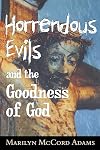
A philosophical treatise focusing primarily on the specific challenge of horrific evils and God's ability to still provide positive meaning to those who suffer them. The book does provide explanations of other philosophical perspectives but assumes a relatively decent handle on philosophical persons and ideas. The author draws much from the Scholastic philosopher-theologians and their immediate predecessors.
The author's descriptions of honor/shame societies, matters of holiness and show more impurity, etc. are quite interesting and do well at exposing the limitations of modern paradigms. The author's demonstration that God's "answer" to evil is found in the cross and God experiencing suffering is quite apt.
For those who understand philosophy, this book probably has value; for the rest of us, the value is more limited. show less
The author's descriptions of honor/shame societies, matters of holiness and show more impurity, etc. are quite interesting and do well at exposing the limitations of modern paradigms. The author's demonstration that God's "answer" to evil is found in the cross and God experiencing suffering is quite apt.
For those who understand philosophy, this book probably has value; for the rest of us, the value is more limited. show less
Horrendous Evils and the Goodness of God (Cornell Studies in the Philosophy of Religion) by Marilyn McCord Adams
This book began clearly and succintly, as I would expect from a book written from the analytic tradition. However, I felt that the later material were largely repetitive, was not as rigourous as I would have liked it to be and appealed too much to the discoveries of empirical psychology or social anthropology. I had hope that she would have performed more clarifying analysis of the concepts rather than unload loads of empirical facts. However, the bold introduction and incoporation of new show more moral concepts unprecendented in analytic moral philosophy (i.e. purity and defilement, honour and shame) to answer how evil can be overcomed deserves applause and praise, although it could have been done in a more rigourous fashion. But I truly benefitted and learned from her attempt at ingrafting these new moral concept into the analytics rather improverished moral framework. Thus, four stars for a creative and bold resolution of the problem of evil. show less
You May Also Like


Associated Authors
Statistics
- Works
- 13
- Also by
- 25
- Members
- 436
- Popularity
- #56,113
- Rating
- 3.9
- Reviews
- 3
- ISBNs
- 25