
Gene Ha
Author of Top 10: Book 1
About the Author
Image credit: Luigi Novi
Series
Works by Gene Ha
Top 10 #10 - Music for the Dead — Illustrator — 9 copies
Top 10 #09 - Rules of Engagement — Illustrator — 8 copies
Top 10 #02 - Blind Justice — Illustrator — 8 copies
Top 10 #03 - Internal Affairs — Illustrator — 7 copies
Top 10 #08 - The Overview — Illustrator — 7 copies
Top 10 #11 - His First Day on the New Job — Illustrator — 6 copies
Top 10 #12 - Court on the Street — Illustrator — 6 copies
Top 10 #04 - Eight Miles High — Illustrator — 6 copies
Top 10 #06 - You Better Watch Out, You Better Not Cry... — Illustrator — 6 copies
Associated Works
Transmetropolitan Vol. 10: One More Time (2004) — Cover artist, some editions — 810 copies, 10 reviews
Fantastic Four [1998] #516 — Cover artist — 3 copies
Fantastic Four [1998] #515 — Cover artist — 2 copies
Fantastic Four [1998] #514 — Cover artist — 2 copies
X-Men: The End [2006] #6 (of 6) — Cover artist — 1 copy
X-Men: The End [2006] #5 (of 6) — Cover artist — 1 copy
X-Men: The End [2006] #3 (of 6) — Cover artist — 1 copy
X-Men: The End [2006] #2 (of 6) — Cover artist — 1 copy
House of Mystery Vol. 2 # 35 — Illustrator — 1 copy
X-Men: The End [2006] #4 (of 6) — Cover artist — 1 copy
Tagged
Common Knowledge
- Birthdate
- 1969-08-19
- Gender
- male
- Nationality
- USA
- Birthplace
- Chicago, Illinois, USA
- Places of residence
- Berwyn, Illinois, USA
South Bend, Indiana, USA - Associated Place (for map)
- USA
Members
Reviews

Access a version of the below that includes illustrations on my blog.
This book wraps up the original twelve-issue Top 10 series by Alan Moore, Gene Ha, and Zander Cannon, and it's just as good as the first volume. My favorite part was probably what happened in the battle between the ultra-mice infecting Dust Devil's mother's apartment and the atom cats brought in by an exterminator: I laughed so hard when it was revealed their battles had triggered an multiversal crisis.
It's not all jokes, show more though. There's a surprisingly moving issue about a hyperspatial traffic accident that results in a collision between a tourist from Rigel and a piece in a gigantic galactic game. The two are fused together and slowly die while a couple cops can't do anything but watch.
The various plot threads from Book 1 are pulled together pretty comprehensively here, as we discover what links many seemingly disparate events together, and Top 10 shows their stuff in a couple devastating battles. I enjoyed the ongoing subplot about Shock-Headed Pete's racism against robots, though I guess it's easy to laugh about racism in this kind of context, where it's devoid of repercussions.
I was a little on the fence for the first couple issues of Top 10, like I said, but once I reached the end of Book 2, I knew I wanted to keep up with the series through all its future incarnations: prequel The Forty-Niners, sequels Beyond the Farthest Precinct and Top 10: Season Two, and spin-off Smax. I like these characters and this concept, and I want to see what else can be done with them. show less
This book wraps up the original twelve-issue Top 10 series by Alan Moore, Gene Ha, and Zander Cannon, and it's just as good as the first volume. My favorite part was probably what happened in the battle between the ultra-mice infecting Dust Devil's mother's apartment and the atom cats brought in by an exterminator: I laughed so hard when it was revealed their battles had triggered an multiversal crisis.
It's not all jokes, show more though. There's a surprisingly moving issue about a hyperspatial traffic accident that results in a collision between a tourist from Rigel and a piece in a gigantic galactic game. The two are fused together and slowly die while a couple cops can't do anything but watch.
The various plot threads from Book 1 are pulled together pretty comprehensively here, as we discover what links many seemingly disparate events together, and Top 10 shows their stuff in a couple devastating battles. I enjoyed the ongoing subplot about Shock-Headed Pete's racism against robots, though I guess it's easy to laugh about racism in this kind of context, where it's devoid of repercussions.
I was a little on the fence for the first couple issues of Top 10, like I said, but once I reached the end of Book 2, I knew I wanted to keep up with the series through all its future incarnations: prequel The Forty-Niners, sequels Beyond the Farthest Precinct and Top 10: Season Two, and spin-off Smax. I like these characters and this concept, and I want to see what else can be done with them. show less

This is branded as a Wonder Woman comic, but Wonder Woman does not appear here. It goes back to the origins of the Amazons, exploring how the tribe of warrior women that ultimately gave birth to Wonder Woman came into existence. Skimming a timeline of DC history, I can see this ties together and dramatizes some preexisting material, but it totally stands on its own, and doesn't feel like a continuity patch or origin story. Indeed, the greatest thing you can say about it (and I speak this as show more someone who reads a lot of tie-in and franchise fiction) is that it transcends its origins as a tie-in comic. I would feel comfortable handing this to someone who doesn't enjoy superhero comics but does like graphic novels and wants to read a bold, dynamic take on Greek mythology, because that's what this is. It's not a rewriting of George Pérez (or whomever), it's a new myth designed to take its place among old ones.
The story starts with the Greek goddesses, who reach their breaking point with the ways men treat women, but find the gods unwilling to do anything about it, and so take things into their own hands. It then follows the doings of the gods, especially Hera, who refuses to overtly move against her husband's will, in parallel with the rise of the Amazon tribes, and a would-be human midwife who ends up encountering the Amazons as they travel across the world slaughtering men who hurt women, and then into a war where the gods attempt to eliminate the Amazons. It's an epic story, but the presence of Hippolyta, the midwife, keeps it grounded; I enjoyed her trajectory very much.
More importantly, though, writer Kelly Sue DeConnick has three top-notch artistic collaborators here. Phil Jimenez's work I honestly don't know that well (aside from event comics like Infinite Crisis and Dark Cybertron, which rarely showcase an artist at their best), but he had a well-regarded run as a writer and artist on Wonder Woman; here, he turns in some brilliant and beautiful two-page spreads, one of jars(!), but in particular, a few depicting Hippolyta's desperate pursuit of a lost infant. Gorgeous, heartbreaking stuff. Gene Ha I've liked since his Top Ten days, but this is probably career best work for him, his attention to character really capturing the struggle and emotions of Hippolyta as she seeks to become an Amazon. And Nicola Scott I've thought a solid artist since her debut on Birds of Prey; here, she knocks it out of the park with the war between the Amazons and the gods. For all three artists, the art is beautifully colored, and the deluxe hardcover collection really shows it off to its utmost; I don't always buy Hugo finalists outside of the category of Best Novel, but I am so glad I'm not reading this comic on my Kindle Fire.
If I had a complaint, it would be that I found the parameters of Hippolyta's key choice in the last issue kind of confusing and rushed, but I'm sure on a reread (this is a tough book to read, but not in a bad way; sometimes it's just nice to read a comic that makes you work a little harder than normal) it would hold up fine. The backmatter tease two more sets of three chapters, but even if we don't get a trilogy of trilogies for Wonder Woman Historia, this will hold up as a tremendous work about what men do to women, and what women do to get away from it. show less
The story starts with the Greek goddesses, who reach their breaking point with the ways men treat women, but find the gods unwilling to do anything about it, and so take things into their own hands. It then follows the doings of the gods, especially Hera, who refuses to overtly move against her husband's will, in parallel with the rise of the Amazon tribes, and a would-be human midwife who ends up encountering the Amazons as they travel across the world slaughtering men who hurt women, and then into a war where the gods attempt to eliminate the Amazons. It's an epic story, but the presence of Hippolyta, the midwife, keeps it grounded; I enjoyed her trajectory very much.
More importantly, though, writer Kelly Sue DeConnick has three top-notch artistic collaborators here. Phil Jimenez's work I honestly don't know that well (aside from event comics like Infinite Crisis and Dark Cybertron, which rarely showcase an artist at their best), but he had a well-regarded run as a writer and artist on Wonder Woman; here, he turns in some brilliant and beautiful two-page spreads, one of jars(!), but in particular, a few depicting Hippolyta's desperate pursuit of a lost infant. Gorgeous, heartbreaking stuff. Gene Ha I've liked since his Top Ten days, but this is probably career best work for him, his attention to character really capturing the struggle and emotions of Hippolyta as she seeks to become an Amazon. And Nicola Scott I've thought a solid artist since her debut on Birds of Prey; here, she knocks it out of the park with the war between the Amazons and the gods. For all three artists, the art is beautifully colored, and the deluxe hardcover collection really shows it off to its utmost; I don't always buy Hugo finalists outside of the category of Best Novel, but I am so glad I'm not reading this comic on my Kindle Fire.
If I had a complaint, it would be that I found the parameters of Hippolyta's key choice in the last issue kind of confusing and rushed, but I'm sure on a reread (this is a tough book to read, but not in a bad way; sometimes it's just nice to read a comic that makes you work a little harder than normal) it would hold up fine. The backmatter tease two more sets of three chapters, but even if we don't get a trilogy of trilogies for Wonder Woman Historia, this will hold up as a tremendous work about what men do to women, and what women do to get away from it. show less

Access a version of the below that includes illustrations on my blog.
This is a weird book, no doubt about it. A rock musician that Robin's really into commits a crime, or seems to, Batman decides the team will investigate, as a favor to Robin. It turns out that Batman utterly despises rock music, and he and Robin (quite temporarily) split up. It also turns out that in additional to homicidal maniacs (right down the hall from them, in fact), Arkham Asylum houses rock managers who did too much show more drugs. Also also: the ghost of Elvis Presley, but blond, and only ever referred to as "God"!
Yet... I cannot imagine a better story of Batman and rock music. The weirdness of the story doesn't bother me, because it's operating by its own rules; this is a heightened world where rock music is powerful, where it instigates riots and sweeps people up at the drop of a beat. It's weird and kind of mystical without being magical or fantastical. People can be hypnotized by it, and terrible crimes can be committed by its adherents, all because of the music. It can do great good, but also great evil, and people will do anything to harness its power. You might now be saying, "this world sounds an awful lot like our world." That's the point!
Of course Batman hates rock music, then. Even at its best, it's disorderly, it's suspect. You don't need the scene where young Bruce Wayne is told to turn off that rock music, because it's time to go to the theatre, to make him hate it. Rock is about changing the world, but through disorder. It's accomplishing what Batman stands for the most, through means that are utterly alien to him.
I should also say that I really liked the look of Gene Ha's art, though his storytelling was often confusing. He draws Batman like a guy in costume, if that makes sense; you can tell his suit is something he's wearing, especially his cowl, not something that magically molds into his body. I don't think that approach would work for every Batman story (it's hard to imagine it in my next read, Batgirl: Year One, for example), but it is the right approach for this one, a story which emphasizes the fragility of who Batman is and what he does.
Batman "Year One" Stories: « Previous in sequence | Next in sequence » show less
This is a weird book, no doubt about it. A rock musician that Robin's really into commits a crime, or seems to, Batman decides the team will investigate, as a favor to Robin. It turns out that Batman utterly despises rock music, and he and Robin (quite temporarily) split up. It also turns out that in additional to homicidal maniacs (right down the hall from them, in fact), Arkham Asylum houses rock managers who did too much show more drugs. Also also: the ghost of Elvis Presley, but blond, and only ever referred to as "God"!
Yet... I cannot imagine a better story of Batman and rock music. The weirdness of the story doesn't bother me, because it's operating by its own rules; this is a heightened world where rock music is powerful, where it instigates riots and sweeps people up at the drop of a beat. It's weird and kind of mystical without being magical or fantastical. People can be hypnotized by it, and terrible crimes can be committed by its adherents, all because of the music. It can do great good, but also great evil, and people will do anything to harness its power. You might now be saying, "this world sounds an awful lot like our world." That's the point!
Of course Batman hates rock music, then. Even at its best, it's disorderly, it's suspect. You don't need the scene where young Bruce Wayne is told to turn off that rock music, because it's time to go to the theatre, to make him hate it. Rock is about changing the world, but through disorder. It's accomplishing what Batman stands for the most, through means that are utterly alien to him.
I should also say that I really liked the look of Gene Ha's art, though his storytelling was often confusing. He draws Batman like a guy in costume, if that makes sense; you can tell his suit is something he's wearing, especially his cowl, not something that magically molds into his body. I don't think that approach would work for every Batman story (it's hard to imagine it in my next read, Batgirl: Year One, for example), but it is the right approach for this one, a story which emphasizes the fragility of who Batman is and what he does.
Batman "Year One" Stories: « Previous in sequence | Next in sequence » show less
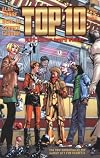
This is certainly in the "guilty pleasure" category, not because it's not done really well (it is) but because it's hard to explain why it would be worth doing. As many many people have pointed out, it can pretty much be summed up as "Hill Street Blues meets Astro City," that is, it's a cop show set in a city where everyone is a superhero (or a robot, alien, or Godzilla). The sight of Alan Moore deciding to do this, presumably stoned out of his mind and giggling fit to die, would make a show more pretty entertaining comic too. Anyway, it goes without saying that Moore has done a fair job of inventing all the superheroes that everyone else forgot to invent and matching them up with various cop-show stereotypes... but typically for him, in the middle of this kind of pointless exercise, he sneaks in an image that made me just stare and cry: Hyperdog, the hero who looks like a guy with a dog's head but is really a dog who sits inside a life-sized human puppet because it makes him look cool. A lot of the credit goes to the artists, who make the whole thing look kind of lush and crunchy. show less
Lists
Awards


You May Also Like


Associated Authors
Statistics
- Works
- 45
- Also by
- 46
- Members
- 3,384
- Popularity
- #7,531
- Rating
- 4.0
- Reviews
- 81
- ISBNs
- 68
- Languages
- 7
- Favorited
- 1