
Douglas Gwyn
Author of Apocalypse of the Word: The Life and Message of George Fox (1624-1691)
About the Author
Image credit: First Friends Meeting
Works by Douglas Gwyn
A Sustainable Life: Quaker Faith and Practice in the Renewal of Creation (2014) 91 copies, 5 reviews
Pendle Hill, A Place to Be and Become: Reflections on the First Ninety Years (2020) 30 copies, 5 reviews
The Anti-War: Peace Finds the Purpose of a Peculiar People; Militant Peacemaking in the Manner of Friends (2016) 25 copies, 3 reviews
Tagged
Common Knowledge
- Gender
- male
- Nationality
- USA
- Places of residence
- Pennsylvania, USA
- Associated Place (for map)
- Pennsylvania, USA
Members
Reviews

Quakers are often challenged when people ask us what we believe. Are we Christians? Some Friends would say yes, some no, and many would hesitate – it depends what you mean by “Christian.” Doug Gwyn explores the different stances Quakers have assumed in relation to Christianity, from the unique “primitive Christianity revived” of early Friends, through the foundationist, Conservative, ecumenical, interfaith, universalist, and nontheist positions of different Quakers today. Each of show more these perspectives makes a contribution to the larger Quaker community, but Gwyn also offers queries testing the limits of each and inviting readers to consider how we are “present-day pioneers in a stream of radical hospitality.” Discussion questions included. show less
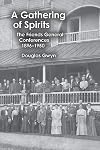
This sweeping book tells about the development of Friends General Conference up to 1950, primarily through the lens of the Conferences. One central motif is that these biennial gatherings renewed the courage and resolve of Friends to face the daunting disappointments the first half of the 20th century. Modernity promised great advances in human society and no group was more confident of progress that FGC Friends at the end of the 19th and beginning of the 20th centuries. Through the show more conferences, the melancholy of two world wars, the capitalist debacle of the Great Depression, and stubborn blights of American racism were turned into the spleen of renewed hope and activism, as friends gather together to learn, network, and find new reasons for hope. Gwyn characterizes the first 50 years of the conferences as FGC's "heroic era". show less
Gwyn writes this pamphlet to examine and challenge the current range of perspectives on Christ among the liberal unprogrammed branch of Quakers today. He characterizes these various perspectives along a spectrum from clearly Christian Friends through ecumenical and interfaith Friends (where he includes "hybridized" faiths combining some elements of Christianity and any other tradition) to "Universalist and nontheist Friends." He then poses questions to each group about what they can say show more about Christ. The point seems to be not only to challenge Christian Friends to clarify their understanding of and encounter with Christ, but also to call back the strayers to the Quaker tradition of Christianity.
There are several problems of confusion and misrepresentation in this, among them the conflating of universalists with nontheists, no explanation at all of what Quaker universalists are, and no clarification of any distinction between nontheists and atheists. He asserts that universalists and nontheists have an incorrect and prejudiced stereotype of Christians, and it seems apparent that he has a comparable stereotyped view of universalists and nontheists. Such stereotyped views are likely when people do not listen well to each other.
Gwyn includes various asides that add to the reader's confusion, but his point emerges, calling Friends to claim and learn to explain Quaker Christianity, as the true Quaker faith. Gwyn presents, from the heart, an important point of view on a controversial issue, but his arguments about the various views are not clearly thought out or carefully written. show less
There are several problems of confusion and misrepresentation in this, among them the conflating of universalists with nontheists, no explanation at all of what Quaker universalists are, and no clarification of any distinction between nontheists and atheists. He asserts that universalists and nontheists have an incorrect and prejudiced stereotype of Christians, and it seems apparent that he has a comparable stereotyped view of universalists and nontheists. Such stereotyped views are likely when people do not listen well to each other.
Gwyn includes various asides that add to the reader's confusion, but his point emerges, calling Friends to claim and learn to explain Quaker Christianity, as the true Quaker faith. Gwyn presents, from the heart, an important point of view on a controversial issue, but his arguments about the various views are not clearly thought out or carefully written. show less

The book compares "covenant", uniting people under the care of a transcendent God, and "contract", uniting them through secular visions of self-interest. It is part of a trilogy on early Quaker history, contributing to understanding early Friends and how the movement changed in the first decades. The author outlines the highly distinctive nature of the Quaker covenant of light and how that was transformed within a generation into a more worldly contractual understanding. It is also a call to show more Quakers today to recover a sense of covenant for the journey ahead." show less
You May Also Like


Associated Authors
Statistics
- Works
- 38
- Members
- 812
- Popularity
- #31,426
- Rating
- 4.2
- Reviews
- 44
- ISBNs
- 27