
Ying Chang Compestine
Author of The Runaway Wok: A Chinese New Year Tale
About the Author
Ying Chang Compestine, a native of the People's Republic of China, teaches cooking at the Boulder Heart Institute and at various cooking schools across the country. A frequent contributor to Cooking Light, Men's Health, and Self magazines
Image credit: Author Ying Chang Compestine speaking at the Asian Festival of Children's Content By Kushnerkali - Own work, CC BY-SA 4.0, https://commons.wikimedia.org/w/index.php?curid=60969599
Works by Ying Chang Compestine
A Banquet for Hungry Ghosts: A Collection of Deliciously Frightening Tales (2009) 103 copies, 6 reviews
Tagged
Common Knowledge
- Legal name
- Compestine, Ying Chang
- Birthdate
- 1963-03-08
- Gender
- female
- Relationships
- Compestine, Vinson (son)
- Nationality
- China
- Birthplace
- Wuhan, China
- Places of residence
- East Bay, California, USA
- Associated Place (for map)
- China
Members
Reviews

When Ming's parents send him to the market, to trade their last eggs for some rice, he returns home with a rusty old wok instead - a seeming disaster with a surprise outcome. For the wok isn't just any old piece of cooking ware, but a magical object, and after being washed and shined, sets out to provide all the food, toys and games, and money that Ming's family, and all their poor neighbors in Beijing, need...
Unlike some of the other reviewers who rated this poorly, I was not offended by show more the "take from the rich and give to the poor" theme here, as it is a common one in many folk traditions - although a story for the Chinese New Year, The Runaway Wok is based on a Danish folktale, The Talking Pot - and does not rely on thievery (as has been claimed) to redistribute wealth, so much as fate. Ming and his family, after all, aren't the ones taking from the greedy man and his family, the wok - a magical object, uncontrolled by any human being, whose actions are meant to be impartial - is, dealing out both reward and punishment. Whether one thinks this punishment is too harsh or not, to describe what happens here as "theft" is to miss the point, incorrectly painting this as a "Robin Hood" story, when it is more a tale of cosmic justice.
All that said, I still found myself mostly unmoved by this second Chinese New Year's story from Ying Chang Compestine, probably because I was comparing it to her first, The Runaway Rice Cake. In that story, an impoverished human family is rewarded for their generosity - their willingness to sacrifice their own comfort, to aid another in greater need - and the spirit of community that this engendered. Here, it just seems to be dumb luck, and while that sort of story has its place, the good fortune at the end didn't feel as satisfying, as a result. Still, tastes vary, and young readers looking for stories for Chinese New Year might still want to take a look at this one. show less
Unlike some of the other reviewers who rated this poorly, I was not offended by show more the "take from the rich and give to the poor" theme here, as it is a common one in many folk traditions - although a story for the Chinese New Year, The Runaway Wok is based on a Danish folktale, The Talking Pot - and does not rely on thievery (as has been claimed) to redistribute wealth, so much as fate. Ming and his family, after all, aren't the ones taking from the greedy man and his family, the wok - a magical object, uncontrolled by any human being, whose actions are meant to be impartial - is, dealing out both reward and punishment. Whether one thinks this punishment is too harsh or not, to describe what happens here as "theft" is to miss the point, incorrectly painting this as a "Robin Hood" story, when it is more a tale of cosmic justice.
All that said, I still found myself mostly unmoved by this second Chinese New Year's story from Ying Chang Compestine, probably because I was comparing it to her first, The Runaway Rice Cake. In that story, an impoverished human family is rewarded for their generosity - their willingness to sacrifice their own comfort, to aid another in greater need - and the spirit of community that this engendered. Here, it just seems to be dumb luck, and while that sort of story has its place, the good fortune at the end didn't feel as satisfying, as a result. Still, tastes vary, and young readers looking for stories for Chinese New Year might still want to take a look at this one. show less

Although suffering from the effects of a year of drought, and the food shortages that followed it, the Chang family prepares for the New Year's celebration as best they can in this heartwarming holiday picture-book, tending to their Kitchen God's altar, and using the last of their rice flour to cook one single nián-gão, or New Year's cake. When the nián-gão jumps out of the pan, however, and takes off with a shout of "Ai yo! I don't think so!," the Changs immediately give chase, pursuing show more the fleeing pastry through the village, until they all, pursued and pursuers, collide with an elderly woman, unsteady on her feet because of hunger. Will the rebellious cake relent, in the face of true need? Will the Changs, with their three hungry boys, share what they have?
The answer to both of these questions is yes, making this Chinese New year's tale, and its conclusion, in which generosity and virtue are amply rewarded, both an engaging story, and a gentle reminder of what is truly important, at this pivotal moment in the year. I appreciated the similarities here, both to the runaway Gingerbread Man tale-type (it's a pancake, in many cultures), and to the Stone Soup story, with its group of villagers that pool what they have, and end up with more than they expected. The artwork, done in acrylic by Tungwai Chau, is colorful and appealing. All in all, a solidly engaging story, one I recommend to anyone looking for children's books with a Chinese New Year's theme. show less
The answer to both of these questions is yes, making this Chinese New year's tale, and its conclusion, in which generosity and virtue are amply rewarded, both an engaging story, and a gentle reminder of what is truly important, at this pivotal moment in the year. I appreciated the similarities here, both to the runaway Gingerbread Man tale-type (it's a pancake, in many cultures), and to the Stone Soup story, with its group of villagers that pool what they have, and end up with more than they expected. The artwork, done in acrylic by Tungwai Chau, is colorful and appealing. All in all, a solidly engaging story, one I recommend to anyone looking for children's books with a Chinese New Year's theme. show less
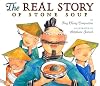
Retelling: This story is narrated by a man who believes that he lived the original story of stone soup. He begins by declaring that there were no tricks involved in the original story and goes on to explain how he discovered stones that turn to soup ingredients. His narration tells one story, but the pictures tell another. The pictures show how he was lazy and disliked by the nephews that worked for him, and how they tricked him into believing they could make soup from stones, when they were show more adding real ingredients all along.
Thoughts and Feelings: I appreciated the effective use of two kinds of irony in this tale. The readers had knowledge about the original tale that the main character did not, and the three servants had knowledge of the "real" tale, that the narrator did not.
The relationship between this tale and the original tale isn't obvious. I think this story is an example of how people might behave when one member of the community isn't making a contribution (the way the original tale celebrates) and is abusing those who are. show less
Thoughts and Feelings: I appreciated the effective use of two kinds of irony in this tale. The readers had knowledge about the original tale that the main character did not, and the three servants had knowledge of the "real" tale, that the narrator did not.
The relationship between this tale and the original tale isn't obvious. I think this story is an example of how people might behave when one member of the community isn't making a contribution (the way the original tale celebrates) and is abusing those who are. show less
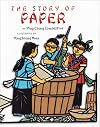
Three boys constantly get in trouble at school when they have to write in the dirt. They find all of the ants, grasshoppers, and worms in the dirt far more interesting than their assignments, and they hate having to walk around with a note from their teacher written on their hands where everyone can see. The boys work together to create a solution to their problem at school. They use everything they can find lying around to create what will become paper. Everyone is impressed with their new show more invention, and the teacher wants to bring it to the Emperor. The story is mostly fictional but details the actual steps of how paper was first made. It is a cute story about kids working together to invent something new to fix an existing problem. show less
Lists
Awards


You May Also Like


Associated Authors
Statistics
- Works
- 27
- Members
- 2,898
- Popularity
- #8,841
- Rating
- 3.9
- Reviews
- 148
- ISBNs
- 104
- Languages
- 3
- Favorited
- 1