

Frank Luntz
Author of Words That Work: It's Not What You Say, It's What People Hear
About the Author
Image credit: Photo credit: Donna Svennevik/Hyperion
Works by Frank Luntz
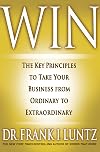
Win: The Key Principles to Take Your Business from Ordinary to Extraordinary (2011) 93 copies, 1 review
What Americans Really Want...Really: The Truth About Our Hopes, Dreams, and Fears (2009) 80 copies, 1 review
Candidates, Consultants and Campaigns: The Style and Substance of American Electioneering (1988) 8 copies
La palabra es poder : lo importante no es lo que dices sino lo que la gente entiende (2011) 3 copies
America 2020 1 copy
The Accidental President 1 copy
Tagged
Common Knowledge
- Birthdate
- 1962-02-23
- Gender
- male
- Education
- University of Pennsylvania
University of Oxford - Occupations
- Republican party strategist
consultant - Nationality
- USA
- Birthplace
- West Hartford, Connecticut, USA
- Places of residence
- West Hartford, Connecticut, USA
England, UK - Associated Place (for map)
- USA
Members
Reviews
I really do not recall ever meeting "Dr Luntz", but I do think he contacted me when I was at Claremont. I remember a guy claiming he was associated with Lee Atwater, and he asked about my seminar on "Progress through Linguistics".
Dr. Luntz is now a very rich man working as one of the highest-paid "consultants" in the world. His clients are very rich plutocrats. He has devoted his life, and this book, to getting rich, but not in a manner which adds to wealth. He chose a twisted path and show more serves those who have destroyed prosperity. This is "stealing" and calling it "winning"; of course, it is still stealing.
On each page of this anecdotal self-promotion by Luntz, I am much reminded of Stockman's admission that during his service to the Roger Ailes/ Reagan administration--Luntz in tow--they had no facts at all behind the purely imaginative description of rich plutocrats as "job creators". That's pure Luntz.
This book reflects his wholesale commitment to the more fraudulent dimensions of word-smithery. Like all "successful" con-men, Luntz comes through this text as a likeable, personable man, who goes to the trouble of trying to get you to trust him. Do you see the flags?
As he repeatedly will tell us, Dr Luntz is a real "regular" on "Fox News". He is in fact, one of its most cherished authorities on developing its talking points, all designed to construct (fabricate) trust. He frames the issues for the largest media monopoly in the world -- the Murdock empire.
Much of Luntz' work and his value as a linguist, lies in his use of focus-groups to sift through vocabularies to find the perfect words. He presents many examples of "effective" words used by persuaders. While the "data" is presented in anecdotal fashion, with personable accounts that make the book persuasive, it is real data. Only rarely is actual candor exhibited -- as when he claims that he "might get in trouble with Rupert, Roger Ailes, and my friends at Fox News {sic} for putting this in print, but if you are watching only one cable news station and rejecting every other perspective, you're limiting your potential to win." [47] He admits he tried to bribe working people to give him access and more privileges over other customers at the expense of others. And he does so repeatedly, under the delusion that to do so reflects his perfectionism and "commitment to doing things right", although it is the opposite. [135]
In this work, we find valuable truths and linguistic facts, presented with unrelenting self-promotion and a gaping indifference to the actual substance. The author is utterly unaware of the impacts of his "lessons". Winning, after all, is all. This work, and Dr. Luntz, is breath-takingly indifferent to the impact which his "winning" has had on society and the real world. Most of us have a broader, more long-term view, of what "winning" is.
In this work, we read the cruel "how to" of how the wealthy plutocracy destroyed America in the decade of 2000s. Since the 1987 rise of neo-conservative "policies" packaged by Luntz, the feudal lords -- many of them interviewed by Luntz, who is "consulted" by them -- have waged a war against the middle class, and they "won" their war.
Of course, if you have gobs of money, you can buy this stuff, and that is the main thing you need to "win". That's what this book is all about.
Luntz offers this bizarre "KEY DEFINITIONS OF WINNING" as yet another gesture towards his subject:
- The ability to grasp the human dimension of every situation;
- the ability to know what questions to ask and when to ask them;
- the ability to see the challenge, and the solution, from every angle;
- the ability to communicate their vision passionately and persuasively;
- the ability to connect with others and create an enduring chemistry;
He follows the almost completely irrelevant list with anecdotes of famous people he has nailed for this book. None have anything helpful to say and none are remotely interested in helping others "win". His group of "winners" are not diverse, scientific, or even involved in building or creating wealth. A few are "leaders", but only because they got rich:
Mike Bloomberg, Arnold Schwarzenegger, Rupert Murdoch, Steve Wynn, Fred Smith, J. Crew, Gibson Guitar, Larry Bird, Jimmy Connors, Mike Richter, Roger Ailes, Don Imus.
Luntz tells stories supposedly illustrating his 9 Principles of Winning: People-focused/Positioning,Priority Identification,Proactive Approach,Problem Solving, Passion, Pragmatic/Practical, Partnership,Persuasion and Persistence. Few of his anecdotes illustrate any of these "principles" -- in fact his list is not helpful and none of the items are "principles". But that label is attractive, infers a mash-up of pragmatism and science, and...there you have it. There's one born every minute that will be fooled.
Luntz offers more than seventy "words that work". They are not "new" words, but they do re-frame reality so that the real world is suitably distorted for the type of "win" you achieve by getting away with a con.
The use of wiggling words may amuse, but almost never works in private one-on-one meetings with any informed expert, or your boss; it may work for public presentations to hundreds of colleagues; but it is ideally suited for television appearances that reach millions in quick sound bytes. Hello, "Fox News" -- the entertainment station that charges plutocrats to lie about liberals.
Luntz still works for Roger Ailes, the CEO of Fox News. This propaganda agency won the right to lie to the American people, in court. The media monopoly is not a "news" organization, yet it asserted and "won" the right to represent itself as such. It is funded by Murdock and linguistically-enabled by Luntz. It has destroyed "News" gathering and reporting in America. Genuine fact-gathering news reporters cannot compete in a monopolized (un-free) market with a wealthy conglomerate offering very entertaining lies.
The plutocracy which has destroyed the American middle class, can thank Dr. Luntz for his part in achieving victory in this Koch-and-Murdock declared war. They are the "winners". We planted the orchard, they picked the low-hanging fruit and burned the orchard. Why? Did they win? Really? show less
Dr. Luntz is now a very rich man working as one of the highest-paid "consultants" in the world. His clients are very rich plutocrats. He has devoted his life, and this book, to getting rich, but not in a manner which adds to wealth. He chose a twisted path and show more serves those who have destroyed prosperity. This is "stealing" and calling it "winning"; of course, it is still stealing.
On each page of this anecdotal self-promotion by Luntz, I am much reminded of Stockman's admission that during his service to the Roger Ailes/ Reagan administration--Luntz in tow--they had no facts at all behind the purely imaginative description of rich plutocrats as "job creators". That's pure Luntz.
This book reflects his wholesale commitment to the more fraudulent dimensions of word-smithery. Like all "successful" con-men, Luntz comes through this text as a likeable, personable man, who goes to the trouble of trying to get you to trust him. Do you see the flags?
As he repeatedly will tell us, Dr Luntz is a real "regular" on "Fox News". He is in fact, one of its most cherished authorities on developing its talking points, all designed to construct (fabricate) trust. He frames the issues for the largest media monopoly in the world -- the Murdock empire.
Much of Luntz' work and his value as a linguist, lies in his use of focus-groups to sift through vocabularies to find the perfect words. He presents many examples of "effective" words used by persuaders. While the "data" is presented in anecdotal fashion, with personable accounts that make the book persuasive, it is real data. Only rarely is actual candor exhibited -- as when he claims that he "might get in trouble with Rupert, Roger Ailes, and my friends at Fox News {sic} for putting this in print, but if you are watching only one cable news station and rejecting every other perspective, you're limiting your potential to win." [47] He admits he tried to bribe working people to give him access and more privileges over other customers at the expense of others. And he does so repeatedly, under the delusion that to do so reflects his perfectionism and "commitment to doing things right", although it is the opposite. [135]
In this work, we find valuable truths and linguistic facts, presented with unrelenting self-promotion and a gaping indifference to the actual substance. The author is utterly unaware of the impacts of his "lessons". Winning, after all, is all. This work, and Dr. Luntz, is breath-takingly indifferent to the impact which his "winning" has had on society and the real world. Most of us have a broader, more long-term view, of what "winning" is.
In this work, we read the cruel "how to" of how the wealthy plutocracy destroyed America in the decade of 2000s. Since the 1987 rise of neo-conservative "policies" packaged by Luntz, the feudal lords -- many of them interviewed by Luntz, who is "consulted" by them -- have waged a war against the middle class, and they "won" their war.
Of course, if you have gobs of money, you can buy this stuff, and that is the main thing you need to "win". That's what this book is all about.
Luntz offers this bizarre "KEY DEFINITIONS OF WINNING" as yet another gesture towards his subject:
- The ability to grasp the human dimension of every situation;
- the ability to know what questions to ask and when to ask them;
- the ability to see the challenge, and the solution, from every angle;
- the ability to communicate their vision passionately and persuasively;
- the ability to connect with others and create an enduring chemistry;
He follows the almost completely irrelevant list with anecdotes of famous people he has nailed for this book. None have anything helpful to say and none are remotely interested in helping others "win". His group of "winners" are not diverse, scientific, or even involved in building or creating wealth. A few are "leaders", but only because they got rich:
Mike Bloomberg, Arnold Schwarzenegger, Rupert Murdoch, Steve Wynn, Fred Smith, J. Crew, Gibson Guitar, Larry Bird, Jimmy Connors, Mike Richter, Roger Ailes, Don Imus.
Luntz tells stories supposedly illustrating his 9 Principles of Winning: People-focused/Positioning,Priority Identification,Proactive Approach,Problem Solving, Passion, Pragmatic/Practical, Partnership,Persuasion and Persistence. Few of his anecdotes illustrate any of these "principles" -- in fact his list is not helpful and none of the items are "principles". But that label is attractive, infers a mash-up of pragmatism and science, and...there you have it. There's one born every minute that will be fooled.
Luntz offers more than seventy "words that work". They are not "new" words, but they do re-frame reality so that the real world is suitably distorted for the type of "win" you achieve by getting away with a con.
The use of wiggling words may amuse, but almost never works in private one-on-one meetings with any informed expert, or your boss; it may work for public presentations to hundreds of colleagues; but it is ideally suited for television appearances that reach millions in quick sound bytes. Hello, "Fox News" -- the entertainment station that charges plutocrats to lie about liberals.
Luntz still works for Roger Ailes, the CEO of Fox News. This propaganda agency won the right to lie to the American people, in court. The media monopoly is not a "news" organization, yet it asserted and "won" the right to represent itself as such. It is funded by Murdock and linguistically-enabled by Luntz. It has destroyed "News" gathering and reporting in America. Genuine fact-gathering news reporters cannot compete in a monopolized (un-free) market with a wealthy conglomerate offering very entertaining lies.
The plutocracy which has destroyed the American middle class, can thank Dr. Luntz for his part in achieving victory in this Koch-and-Murdock declared war. They are the "winners". We planted the orchard, they picked the low-hanging fruit and burned the orchard. Why? Did they win? Really? show less
The world’s best message is ineffective if the person on the receiving end does not understand or relate to it.
It is a harsh standard. It is a message communicators ignore at their own peril. You can be brilliant, creative, even right, but your message will fall flat unless it touches the hearer’s prism of experience, beliefs, preconceptions and prejudices.
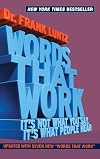
In Words that Work: It’s Not What You Say, It’s What People Hear, Frank Luntz offers insights into finding and using the right show more words to achieve your goals. The key to communication is to place yourself in the listener’s situation and understand his or her deepest thoughts and beliefs. What the listener perceives constitutes the listener’s reality.
Based on his experience as a political and corporate pollster he recommends 11 rules for effective communication:
1. Use small words.
2. Use short sentences.
3. Credibility is as important as philosophy.
4. Consistency matters.
5. Novelty: offer something new.
6. Sound and texture matter.
7. Speak aspirationally.
8. Visualize.
9. Ask a question.
10. Provide context and explain relevance.
11. Visual imagery matters.
Luntz does not stop there. In addition to an insightful discussion complete with illustrations from his professional experience of the 11 rules, he adds critical elaboration:
1. Never assume knowledge or awareness.
2. Get the order right.
3. Gender can obstruct understanding.
4. It’s about the children.
5. How you define determines how you are received.
If communicating is important to you, and who does not need to, then time spent reading Frank Luntz’s book will be well spent. We are all subject to the power of language. Words spell the difference between success and failure. The right words grant you an edge. The author says it all in his subtitle, “It’s not what you say—it’s what people hear.”
Penned by the Pointed Pundit
January 19, 2007
5:48:53 PM show less
It is a harsh standard. It is a message communicators ignore at their own peril. You can be brilliant, creative, even right, but your message will fall flat unless it touches the hearer’s prism of experience, beliefs, preconceptions and prejudices.
In Words that Work: It’s Not What You Say, It’s What People Hear, Frank Luntz offers insights into finding and using the right show more words to achieve your goals. The key to communication is to place yourself in the listener’s situation and understand his or her deepest thoughts and beliefs. What the listener perceives constitutes the listener’s reality.
Based on his experience as a political and corporate pollster he recommends 11 rules for effective communication:
1. Use small words.
2. Use short sentences.
3. Credibility is as important as philosophy.
4. Consistency matters.
5. Novelty: offer something new.
6. Sound and texture matter.
7. Speak aspirationally.
8. Visualize.
9. Ask a question.
10. Provide context and explain relevance.
11. Visual imagery matters.
Luntz does not stop there. In addition to an insightful discussion complete with illustrations from his professional experience of the 11 rules, he adds critical elaboration:
1. Never assume knowledge or awareness.
2. Get the order right.
3. Gender can obstruct understanding.
4. It’s about the children.
5. How you define determines how you are received.
If communicating is important to you, and who does not need to, then time spent reading Frank Luntz’s book will be well spent. We are all subject to the power of language. Words spell the difference between success and failure. The right words grant you an edge. The author says it all in his subtitle, “It’s not what you say—it’s what people hear.”
Penned by the Pointed Pundit
January 19, 2007
5:48:53 PM show less
While much of this book (not unsurprisingly) focused on political language, there was a solid chunk devoted to business language and general effective writing.
And, regardless of what you think of Luntz as a guy, this is an amazing book when it comes to effective communication.
And, regardless of what you think of Luntz as a guy, this is an amazing book when it comes to effective communication.
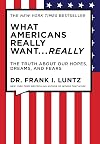
Dr. Frank I. Luntz draws on experience as a secret shopper, focus group runner, and consultant in industries as varied as automotive, financial services, and more. While much of this 2009 book talks about the rise of Obama, the wisdom from industry and of the American consumer has much broader value and keeps this work from being very dated. Certainly entrepreneurs and marketers will find much value here. There is sociological knowledge in the assessment of thoughts and motivations of the show more tech-savvy young and the politically important seniors. Luntz leads this all and summarizes to a family values and back-to-religion culmination that doesn't reach me while I very much appreciate his impressive insights into workings of the American consumer and voter. show less
Awards


You May Also Like


Associated Authors
Statistics
- Works
- 8
- Members
- 969
- Popularity
- #26,569
- Rating
- 3.7
- Reviews
- 9
- ISBNs
- 24
- Languages
- 1
- Favorited
- 1
