
Harry Beckwith
Author of Selling the Invisible: A Field Guide to Modern Marketing
About the Author
While at Stanford University, Harry Beckwith won the national collegiate journalism award, was named Oregon Law Review Editor-in-Chief, and graduated Phi Beta Kappa in 1972. He worked as a federal judicial clerk, a medical malpractice and personal injury trial attorney, legal counsel to the city of show more Portland, Oregon, and for an advertising agency. He currently works with twenty-three Fortune 500 companies and is a branding consultant. He has written numerous marketing books including Selling the Invisible, which was named one of the top ten business and management books of all time. (Bowker Author Biography) show less
Works by Harry Beckwith
Sellind the Invisible 1 copy
TË SHESËSH TË PADUKSHMEN 1 copy
Tagged
Common Knowledge
- Birthdate
- 1949
- Gender
- male
- Education
- Stanford University
- Organizations
- Beckwith Partners
- Places of residence
- Minneapolis, Minnesota, USA
- Associated Place (for map)
- Minnesota, USA
Members
Reviews
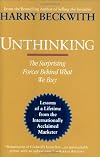
This was a very quick read. It reminded me of a lot of Malcolm Gladwell's work, which to me is pretty good. Harry Beckwith makes a compelling case with numerous examples and anecdotes to show that Americans and humans in general don't really think rationally when it comes to buying things. We follow trends, we like the familiar, but not the too familiar or it becomes boring.
In the book, Beckwith lists three main things we follow when buying things: Childhood, Culture and Eyes.
As a person show more that isn't a marketer, this book was interesting from the psychology standpoint, but I didn't really care about the tips for improving your brand or whatever. show less
In the book, Beckwith lists three main things we follow when buying things: Childhood, Culture and Eyes.
As a person show more that isn't a marketer, this book was interesting from the psychology standpoint, but I didn't really care about the tips for improving your brand or whatever. show less
This was interesting. The author breaks it down into three categories. We buy things because they remind us of childhood. We buy things because er.. it fits our culture. And we buy things because they appeal to our eyes. Childhood:We like to play and we like bright colors.Culture:Americans are drawn to loners, but we like to be a part of things. And we're basically optimistic.Eyes:We like pretty things. Which is ableist language, because he also includes 'smooth' and 'symmetrical' and things show more that you don't have to see to appreciate.There's some interesting tidbits in here, and I think it'd be interesting to try to write a book and market it with these things in mind.That said, I do have some issues with the book itself. He starts out talking about sports. Snoore. And he'll come back to sports now and again, too. And cars. And whenever he mentions sex, it's from the male point of view. Until I felt like every time he said 'you', and he said that a lot (which is also one of his points), he was talking to someone older and maler than me. In other words, not me.I think the book suffers for it, and he should've gotten a female coauthor or editor to really point these things out.At one point, he talks about how we all learned to spell the word 'geography'. Did you know there's a mnemonic for it? I didn't. I thought you just.. spelled it. It's not exactly the hardest word in the English dictionary. I wouldn't even put it in the top 100.He also seems obsessed with Nikes. Every third story, he seemed to come back to the stupid Nike shoes. Just how much Nike stock does this guy own?Also, here's a tip: If you're going to tell people to go to a website and enter a search term, well, you'd just better be darned sure that's going to work by the time your book goes to print. Because I got this book pretty hot off the press, and the result I got was "No result matches your query". So.I give it 3 stars for the interesting info in here and for the readability. But it definitely lost 2 for being sexist. Well, maybe 1.5 for sexist and .5 for that search not working and other uncorrected typographical errors. show less
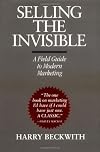
About a month ago, my boss asked me to order this book for her. She'd heard it was life-changing. Every day at lunch, she'd read a couple chapters, often commenting on what she'd learned. When she finished, she handed it to me, telling me that I needed to read it to prepare for the marketing we're about to start for our office. As luck would have it, the office closed the following day due to about eighteen inches of snow, so I got the chance to finish it pretty quickly.
Selling the Invisible show more is a quick read. It's chopped up into tiny sections, each summarized with a compact piece of advice at the end. I had some concerns about whether this book would be relevant to my work in a doctor's office. I shouldn't have worried. Beckwith's advice is applicable to just about every industry you could possibly imagine.
Reading the book, I learned a lot about how prospects think. I was surprised that I'd never thought about marketing this way before. I am, after all, a prospective client for a lot of services. I'd just never thought about what it was that made me choose which service to go with. Beckwith's advice is a lot of common sense, but it's likely things you haven't thought about before.
There's plenty of good information in here. You'll learn how to attract a client. How to keep a client. How not to scare a prospective client away. How to differentiate yourself from your competition. How to develop your brand. How to sell something based on promises alone. It's very useful as a starting point.
Really, the only problem I had with it is that it's seventeen years old. In this day and age, social media marketing is hugely important. More important in most industries, at least, than advertising in trade journals and on the radio. Because of that, I felt that a lot of the information, though good, was outdated. It would be interesting to see the book updated with information on where to start with online advertising, and what to do in terms of getting set up on social media.
But all in all, it's a solid introduction to the world of marketing for someone like myself, with no experience in selling anything. show less
Selling the Invisible show more is a quick read. It's chopped up into tiny sections, each summarized with a compact piece of advice at the end. I had some concerns about whether this book would be relevant to my work in a doctor's office. I shouldn't have worried. Beckwith's advice is applicable to just about every industry you could possibly imagine.
Reading the book, I learned a lot about how prospects think. I was surprised that I'd never thought about marketing this way before. I am, after all, a prospective client for a lot of services. I'd just never thought about what it was that made me choose which service to go with. Beckwith's advice is a lot of common sense, but it's likely things you haven't thought about before.
There's plenty of good information in here. You'll learn how to attract a client. How to keep a client. How not to scare a prospective client away. How to differentiate yourself from your competition. How to develop your brand. How to sell something based on promises alone. It's very useful as a starting point.
Really, the only problem I had with it is that it's seventeen years old. In this day and age, social media marketing is hugely important. More important in most industries, at least, than advertising in trade journals and on the radio. Because of that, I felt that a lot of the information, though good, was outdated. It would be interesting to see the book updated with information on where to start with online advertising, and what to do in terms of getting set up on social media.
But all in all, it's a solid introduction to the world of marketing for someone like myself, with no experience in selling anything. show less
Short book packed with ideas on how to sell services. Many of them generic, however there were a few I found very valuable. One that stood out for me was: You are selling a relationship not your expertise. The reason is that most of your prospects cannot evaluate your expertise so it is assumed. They can however, tell if the relationship is good. This is the kind of book I will listen to again.
Lists
My List (1)
Awards

You May Also Like


Associated Authors
Statistics
- Works
- 13
- Members
- 1,411
- Popularity
- #18,214
- Rating
- 3.8
- Reviews
- 14
- ISBNs
- 66
- Languages
- 8