
Geoffrey A. Moore
Author of Crossing the Chasm
About the Author
Geoffrey A. Moore is a managing director with TCG Advisors, a consulting firm specializing in strategy and business transformation services.
Image credit: By Matthew Langham - http://www.flickr.com/photos/silent-penguin/8668998/in/photostream/, CC BY 2.0, https://commons.wikimedia.org/w/index.php?curid=11265546
Works by Geoffrey A. Moore
Inside the Tornado: Marketing Strategies from Silicon Valley's Cutting Edge (1995) 543 copies, 4 reviews
Dealing with Darwin: How Great Companies Innovate at Every Phase of Their Evolution (2005) 213 copies, 1 review
Living on the Fault Line : Managing for Shareholder Value in the Age of the Internet (2000) 179 copies, 1 review
The Infinite Staircase: What the Universe Tells Us About Life, Ethics, and Mortality (2021) 21 copies, 1 review
Tagged
Common Knowledge
- Birthdate
- 1946-07-31
- Gender
- male
Members
Reviews
Crossing the Chasm, 3rd Edition: Marketing and Selling Disruptive Products to Mainstream Customers (Collins Business Essentials) by Geoffrey A. Moore
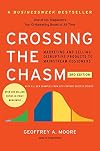
Most technology products begin with technologists playing in their environments. They then pick up steam when early visionaries figure out how to use it to expand their individual platforms and gain a competitive edge. However, many, if not most, products die there and never find their way to mainstream use. In this classic book, Geoffrey Moore explains why. The motives that drive these first two groups are different than the motives of mainstream customers, whom he divides into show more “pragmatists” and “conservatives.” He calls the gulf between these two as a “chasm” and in this book explores strategies for traversing this gap.
Professionally, I am a developer who brings biomedical software from mere idea into wider adoption in the marketplace. I’m well-aware of these phenomena that Moore describes and am always looking for wiser ways to engage users and communities of potential users. This book explains many dynamics I encounter on a daily basis, and it helps to put words on these trends. As a pioneer, I pride myself on being creative and innovative, but I also desperately want those new advances to be brought into effective use through hard-wrought gains. This book teaches me how to do both acts to achieve a greater benefit.
As evidenced by this book being in a third edition, Moore has found a wide audience for his instruction. Its message has continued through three-to-four decades, an eternity in the fast-paced world of high-tech. Although I’m hesitant to criticize a working product, to me, this work should receive a different subtitle: It is less a book about selling and marketing and more of a description of how high-tech works. Its examples have been updated through the years – making it easy to read – but its conceptual relevance has remained constant.
Marketers and salespeople are the obvious, stated audiences for this book. Nonetheless, anyone involved in making high-tech products, including engineers, managers, developers, and executives, should pay heed. It shines a light on the essential business challenges of bringing technological ideas to fruition and adoption. Modern society has achieved an effective track record of technological advancement, but improvements and efficiencies can always be gained. Moore shows us how by showing us how to think better. show less
Professionally, I am a developer who brings biomedical software from mere idea into wider adoption in the marketplace. I’m well-aware of these phenomena that Moore describes and am always looking for wiser ways to engage users and communities of potential users. This book explains many dynamics I encounter on a daily basis, and it helps to put words on these trends. As a pioneer, I pride myself on being creative and innovative, but I also desperately want those new advances to be brought into effective use through hard-wrought gains. This book teaches me how to do both acts to achieve a greater benefit.
As evidenced by this book being in a third edition, Moore has found a wide audience for his instruction. Its message has continued through three-to-four decades, an eternity in the fast-paced world of high-tech. Although I’m hesitant to criticize a working product, to me, this work should receive a different subtitle: It is less a book about selling and marketing and more of a description of how high-tech works. Its examples have been updated through the years – making it easy to read – but its conceptual relevance has remained constant.
Marketers and salespeople are the obvious, stated audiences for this book. Nonetheless, anyone involved in making high-tech products, including engineers, managers, developers, and executives, should pay heed. It shines a light on the essential business challenges of bringing technological ideas to fruition and adoption. Modern society has achieved an effective track record of technological advancement, but improvements and efficiencies can always be gained. Moore shows us how by showing us how to think better. show less
The Infinite Staircase: What the Universe Tells Us About Life, Ethics, and Mortality by Geoffrey A. Moore
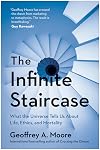
While you can’t fault an author for trying to work out their own personal philosophical views, those views don't always turn out to be as profound as the author might have initially believed them to be. Unfortunately, I think this might be the case with The Infinite Staircase. I’ll explain why shortly, but let’s first explore the main claims of the book.
The principal claim, I suppose, is that your picture of how the world works (metaphysics) influences the moral principles that govern show more your behavior (ethics), and so before you consider what it means to be a good person, you had better give your metaphysical views some thought. I think this is a reasonable proposition.
With that in mind, Moore spends the first two-thirds of the book reviewing his own secular metaphysical view, which he calls the “infinite staircase.” Essentially, Moore is claiming that we can describe reality at different levels, and that each level contains emergent properties that are not reducible to the levels below it.
At the lowest levels, we can describe reality in materialistic terms via physics, chemistry, and biology (what Moore refers to as the “metaphysics of entropy”). The next levels of description account for mind, consciousness, values, and culture, and the highest levels account for language, narrative, analytics, and theory. Because each level has emergent properties, you can’t account for, say, consciousness strictly in terms of the levels below it (via the natural sciences).
There are two points of criticism the reader may consider at this point. One is that there is nothing particularly novel about Moore’s infinite staircase theory. The two foundations on which his theory critically depends—entropy and emergentism—have long been established, and this won’t be any major revelation for those grounded in the basic sciences.
Second, his reliance on emergentism as an explanation feels shallow. To say that consciousness “emerges” out of physics is really to say you have no idea how it happens. Moore never tells us whether emergentism is a descriptive limitation (consciousness does reduce to physics; we just don’t have the capacity to understand how it does so) or an ontological reality (consciousness does not reduce to physics, period). But we must remember, while emergentism appears to be true in principle, it doesn’t explain anything; it would be like saying that oxygen “emerges” out of plants and feeling satisfied with the answer without getting into the details of photosynthesis.
What you’re left with is the rather banal observation that reality can be described at different levels. Perhaps this will come as a revelation for some, but for others it will all seem rather obvious, especially to those that understand the limits of reductionism and the importance of the humanities. Yes, we know that you can’t explain the causes of World War II in terms of particle physics—even if ontologically it could be reduced to that level—and that history as a discipline is necessary to get to the appropriate level of explanation. I just don’t think this is a particularly novel insight, or that it warrants the pages devoted to the topic.
Moore’s coverage of ethics is a little better. Here he correctly points out that values arise at a pre-linguistic level, shared universally among all mammals. He reverses the arrow of causation between morality and religion, noting that it is not religion that makes us moral but that our inherent moral nature manifests itself in religion (along with various other narratives). Our job, in a secular age, is to use language and narrative to modulate our inherently good nature based on the universal mammalian proclivity for sympathy, empathy, and maternal/paternal love.
But even here the reader may point out another flaw in his theory. Moore is claiming that values arise after the emergence of consciousness but before the emergence of language and narrative; but if that’s the case, then perhaps one does not need to flesh out their metaphysical views to be a good person. In fact, it seems that language and theory are the reasons for unethical behavior in the first place. We are taught to act evil, to consider others as outsiders, and to prioritize our own individual selfish needs. If Moore is correct, and values arise pre-linguistically, it seems that what we need is not his infinite staircase theory (grounded in language) but rather pre-linguistic methods to reconnect with our inherently peaceful and tolerant nature; essentially, meditation and mindfulness training.
Overall, Moore is trying to provide a linear, ultimate description of reality (metaphysics) as a foundation for ethics, but he fails on several grounds. First, his metaphysics relies on emergentism, which is essentially a non-explanation. To say consciousness arises out of physics, chemistry, and biology but to not elaborate on what or how this can happen is simply to state the obvious fact that we can describe reality in different ways. This isn’t a metaphysical view so much as a recognition of ignorance as to the ultimate nature of reality and the nature of consciousness.
Moore also never quite takes his own theory seriously enough to fully consider the limitations of language, limitations he points out but then ignores as he builds up his staircase. At best, language and theory should adopt a more modulatory role, but what Moore really wants to say (but never does) is that non-linguistic methods such as meditation are the more direct route to ethical behavior.
Moore even claims in chapter 4 that any viable metaphysical theory must be precise, yet his own theory lacks that precision as outlined above. He seems to be saying simultaneously that reality is too complex to capture via language (as emergentism suggests), but also that his infinite staircase theory has precisely captured reality via language. He also tells us that values arise prior to language and theory but that to be ethical we need to over-rely on language and theory as starting points.
In Chapter 9, Moore writes, “If all you took away from your engagement with ethics was Be kind, you would not be too far off the mark.” This is true because all ethical systems operate on some version of the Golden Rule (treat others the way you would want to be treated) or some version of the harm principle (avoid causing unnecessary harm), based on our biological nature as mammals. This is why stripping away language, bias, and preconceptions via meditation often leads to an increase in empathy and compassion. And if this is the case, as Moore seems to think it is, then why is a 200-page linguistic description of reality necessary for one to be moral when all that seems to be required is the injunction to be kind and to connect with your pre-linguistic values? show less
The principal claim, I suppose, is that your picture of how the world works (metaphysics) influences the moral principles that govern show more your behavior (ethics), and so before you consider what it means to be a good person, you had better give your metaphysical views some thought. I think this is a reasonable proposition.
With that in mind, Moore spends the first two-thirds of the book reviewing his own secular metaphysical view, which he calls the “infinite staircase.” Essentially, Moore is claiming that we can describe reality at different levels, and that each level contains emergent properties that are not reducible to the levels below it.
At the lowest levels, we can describe reality in materialistic terms via physics, chemistry, and biology (what Moore refers to as the “metaphysics of entropy”). The next levels of description account for mind, consciousness, values, and culture, and the highest levels account for language, narrative, analytics, and theory. Because each level has emergent properties, you can’t account for, say, consciousness strictly in terms of the levels below it (via the natural sciences).
There are two points of criticism the reader may consider at this point. One is that there is nothing particularly novel about Moore’s infinite staircase theory. The two foundations on which his theory critically depends—entropy and emergentism—have long been established, and this won’t be any major revelation for those grounded in the basic sciences.
Second, his reliance on emergentism as an explanation feels shallow. To say that consciousness “emerges” out of physics is really to say you have no idea how it happens. Moore never tells us whether emergentism is a descriptive limitation (consciousness does reduce to physics; we just don’t have the capacity to understand how it does so) or an ontological reality (consciousness does not reduce to physics, period). But we must remember, while emergentism appears to be true in principle, it doesn’t explain anything; it would be like saying that oxygen “emerges” out of plants and feeling satisfied with the answer without getting into the details of photosynthesis.
What you’re left with is the rather banal observation that reality can be described at different levels. Perhaps this will come as a revelation for some, but for others it will all seem rather obvious, especially to those that understand the limits of reductionism and the importance of the humanities. Yes, we know that you can’t explain the causes of World War II in terms of particle physics—even if ontologically it could be reduced to that level—and that history as a discipline is necessary to get to the appropriate level of explanation. I just don’t think this is a particularly novel insight, or that it warrants the pages devoted to the topic.
Moore’s coverage of ethics is a little better. Here he correctly points out that values arise at a pre-linguistic level, shared universally among all mammals. He reverses the arrow of causation between morality and religion, noting that it is not religion that makes us moral but that our inherent moral nature manifests itself in religion (along with various other narratives). Our job, in a secular age, is to use language and narrative to modulate our inherently good nature based on the universal mammalian proclivity for sympathy, empathy, and maternal/paternal love.
But even here the reader may point out another flaw in his theory. Moore is claiming that values arise after the emergence of consciousness but before the emergence of language and narrative; but if that’s the case, then perhaps one does not need to flesh out their metaphysical views to be a good person. In fact, it seems that language and theory are the reasons for unethical behavior in the first place. We are taught to act evil, to consider others as outsiders, and to prioritize our own individual selfish needs. If Moore is correct, and values arise pre-linguistically, it seems that what we need is not his infinite staircase theory (grounded in language) but rather pre-linguistic methods to reconnect with our inherently peaceful and tolerant nature; essentially, meditation and mindfulness training.
Overall, Moore is trying to provide a linear, ultimate description of reality (metaphysics) as a foundation for ethics, but he fails on several grounds. First, his metaphysics relies on emergentism, which is essentially a non-explanation. To say consciousness arises out of physics, chemistry, and biology but to not elaborate on what or how this can happen is simply to state the obvious fact that we can describe reality in different ways. This isn’t a metaphysical view so much as a recognition of ignorance as to the ultimate nature of reality and the nature of consciousness.
Moore also never quite takes his own theory seriously enough to fully consider the limitations of language, limitations he points out but then ignores as he builds up his staircase. At best, language and theory should adopt a more modulatory role, but what Moore really wants to say (but never does) is that non-linguistic methods such as meditation are the more direct route to ethical behavior.
Moore even claims in chapter 4 that any viable metaphysical theory must be precise, yet his own theory lacks that precision as outlined above. He seems to be saying simultaneously that reality is too complex to capture via language (as emergentism suggests), but also that his infinite staircase theory has precisely captured reality via language. He also tells us that values arise prior to language and theory but that to be ethical we need to over-rely on language and theory as starting points.
In Chapter 9, Moore writes, “If all you took away from your engagement with ethics was Be kind, you would not be too far off the mark.” This is true because all ethical systems operate on some version of the Golden Rule (treat others the way you would want to be treated) or some version of the harm principle (avoid causing unnecessary harm), based on our biological nature as mammals. This is why stripping away language, bias, and preconceptions via meditation often leads to an increase in empathy and compassion. And if this is the case, as Moore seems to think it is, then why is a 200-page linguistic description of reality necessary for one to be moral when all that seems to be required is the injunction to be kind and to connect with your pre-linguistic values? show less
Crossing the Chasm: Marketing and Selling High-Tech Products to Mainstream Customers (Collins Business Essentials) by Geoffrey A. Moore
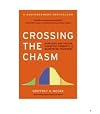
The first half of this book is gold. It kicks off with the diffusion of innovations theory and a characterization of innovators, early adopters, early majority, late majority, and laggards. It goes through lots of concrete strategy on how to market to each of these groups, how different they are, and why there is a tricky chasm between the two early adopter groups and everyone else. The lessons here go beyond marketing a product and are just as useful in other contexts, such as how to show more convince people at your own company to do something. The writing is clear, keeps jargon to a minimum, and has lots of good analogies and even a few good jokes.
As you get into the second half of the book, it runs out of steam. Or, to be fair, perhaps it just wasn't what I was looking for. It starts to go into detailed tactics, and at this level of detail, the book really shows its age. Many of the companies and technologies it uses as examples are long gone. Worse yet, some of the advice doesn't make sense any more. For example, the book describes the Internet as an up and coming technology you might want to pay attention to. The book also shies away from any sort of data or talking to real customers in favor of intuition and experience. This may be the right decision in some scenarios, but with the data access and analysis we have today, it's not always a good trade-off.
In short, well worth reading the first few parts to wrap your head around the different customer segments and how your marketing tactics have to change as you capture more of the market, but consider skipping the rest.
Some good quotes from the book:
Innovators pursue new technology products aggressively. They sometimes seek them out even before a formal marketing program has been launched. This is because technology is a central interest in their life, regardless of what function it is performing.
Early adopters, like innovators, buy into new product concepts very early in their life cycle, but unlike innovators, they are not technologists. Rather they are people who find it easy to imagine, understand, and appreciate the benefits of a new technology, and to relate these potential benefits to their other concerns.
[...]
The early majority share some of the early adopter’s ability to relate to technology, but ultimately they are driven by a strong sense of practicality. They know that many of these newfangled inventions end up as passing fads, so they are content to wait and see how other people are making out before they buy in themselves.
[...]
The late majority shares all the concerns of the early majority, plus one major additional one: Whereas people in the early majority are comfortable with their ability to handle a technology product, should they finally decide to purchase it, members of the late majority are not. As a result, they wait until something has become an established standard, and even then they want to see lots of support and tend to buy, therefore, from large, well-established companies.
[...]
Finally there are the laggards. These people simply don’t want anything to do with new technology, for any of a variety of reasons, some personal and some economic. The only time they ever buy a technological product is when it is buried so deep inside another product—the way, say, that a microprocessor is designed into the braking system of a new car—that they don’t even know it is there.
What the early adopter is buying [...] is some kind of change agent. By being the first to implement this change in their industry, the early adopters expect to get a jump on the competition, whether from lower product costs, faster time to market, more complete customer service, or some other comparable business advantage. They expect a radical discontinuity between the old ways and the new, and they are prepared to champion this cause against entrenched resistance. Being the first, they also are prepared to bear with the inevitable bugs and glitches that accompany any innovation just coming to market.
By contrast, the early majority want to buy a productivity improvement for existing operations. They are looking to minimize the discontinuity with the old ways. They want evolution, not revolution. They want technology to enhance, not overthrow, the established ways of doing business. And above all, they do not want to debug somebody else’s product. By the time they adopt it, they want it to work properly and to integrate appropriately with their existing technology base.
Marketing professionals insist on market segmentation because they know no meaningful marketing program can be implemented across a set of customers who do not reference each other. The reason for this is simply leverage. No company can afford to pay for every marketing contact made. Every program must rely on some ongoing chain-reaction effects—what is usually called word of mouth. The more self-referencing the market and the more tightly bounded its communications channels, the greater the opportunity for such effects.
When pragmatists buy, they care about the company they are buying from, the quality of the product they are buying, the infrastructure of supporting products and system interfaces, and the reliability of the service they are going to get. In other words, they are planning on living with this decision personally for a long time to come. (By contrast, the visionaries are more likely to be planning on implementing the great new order and then using that as a springboard to their next great career step upward.) Because pragmatists are in it for the long haul, and because they control the bulk of the dollars in the marketplace, the rewards for building relationships of trust with them are very much worth the effort.
Most companies fail to cross the chasm because, confronted with the immensity of opportunity represented by a mainstream market, they lose their focus, chasing every opportunity that presents itself, but finding themselves unable to deliver a salable proposition to any true pragmatist buyer. The D-Day strategy keeps everyone on point—if we don’t take Normandy, we don’t have to worry about how we’re going to take Paris.
Positioning is the single largest influence on the buying decision. It serves as a kind of buyers’ shorthand, shaping not only their final choice but even the way they evaluate alternatives leading up to that choice. In other words, evaluations are often simply rationalizations of pre-established positioning.
Here there is one fundamental key to success: When most people think of positioning in this way, they are thinking about how to make their products easier to sell. But the correct goal is to make them easier to buy. show less
As you get into the second half of the book, it runs out of steam. Or, to be fair, perhaps it just wasn't what I was looking for. It starts to go into detailed tactics, and at this level of detail, the book really shows its age. Many of the companies and technologies it uses as examples are long gone. Worse yet, some of the advice doesn't make sense any more. For example, the book describes the Internet as an up and coming technology you might want to pay attention to. The book also shies away from any sort of data or talking to real customers in favor of intuition and experience. This may be the right decision in some scenarios, but with the data access and analysis we have today, it's not always a good trade-off.
In short, well worth reading the first few parts to wrap your head around the different customer segments and how your marketing tactics have to change as you capture more of the market, but consider skipping the rest.
Some good quotes from the book:
Innovators pursue new technology products aggressively. They sometimes seek them out even before a formal marketing program has been launched. This is because technology is a central interest in their life, regardless of what function it is performing.
Early adopters, like innovators, buy into new product concepts very early in their life cycle, but unlike innovators, they are not technologists. Rather they are people who find it easy to imagine, understand, and appreciate the benefits of a new technology, and to relate these potential benefits to their other concerns.
[...]
The early majority share some of the early adopter’s ability to relate to technology, but ultimately they are driven by a strong sense of practicality. They know that many of these newfangled inventions end up as passing fads, so they are content to wait and see how other people are making out before they buy in themselves.
[...]
The late majority shares all the concerns of the early majority, plus one major additional one: Whereas people in the early majority are comfortable with their ability to handle a technology product, should they finally decide to purchase it, members of the late majority are not. As a result, they wait until something has become an established standard, and even then they want to see lots of support and tend to buy, therefore, from large, well-established companies.
[...]
Finally there are the laggards. These people simply don’t want anything to do with new technology, for any of a variety of reasons, some personal and some economic. The only time they ever buy a technological product is when it is buried so deep inside another product—the way, say, that a microprocessor is designed into the braking system of a new car—that they don’t even know it is there.
What the early adopter is buying [...] is some kind of change agent. By being the first to implement this change in their industry, the early adopters expect to get a jump on the competition, whether from lower product costs, faster time to market, more complete customer service, or some other comparable business advantage. They expect a radical discontinuity between the old ways and the new, and they are prepared to champion this cause against entrenched resistance. Being the first, they also are prepared to bear with the inevitable bugs and glitches that accompany any innovation just coming to market.
By contrast, the early majority want to buy a productivity improvement for existing operations. They are looking to minimize the discontinuity with the old ways. They want evolution, not revolution. They want technology to enhance, not overthrow, the established ways of doing business. And above all, they do not want to debug somebody else’s product. By the time they adopt it, they want it to work properly and to integrate appropriately with their existing technology base.
Marketing professionals insist on market segmentation because they know no meaningful marketing program can be implemented across a set of customers who do not reference each other. The reason for this is simply leverage. No company can afford to pay for every marketing contact made. Every program must rely on some ongoing chain-reaction effects—what is usually called word of mouth. The more self-referencing the market and the more tightly bounded its communications channels, the greater the opportunity for such effects.
When pragmatists buy, they care about the company they are buying from, the quality of the product they are buying, the infrastructure of supporting products and system interfaces, and the reliability of the service they are going to get. In other words, they are planning on living with this decision personally for a long time to come. (By contrast, the visionaries are more likely to be planning on implementing the great new order and then using that as a springboard to their next great career step upward.) Because pragmatists are in it for the long haul, and because they control the bulk of the dollars in the marketplace, the rewards for building relationships of trust with them are very much worth the effort.
Most companies fail to cross the chasm because, confronted with the immensity of opportunity represented by a mainstream market, they lose their focus, chasing every opportunity that presents itself, but finding themselves unable to deliver a salable proposition to any true pragmatist buyer. The D-Day strategy keeps everyone on point—if we don’t take Normandy, we don’t have to worry about how we’re going to take Paris.
Positioning is the single largest influence on the buying decision. It serves as a kind of buyers’ shorthand, shaping not only their final choice but even the way they evaluate alternatives leading up to that choice. In other words, evaluations are often simply rationalizations of pre-established positioning.
Here there is one fundamental key to success: When most people think of positioning in this way, they are thinking about how to make their products easier to sell. But the correct goal is to make them easier to buy. show less
Crossing the Chasm: Marketing and Selling Disruptive Products to Mainstream Customers by Geoffrey A. Moore
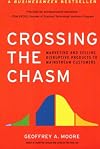
If your background is in engineering or mathematics, you probably have enough prejudice against marketing books full of hype and buzz. Especially if you've been in the field and observed many a brand come and go throughout the last 20 years, you will really have a hard time reading marketing books with big words, let alone recommend them to your peers. Fortunately, Crossing the Chasm is a rare book, or should I say an outlier in this respect, that goes to the heart of the matter, and in a show more few pages shows what the real challenges are for a new high-tech company when it comes to marketing and establishing a brand.
There are a lot of important lessons to learn from this book and I think even the simplest lesson, that there is a big chasm to be crossed, where exactly it is placed, why it exists, and you better be aware of it for your own good, is enough reason to read this book. But of course the book does not stop there, and continue with important topics such as what companies should do in each phase of their life-cycle, what types of users / customers are there, what kind of strategies you need to employ for which type of user and when you should do that, what the whole product means versus the core technology itself and a few other important points. Another lesson that is crystal clear: The enthusiasm and the bright energy of the starting point, all of those technological innovations are great and cool, without them you cannot start any high-tech product but it is also sad to see that they are not enough for being really successful and establishing the product as the dominant brand in the sector.
The no-nonsense approach of the author, as well as the striking and famous examples he uses to convey his messages are very well thought out. The book never gets dull and I have earmarked many pages, underlined many sentences and could not help myself for applying the principles to other technology example I have witnessed practically during the last 20 years. What I really liked in the end is that it gives me a time-tested solid framework for thinking and analyzing many cases and focus on what not to do, as well as things to be done.
It is a pleasure to see that so many years after its publication, the basic principles and lessons of the book are still very much relevant. I will not hesitate to recommend this book to my peers and keep it hidden from my competitors. show less
There are a lot of important lessons to learn from this book and I think even the simplest lesson, that there is a big chasm to be crossed, where exactly it is placed, why it exists, and you better be aware of it for your own good, is enough reason to read this book. But of course the book does not stop there, and continue with important topics such as what companies should do in each phase of their life-cycle, what types of users / customers are there, what kind of strategies you need to employ for which type of user and when you should do that, what the whole product means versus the core technology itself and a few other important points. Another lesson that is crystal clear: The enthusiasm and the bright energy of the starting point, all of those technological innovations are great and cool, without them you cannot start any high-tech product but it is also sad to see that they are not enough for being really successful and establishing the product as the dominant brand in the sector.
The no-nonsense approach of the author, as well as the striking and famous examples he uses to convey his messages are very well thought out. The book never gets dull and I have earmarked many pages, underlined many sentences and could not help myself for applying the principles to other technology example I have witnessed practically during the last 20 years. What I really liked in the end is that it gives me a time-tested solid framework for thinking and analyzing many cases and focus on what not to do, as well as things to be done.
It is a pleasure to see that so many years after its publication, the basic principles and lessons of the book are still very much relevant. I will not hesitate to recommend this book to my peers and keep it hidden from my competitors. show less
Lists
My List (1)
Awards

You May Also Like


Associated Authors
Statistics
- Works
- 10
- Members
- 2,965
- Popularity
- #8,601
- Rating
- 3.8
- Reviews
- 24
- ISBNs
- 58
- Languages
- 5
- Favorited
- 2