

Margaret Alice Murray (1863–1963)
Author of The God of the Witches
About the Author
Works by Margaret Alice Murray
Associated Works
Tombs of the courtiers and Oxyrhynkhos, (British School of Archaeology in Egypt and Egyptian Research Account. Twenty-eighth year, 1922. [Publication) (1925) — Contributor — 3 copies
The Cradles of Civilization: The Splendor That Was Egypt & The Greatness That Was Babylon (2 Volume Set in Slipcase) (1966) — Contributor — 1 copy
Tagged
Common Knowledge
- Legal name
- Murray, Margaret Alice
- Birthdate
- 1863-07-13
- Date of death
- 1963-11-13
- Gender
- female
- Education
- University College London (D.Litt|1931)
- Occupations
- archaeologist
Egyptologist
anthropologist
professor
suffragist
scholar (show all 7)
autobiographer - Organizations
- University College London
Folklore Society (president 1953-55)
Women's Social and Political Union - Awards and honors
- Royal Anthropological Institute (Fellow)
- Relationships
- Caton-Thompson, Gertrude (student)
Flinders Petrie (student, colleague)
Petrie, Hilda Flinders (colleague) - Short biography
- Margaret Alice Murray was born in Calcutta, India, the daughter of a British businessman and a missionary social worker. She moved back and forth between India and England, receiving her early education in England with a governess and then studying in Germany in 1873-75. In 1883, she trained to work as a nurse, but had to abandon this career as she was considered too short of stature. In 1894, she began to study Egyptology at University College London (UCL) under Sir Flinders Petrie, and accompanied him to work on archaeological digs in Egypt and southern Palestine. Margaret Murray was the first in a line of female Egyptologists employed by the Manchester Museum at the University of Manchester. In 1908, she began the unwrapping of the Two Brothers, a Middle Kingdom Egyptian burial now considered a pioneering interdisciplinary study of mummies. Around 1915, she turned her attention to the history of witchcraft in Europe. In 1921, she published her first book on the subject, The Witch-Cult in Western Europe. Her work and her association with Prof. Petrie helped her secure a position as a junior lecturer at UCL. In 1925, she was named Assistant Professor of Egyptology, a post she held until her retirement in 1934. She was a prolific writer who produced more than 100 books and articles on anthropology, archeology and Egyptology, including Egyptian Temples (1931) and The Splendour that Was Egypt (1949). After her retirement, she continued to study witchcraft and travelled around the country giving lectures. She published her autobiography shortly before her death in 1963 as My First Hundred Years, recording in it her belief in reincarnation.
- Nationality
- UK
- Birthplace
- Calcutta, British India
- Places of residence
- Calcutta, Bengal Presidency, British India (birth)
London, England, UK
Abydos, Egypt
Palestine
Manchester, England, UK
Cambridge, Cambridgeshire, England, UK - Place of death
- Welwyn, Hertfordshire, England, UK
- Associated Place (for map)
- England, UK
Members
Reviews
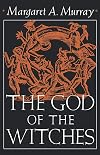
Well, er... This is entertaining enough as the potential basis for a fantasy novel, but as far as actual scholarship goes, it's pretty lacking. Murray's theory that there was some kind of unified pagan religion in Europe prior to the advent of Christianity is iffy enough, but when she posits that Joan of Arc and Thomas a Beckett were pagan sacrifices, things get pretty whacky.

This book is one of the foundations of neopagan, new age-y feminism, but it is completely out of date (first published in 1931) and requires extensive suspension of disbelief. Murray herself seems to have sat too long in a room alone with The Golden Bough, another discredited anthropological examination of folklore.
Murray published The Witch-Cult in Western Europe ten years before she published The God of the Witches, which was intended as a more popular presentation of her basic thesis that show more witches were underground adherents of a nature religion that originated in the Paleolithic.
I've had this book since college and upon giving it a recent skim, I decided to place it on the discard pile. I've given it two stars, not because I think it has anything worthwhile to say, but because it's fun in its loopy way and is probably of value to people who are interested in the development of matriarchy theories and neopaganism.
There is at least one authentic survival of a repressed religion, and that took place among the Iberian crypto-Jews. These were Jews who were forced to convert to Christianity and continued to practice Judaism in secret. show less
Murray published The Witch-Cult in Western Europe ten years before she published The God of the Witches, which was intended as a more popular presentation of her basic thesis that show more witches were underground adherents of a nature religion that originated in the Paleolithic.
I've had this book since college and upon giving it a recent skim, I decided to place it on the discard pile. I've given it two stars, not because I think it has anything worthwhile to say, but because it's fun in its loopy way and is probably of value to people who are interested in the development of matriarchy theories and neopaganism.
There is at least one authentic survival of a repressed religion, and that took place among the Iberian crypto-Jews. These were Jews who were forced to convert to Christianity and continued to practice Judaism in secret. show less

While Margaret Murray's book is classic research into the witch trials of the middle ages and their connection to pre-Christian pagan religion is historically important as a Wiccan/Neopagan foundation document, the books research and theory is somewhat flimsy in the light of hard historical fact. In the book, it states that many of those killed during the witch trails were actually part of various witch-cults. This conclusion has been refuted by other scalars and researchers time and time again.
Even though it's been debunked by modern scholars, this is valuable for the insight into where Gardner got his original historical influences.
Lists
Folk Horror (1)
You May Also Like


Associated Authors
Statistics
- Works
- 26
- Also by
- 5
- Members
- 1,038
- Popularity
- #24,806
- Rating
- 3.3
- Reviews
- 8
- ISBNs
- 84
- Languages
- 4