
Doris Mary Stenton (1894–1971)
Author of English Society in the Early Middle Ages
About the Author
Image credit: photo by Gilbert Adams (British Academy)
Works by Doris Mary Stenton
Tagged
Common Knowledge
- Legal name
- Stenton, Doris Mary
- Other names
- Parsons, Doris Mary (birth name)
Lady Stenton - Birthdate
- 1894-08-27
- Date of death
- 1971-12-29
- Gender
- female
- Education
- University College London (MA, first class honours|History|1916)
University College, Reading - Occupations
- historian
- Awards and honors
- Fellow, British Academy (1954)
- Relationships
- Stenton, Sir Frank Merry (spouse)
- Nationality
- UK
- Birthplace
- Reading, Berkshire, England, UK
- Places of residence
- Reading, Berkshire, England, UK
- Place of death
- Reading, Berkshire, England, UK
- Associated Place (for map)
- Reading, Berkshire, England, UK
Members
Reviews
English Society in the Early Middle Ages (1066-1307) (The Pelican History of England: 3) by Doris Mary Stenton

The book covers English history from the Norman Conquest in 1066 up through the death of King Edward I in 1307; like the other Pelican Histories (I am finding), it focuses less on giving a chronological account of its era and more on giving a sketch of how society operated in the era in question. But while volume one covered nine centuries and volume two six, this one covers just three, meaning that you do get a more solid sense of the events of the period, even if they are mostly just show more sketched in. Additionally, the book has a timeline of key dates in the back, an innovation I found helpful whenever I got a bit lost in the chronology. Chapters here cover topics such as the king's household and government (this is where you get the sketch of the changes in kingship over the centuries); barons and knights; the organization of places such as forests, villages, towns, boroughs, and cities; the church; and the arts.
It's interesting to note how each author of the series has a different prism through which they explore the society of the period. While volume one emphasized (to its detriment, I think) locations and volume two economic power, Stenton mostly focuses on political power: the growth of Parliament, the expansion of the bureaucracy, the creation of limits on the king in the form of Magna Carta. There is a lot of emphasis here on who owed whom allegiance, and whose power was channeled through whom. It's a useful way to understand how England was operating as a state not just a nation.
Unfortunately, this is the longest of the Pelican Histories that I own (I don't have all eight yet as of this writing) and reason is that it sometimes goes into unnecessary detail. For example, that the King's Forests were highly regulated is interesting and a good example of the way the new Norman kings exerted political power... but Stenton provides more detail than a book with this audience and scope actually needs in order to make this point. Moments like this felt more like they belong in a more academic piece. (But Stenton's style is probably the most academic of the three volumes I've read so far, as its extensive end notes attest!) I found that especially as I got closer to the end, I was doing more skimming.
Still, it's reasonably accessible and provides a clear sketch of the time. I particularly found myself fascinated by the so-called "Angevin Empire" (I don't think Stenton herself uses this term) from 1154 to 1214, when the King of England also ruled other parts of Britain as well of chunks of France through various political positions, but without any kind of unified government... and indeed, the King of England was also a duke who owed homage to the King of France! Complicated and kind of fascinating. show less
It's interesting to note how each author of the series has a different prism through which they explore the society of the period. While volume one emphasized (to its detriment, I think) locations and volume two economic power, Stenton mostly focuses on political power: the growth of Parliament, the expansion of the bureaucracy, the creation of limits on the king in the form of Magna Carta. There is a lot of emphasis here on who owed whom allegiance, and whose power was channeled through whom. It's a useful way to understand how England was operating as a state not just a nation.
Unfortunately, this is the longest of the Pelican Histories that I own (I don't have all eight yet as of this writing) and reason is that it sometimes goes into unnecessary detail. For example, that the King's Forests were highly regulated is interesting and a good example of the way the new Norman kings exerted political power... but Stenton provides more detail than a book with this audience and scope actually needs in order to make this point. Moments like this felt more like they belong in a more academic piece. (But Stenton's style is probably the most academic of the three volumes I've read so far, as its extensive end notes attest!) I found that especially as I got closer to the end, I was doing more skimming.
Still, it's reasonably accessible and provides a clear sketch of the time. I particularly found myself fascinated by the so-called "Angevin Empire" (I don't think Stenton herself uses this term) from 1154 to 1214, when the King of England also ruled other parts of Britain as well of chunks of France through various political positions, but without any kind of unified government... and indeed, the King of England was also a duke who owed homage to the King of France! Complicated and kind of fascinating. show less
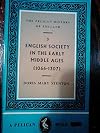
This book was written in 1951, so is probably more than a little out of date in some ways, but I thoroughly enjoyed Lady Stanton's use of contemporary sources to illustrate her arguments and give some context to her examination of English society during the eleventh through thirteenth centuries.

This is a description of England during the two-and-a-half centuries since the Norman Conquest. A chronological setting is given to the developments of society during the period, by reference to political events of the time. The relations between the King, the nobles, the Church and the people are described and the author also sketches the stages by which departments of state evolved out of the individual authority of officers of the royal household, and parliament out of the King's control.

You May Also Like


Statistics
- Works
- 10
- Members
- 601
- Popularity
- #41,821
- Rating
- 3.5
- Reviews
- 5
- ISBNs
- 13