

James A. Baker, III
Author of The Iraq Study Group Report
About the Author
Works by James A. Baker, III
Associated Works
Booknotes: America's Finest Authors on Reading, Writing, and the Power of Ideas (1997) — Contributor — 457 copies, 5 reviews
Oil, Dollars, Debt, and Crises: The Global Curse of Black Gold (2009) — Foreword, some editions — 23 copies
Tagged
Common Knowledge
- Legal name
- Baker, James Addison, III
- Birthdate
- 1930-04-28
- Gender
- male
- Education
- Princeton University (1952)
University of Texas School of Law (1957) - Occupations
- United States Secretary of the Treasury (1985-1988)
U.S. Secretary of State (1989-1992)
White House Chief of Staff (1981-1985)
military officer
lawyer
White House Chief of Staff (1992-1993) - Organizations
- Republican Party
Ronald Reagan's cabinet (1985-1988|Secretary of the Treasury)
Ronald Reagan administration (1981-1988)
George H. W. Bush's cabinet (1989-1992|Secretary of State)
George H. W. Bush administration (1989-1993) - Awards and honors
- Presidential Medal of Freedom (1991)
Grand Cordon of the Order of the Rising Sun (2015) - Nationality
- USA
- Birthplace
- Houston, Texas, USA
- Places of residence
- Houston, Texas, USA
- Associated Place (for map)
- Houston, Texas, USA
Members
Reviews
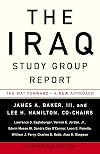
I've just finished reading the Vintage edition of The Iraq Study Group Report, which was printed almost overnight for its public release last Wednesday. It's a fairly short document - just 96 pages of report and another fifty pages of supporting documents - but it's an important one. This bipartisan group of some of the most interesting minds in American political life today managed to reach consensus on seventy-nine recommendations for a new approach to America's policy toward Iraq and the show more wider Middle East region. These recommendations are not something that we ought to take lightly, and I hope that they will be given their due by those who must decide whether to act of them or to continue down the current, perilous, path.
I believe that the recommendations contained in this report, if pursued in a comprehensive, bipartisan and coherent manner, have the potential to provide America with not only a viable exit strategy from Iraq, but also a blueprint for lasting stability in the Middle East and a lessening of ideological warfare here at home. No, this report is not a magic bullet and will not solve our problems overnight. But following this strategy, it seems to me, would improve our chances of success ... or at least decrease our chances of abject and utter failure characterized by continued deterioration of Iraq and a possible regional conflagration. show less
I believe that the recommendations contained in this report, if pursued in a comprehensive, bipartisan and coherent manner, have the potential to provide America with not only a viable exit strategy from Iraq, but also a blueprint for lasting stability in the Middle East and a lessening of ideological warfare here at home. No, this report is not a magic bullet and will not solve our problems overnight. But following this strategy, it seems to me, would improve our chances of success ... or at least decrease our chances of abject and utter failure characterized by continued deterioration of Iraq and a possible regional conflagration. show less
A manual on how a great power can be Gulliver. Any one seeking a manual on defeatism should go no further than this little tome.
In January 2009 the results of participation in local elections all over Iraq was 51% according to the IHEC, Iraq’s Independent High Electoral Commission. The number of Iraqis who cast their votes 7.5 million. Voting centers in Baghdad and other 13 provinces were ready to receive 15 million eligible voters elected candidates to occupy all 440 seats in local show more councils.
On the other hand, the closet equivalent to the Iraqi vote, American off-year elections, run around 37%, the "normal" modern midterm voter participation rate. In pointed contrast, the lowest rate--40%--was in Anbar, the Sunni heartland west of Baghdad. The sprawling desert area was dominated in 2005 by al Qaeda in Iraq. Thus, in four years, the Americans succeeded in pushing out AQ in Iraq and Iraqis responded by voting with more confidence and a higher percentage of them voted than the average American.
Apparently the Americans are better at exporting democracy than they are at practicing it.
The defeatism of American leaders would be laughable if it were not so dangerous to American's security to have these people in positions of power. In December 2006, those purveyors of pessimism, The Iraq Study Group, concluded: "The situation in Iraq is grave and deteriorating (p. xiii)." And again they concluded that the situation in Anbar, one of worst four provinces cited, was "highly insecure (p. 6)." show less
In January 2009 the results of participation in local elections all over Iraq was 51% according to the IHEC, Iraq’s Independent High Electoral Commission. The number of Iraqis who cast their votes 7.5 million. Voting centers in Baghdad and other 13 provinces were ready to receive 15 million eligible voters elected candidates to occupy all 440 seats in local show more councils.
On the other hand, the closet equivalent to the Iraqi vote, American off-year elections, run around 37%, the "normal" modern midterm voter participation rate. In pointed contrast, the lowest rate--40%--was in Anbar, the Sunni heartland west of Baghdad. The sprawling desert area was dominated in 2005 by al Qaeda in Iraq. Thus, in four years, the Americans succeeded in pushing out AQ in Iraq and Iraqis responded by voting with more confidence and a higher percentage of them voted than the average American.
Apparently the Americans are better at exporting democracy than they are at practicing it.
The defeatism of American leaders would be laughable if it were not so dangerous to American's security to have these people in positions of power. In December 2006, those purveyors of pessimism, The Iraq Study Group, concluded: "The situation in Iraq is grave and deteriorating (p. xiii)." And again they concluded that the situation in Anbar, one of worst four provinces cited, was "highly insecure (p. 6)." show less
http://nhw.livejournal.com/817463.html
For a main text of less than a hundred pages, aimed exclusively at policy-makers concerned with the question of What Next?, it is not bad - especially the recommendations on better US diplomacy in the region, ie Iran and Syria, and the Israel/Palestine dispute. Shame that doesn't appear to be happening.
I missed, though, any serious analysis of how the greatest military machine the world has ever known, run by the most powerful democratic state in show more history, had managed to get itself in this fix in the first place. So it feels very incomplete. show less
For a main text of less than a hundred pages, aimed exclusively at policy-makers concerned with the question of What Next?, it is not bad - especially the recommendations on better US diplomacy in the region, ie Iran and Syria, and the Israel/Palestine dispute. Shame that doesn't appear to be happening.
I missed, though, any serious analysis of how the greatest military machine the world has ever known, run by the most powerful democratic state in show more history, had managed to get itself in this fix in the first place. So it feels very incomplete. show less
Interesting. Gives you (somewhat) an idea of how-and-why we're still in the mess we're in over there. Overall though not much from a historical perspective of this timeframe (2005-2007 Iraq/US relations).
Lists
Awards

You May Also Like


Associated Authors
Statistics
- Works
- 9
- Also by
- 6
- Members
- 806
- Popularity
- #31,649
- Rating
- 3.6
- Reviews
- 8
- ISBNs
- 19
- Languages
- 2

