
Ernest Findlay Scott (1868–1954)
Author of The literature of the New Testament
About the Author
Works by Ernest Findlay Scott
Beginner's Guide to Microprocessors and Computing (Bernard Babani Publishing Radio & Electronics Books) (1980) 4 copies
The New Testament Idea of Revelation 3 copies
The Book of Revelation 2 copies
An Outline of Christianity, the Story of Our Civilization, V1: The Birth of Christianity (2010) 2 copies
The Federal Reporter, Vol. 3 1 copy
The Federal Reporter, Vol. 8 1 copy
Tagged
Common Knowledge
- Other names
- Scott, E. F.
Scott, Ernest F. - Birthdate
- 1868-03-18
- Date of death
- 1954
- Gender
- male
- Organizations
- Union Theological Seminary
- Nationality
- UK
- Places of residence
- Towlaw, England, UK (birth)
- Associated Place (for map)
- England, UK
Members
Reviews

One has to keep in mind the difference between fact and fiction when reading this interesting and thought-provoking book. Scott's opinions regarding the church and its early leaders may not set well with those who take a strict literal view of the New Testament. To Scott, each New Testament writer sees the church from a different perspective, is influenced by their background and culture, yet writes accordingly in the Spirit. Inconsistencies in the NT are then to be expected, but the church show more eventually grew to overlook them instead of being overcome by them.
The book has ten chapters which give clues to the focus of the author:
I. Difference and Unity in the New Testament
II. The Primitive Teaching
III. Hellenistic Christianity
IV. The Religion of Paul
V. The Rivals of Paul
VI. Apocalyptic Christianity
VII. Western Christianity
IX. The Johannine Teaching
X. The Rise of a Common Religion
I believe the book is useful to persons who are interested in trying to develop a better understanding of what the primitive church may have been, and why it is so difficult to try to replicate it today.
The author is a good writer. The book is not technical. Indexed. show less
The book has ten chapters which give clues to the focus of the author:
I. Difference and Unity in the New Testament
II. The Primitive Teaching
III. Hellenistic Christianity
IV. The Religion of Paul
V. The Rivals of Paul
VI. Apocalyptic Christianity
VII. Western Christianity
IX. The Johannine Teaching
X. The Rise of a Common Religion
I believe the book is useful to persons who are interested in trying to develop a better understanding of what the primitive church may have been, and why it is so difficult to try to replicate it today.
The author is a good writer. The book is not technical. Indexed. show less
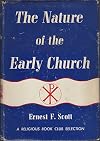
In reference to Scott's book, A. T. DeGroot's states "It is scarcely possible to exaggerate the importance of the study of the volume by Ernest F. Scott, The Nature of the Early Church" in his book, The Restoration Principle (p. 85).
Scott describes how the church "was the creation of an ecstasy." When Christ did not return it adapted to the world in which it existed, because it needed to. As a result, the church was able to influence the world in a positive way, even though all of this world show more are not in it.
Chapters in the book are:
I. The Significance of the Primitive Church
II. The Church and the Message of Jesus
III. The Initial Period
IV. Worship in the Early Church
V. The Organizing of the Church
VI. Teaching in the Early Church
VII. Paul's Conception of the Church
VIII. The Ethical Task of the Church
IX. The Church and the State
X. Conclusion
The book includes a short bibliography. It is indexed.
This is a very readable book that provides much food for thought regrading the early church. It is especially thought provoking for those who believe in the need to restore the church to the ancient order. show less
Scott describes how the church "was the creation of an ecstasy." When Christ did not return it adapted to the world in which it existed, because it needed to. As a result, the church was able to influence the world in a positive way, even though all of this world show more are not in it.
Chapters in the book are:
I. The Significance of the Primitive Church
II. The Church and the Message of Jesus
III. The Initial Period
IV. Worship in the Early Church
V. The Organizing of the Church
VI. Teaching in the Early Church
VII. Paul's Conception of the Church
VIII. The Ethical Task of the Church
IX. The Church and the State
X. Conclusion
The book includes a short bibliography. It is indexed.
This is a very readable book that provides much food for thought regrading the early church. It is especially thought provoking for those who believe in the need to restore the church to the ancient order. show less
You May Also Like


Statistics
- Works
- 50
- Members
- 485
- Popularity
- #50,912
- Rating
- 3.0
- Reviews
- 3
- ISBNs
- 26
- Languages
- 1