
Phil Zuckerman
Author of Society without God: What the Least Religious Nations Can Tell Us About Contentment
About the Author
Phil Zuckerman is also the author of Strife in the Sanctuary (AltaMira Press, 1999). He is currently a professor of sociology at Pitzer College. (Bowker Author Biography)
Image credit: New York Times
Works by Phil Zuckerman
Society without God: What the Least Religious Nations Can Tell Us About Contentment (2008) 262 copies, 11 reviews
What It Means to Be Moral: Why Religion Is Not Necessary for Living an Ethical Life (2019) 50 copies, 1 review
Associated Works
Tagged
Common Knowledge
- Canonical name
- Zuckerman, Phil
- Gender
- male
- Education
- University of Oregon (BA|Sociology 1992, MA|Sociology 1995, PhD|Sociology, 1998)
- Occupations
- sociologist
university professor - Organizations
- Pitzer College
Aarhus University
University of Oregon - Awards and honors
- Scholar in Residence, Pitzer College (2009)
Top 5 Professor at the Claremont Colleges (2001-2002)
Outstanding Teaching Award (University of Oregon ∙ 1997)
American Sociological Association Graduate Student Paper Award, 1st place (Religion Section)
Centurion Award (University of Oregon ∙ 1992) - Nationality
- USA
- Associated Place (for map)
- USA
Members
Reviews
What It Means to Be Moral: Why Religion Is Not Necessary for Living an Ethical Life by Phil Zuckerman
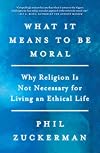
With the exception of morality, religion has lost its relevance. We now look to the natural and social sciences, history, literature, philosophy, and evolutionary psychology to not only better explain the world and our place in it but also to explain the origin of religion itself.
Morality is, therefore, truly religion’s last stand in its claim to modern relevance. But as Phil Zuckerman shows, we have better explanations for morality, too.
In the first part of the book, Zuckerman thoroughly show more reveals the incoherence of theistic morality. In addition to the fact that there is little to no evidence of the existence of any god—and that even if there were, we have no capacity to know anything about him/her/it/they—there is the problem of scriptural interpretation (making religion the epitome of moral relativism), the problem of evil, and the Euthyphro dilemma, which is worth elaborating on because it truly cuts to the heart of the matter.
The Euthyphro Dilemma was introduced by Plato in the Euthyphro dialogue. In it, Socrates essentially asks Euthyphro this: is an act moral because god commands it, or does god command it because it is moral? If the first, then morality is arbitrary, entirely at god’s whim, and reduces morality to mere obedience. If god tells you to murder your son, for instance, then you had better do it.
Most of us reject this definition of morality on its face. What about the second option, that an act is commanded by god because it is moral by some other standard? If that’s the case, then morality is independent of god and god becomes irrelevant in regard to moral deliberation.
And so, the dilemma shows that divine command theory leads either to arbitrary obedience to god or else to god’s irrelevance. In the 2,400 years that have passed since Plato wrote this dialogue, there have been no satisfactory answers.
Here’s how Zuckerman summarizes the emptiness of theistic morality, which is hard to argue against:
“There is no compelling evidence that God exists, and even if there were, we can’t agree on what it wills, and even if we could, then human morality would be reduced to nothing more than docile obedience—which is an abdication of moral responsibility. And even if we freely submitted to such a slave dynamic, there’s nothing to prove that what God commands is ‘moral,’ per se, other than criteria somehow existing independently of God, thereby rendering God’s relation to morality redundant.”
These are serious problems that have no answers. The best the religious are able to do lately is to claim that humanism is founded on the principles of religion, as if we require an imaginary, magical being to tell us not to inflict unnecessary harm on others, and that we couldn’t figure this out on our own. (You might ask how humanity survived for hundreds of thousands of years prior to the emergence of Christianity without any sense of pre-existing or innate morality. What is more likely is that Christianity itself was an outgrowth of our evolutionary psychology—mixed with the supernaturalism of the times.)
So where does Zuckerman think we get our morals? From a complex mixture of our biology, evolutionary history, culture, experiences, and rational reflection. Most of us don’t need to be taught how to be empathetic, sympathetic, and compassionate, and morality is simply an extension of these innate traits to a wider circle of individuals.
All religious and philosophical systems of morality share certain things in common: a recognition of the Golden Rule (found in numerous belief systems that predate Christianity), and adherence to the harm principle, which says that our actions should not inflict unnecessary harm upon others (because we would not want unnecessary harm inflicted upon us.)
God simply doesn’t factor into the equation; morality has entirely to do with concern for the well-being of people, right here, right now, on this planet, and with the type of society we all want to inhabit and the type of people we all want to become. Religion only muddies the waters, divides humanity, and impinges upon our natural empathy.
What I like about Zuckerman’s approach here—in contrast to someone like Sam Harris—is that he doesn’t pretend that morality has to be grounded in something objective. It doesn’t, and it’s not. Morality is a social construction, but that doesn’t mean that anything goes. We all have the responsibility to justify our actions to each other, and out of this reciprocal justification emerges a morality based on interchangeable perspectives and recognition of universal rights. This is the basis of secular morality, and as long as it is allowed to function without hindrance based on archaic notions of tribal morality, progress should continue.
My only complaint is with the subtitle of the book, which reads “Why Religion is Not Necessary For Living an Ethical Life.” As Zuckerman successfully demonstrates, it is often the case that religion gets in the way of living an ethical life. He shows how the least religious parts of the world and the United States are the least violent, in addition to the numerous ways in which religion has been used historically for unimaginable levels of oppression and suffering. Yes, some religious people are genuinely good people that do great things in the world, but we always praise them for their moderation, or, to put it in another way, for how secular they are in their interpretation of scripture.
Overall, I see this book as being invaluable in two regards. First, it can act as an eye-opener to any religious individual that cannot understand how anyone can be moral without god. They will see the emptiness and contradictions of theistic morality, in addition to gaining an understanding of how morality far outdates organized religion and how morality is in our biology and based on what amounts to fairly simple principles.
Second, secularists will find a fresh alternative to the scientism espoused by the likes of Sam Harris and others, who ultimately succumb to the religious argument that if morality is not based on something objective and certain, it can mean nothing at all. As Zuckerman shows, science can certainly inform morality, but it is the fluid nature of morality that we should celebrate and embrace; for it is in the deliberation and discussion among rational beings regarding deeply complex issues that non-violent moral compromise and progress can be achieved at all. show less
Morality is, therefore, truly religion’s last stand in its claim to modern relevance. But as Phil Zuckerman shows, we have better explanations for morality, too.
In the first part of the book, Zuckerman thoroughly show more reveals the incoherence of theistic morality. In addition to the fact that there is little to no evidence of the existence of any god—and that even if there were, we have no capacity to know anything about him/her/it/they—there is the problem of scriptural interpretation (making religion the epitome of moral relativism), the problem of evil, and the Euthyphro dilemma, which is worth elaborating on because it truly cuts to the heart of the matter.
The Euthyphro Dilemma was introduced by Plato in the Euthyphro dialogue. In it, Socrates essentially asks Euthyphro this: is an act moral because god commands it, or does god command it because it is moral? If the first, then morality is arbitrary, entirely at god’s whim, and reduces morality to mere obedience. If god tells you to murder your son, for instance, then you had better do it.
Most of us reject this definition of morality on its face. What about the second option, that an act is commanded by god because it is moral by some other standard? If that’s the case, then morality is independent of god and god becomes irrelevant in regard to moral deliberation.
And so, the dilemma shows that divine command theory leads either to arbitrary obedience to god or else to god’s irrelevance. In the 2,400 years that have passed since Plato wrote this dialogue, there have been no satisfactory answers.
Here’s how Zuckerman summarizes the emptiness of theistic morality, which is hard to argue against:
“There is no compelling evidence that God exists, and even if there were, we can’t agree on what it wills, and even if we could, then human morality would be reduced to nothing more than docile obedience—which is an abdication of moral responsibility. And even if we freely submitted to such a slave dynamic, there’s nothing to prove that what God commands is ‘moral,’ per se, other than criteria somehow existing independently of God, thereby rendering God’s relation to morality redundant.”
These are serious problems that have no answers. The best the religious are able to do lately is to claim that humanism is founded on the principles of religion, as if we require an imaginary, magical being to tell us not to inflict unnecessary harm on others, and that we couldn’t figure this out on our own. (You might ask how humanity survived for hundreds of thousands of years prior to the emergence of Christianity without any sense of pre-existing or innate morality. What is more likely is that Christianity itself was an outgrowth of our evolutionary psychology—mixed with the supernaturalism of the times.)
So where does Zuckerman think we get our morals? From a complex mixture of our biology, evolutionary history, culture, experiences, and rational reflection. Most of us don’t need to be taught how to be empathetic, sympathetic, and compassionate, and morality is simply an extension of these innate traits to a wider circle of individuals.
All religious and philosophical systems of morality share certain things in common: a recognition of the Golden Rule (found in numerous belief systems that predate Christianity), and adherence to the harm principle, which says that our actions should not inflict unnecessary harm upon others (because we would not want unnecessary harm inflicted upon us.)
God simply doesn’t factor into the equation; morality has entirely to do with concern for the well-being of people, right here, right now, on this planet, and with the type of society we all want to inhabit and the type of people we all want to become. Religion only muddies the waters, divides humanity, and impinges upon our natural empathy.
What I like about Zuckerman’s approach here—in contrast to someone like Sam Harris—is that he doesn’t pretend that morality has to be grounded in something objective. It doesn’t, and it’s not. Morality is a social construction, but that doesn’t mean that anything goes. We all have the responsibility to justify our actions to each other, and out of this reciprocal justification emerges a morality based on interchangeable perspectives and recognition of universal rights. This is the basis of secular morality, and as long as it is allowed to function without hindrance based on archaic notions of tribal morality, progress should continue.
My only complaint is with the subtitle of the book, which reads “Why Religion is Not Necessary For Living an Ethical Life.” As Zuckerman successfully demonstrates, it is often the case that religion gets in the way of living an ethical life. He shows how the least religious parts of the world and the United States are the least violent, in addition to the numerous ways in which religion has been used historically for unimaginable levels of oppression and suffering. Yes, some religious people are genuinely good people that do great things in the world, but we always praise them for their moderation, or, to put it in another way, for how secular they are in their interpretation of scripture.
Overall, I see this book as being invaluable in two regards. First, it can act as an eye-opener to any religious individual that cannot understand how anyone can be moral without god. They will see the emptiness and contradictions of theistic morality, in addition to gaining an understanding of how morality far outdates organized religion and how morality is in our biology and based on what amounts to fairly simple principles.
Second, secularists will find a fresh alternative to the scientism espoused by the likes of Sam Harris and others, who ultimately succumb to the religious argument that if morality is not based on something objective and certain, it can mean nothing at all. As Zuckerman shows, science can certainly inform morality, but it is the fluid nature of morality that we should celebrate and embrace; for it is in the deliberation and discussion among rational beings regarding deeply complex issues that non-violent moral compromise and progress can be achieved at all. show less
Society without God: What the Least Religious Nations Can Tell Us About Contentment by Phil Zuckerman
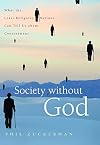
I finished reading this book on Easter, one of the holiest (and weirdest, IMO) days in America. As an atheist, it was comforting to read about people who, like me, 1) don't give much thought about God in general, 2) don't believe in heaven or hell, and 3) don't think there is an afterlife.
I'm quite jealous of people living in Denmark and Sweden who have a high standard of living and don't have to worry about religious zealots and right-wing nut jobs in their own government who are working show more to control the reproductive rights of women and are obsessed with getting all up in everyone's personal business in the name of "family values" and morality. I wish the many outspoken Christians I know would read this and gain some perspective. This book is proof that societies can be highly functional, and its citizens healthy and happy, *without* religion. show less
I'm quite jealous of people living in Denmark and Sweden who have a high standard of living and don't have to worry about religious zealots and right-wing nut jobs in their own government who are working show more to control the reproductive rights of women and are obsessed with getting all up in everyone's personal business in the name of "family values" and morality. I wish the many outspoken Christians I know would read this and gain some perspective. This book is proof that societies can be highly functional, and its citizens healthy and happy, *without* religion. show less
Society without God: What the Least Religious Nations Can Tell Us About Contentment by Phil Zuckerman
Reading this book reminded me of a conversation I once had with a psychotherapist acquaintance. I had asked her somewhat distractedly what she was planning to do for the holidays, meaning Christmastime. She looked at me rather strangely, and said, "Well, I'm Jewish. Christmas has no meaning for me at all. Christmas Day is like any other day for me. I'll read the paper, have breakfast with my family, and enjoy a day off." There was something so bland about the way she said it, that it really show more struck home how little one of the seemingly routine annual parts of community life can mean to someone who lives in the same society. I mean, I knew Jews didn't celebrate Christmas, but I figured that in a Christmas-crazy country such as the U.S., everyone was touched in some way. Apparently not.
I had the same aha! moment reading this analysis of the secular societies of Denmark and Sweden. In our own rich and self-touted "Christian" nation, we talk incessantly of faith, and of solving homelessness, poverty, hunger, joblessness, lack of health care, and illiteracy. Somehow, though, we don't fix those things. We talk the talk and then go off and pretend we've done our duty because solving such problems isn't really possible (right?), even in a country where faith would seem to be an overwhelming impetus to succeed.
Denmark and Sweden, on the other hand, have almost entirely secular societies in which thoughts of religion, faith, God, and the meaning of life have little or no place in everyday life. Shockingly little, the author thought, and so did I as I read the book. And yet these two countries rank at the top or close to the top in all areas of social welfare, and certainly above the U.S. They have solved, for all intents, all the social ills listed above. With no religious nudging, at least of the type touted in the United States, they have transformed their society into what I've always thought should be a "Christian" approach to society: sharing resources so that no one suffers who need not.
In interview after interview with Danish and Swedish citizens, the author found a repeated disinterest in religion. Not rejection, but simple disinterest. Animated and opinionated in all other areas of life, subjects often fell silent or grew bored with the topic. The supernatural, it seems, is not a topic of normal thought there. Nor is the existence of the soul, the meaning of life, or existence after death. People who do have opinions on such matters consider them private, and discussing them is considered rude. One interviewee recounted a drunken evening during which a longtime friend asked if he could share a secret about himself. He was, he said, a believer in God. He was rather embarrassed talking of such a personal issue and hoped his friend wouldn't think him a bad person for his belief.
The author proposes various reasons for the secular versus religious natures of different societies. He discusses church monopolies and the need (or lack thereof) for marketing churches, the greater or lesser degrees of personal and national security, the percentage of working women (historically the family members with the most time and interest to devote to church activities and to getting their families involved), and the history of how religion came to be adopted in a particular society (i.e., from the top down or the bottom up). He then goes on to discuss secular religion, that is, people who define themselves by religion, whether Christian, Jewish, Muslim, etc., but who are not involved in religious activities.
The book closes with interviews with a fellow professor, first in his native Denmark, and then after a year spent in California. This fellow came to the U.S. believing himself to be a Christian and left having decided that if what he saw here is Christianity, then he wasn't a Christian after all. The author asks him, So when you go back to Denmark, if someone were to ask you, what would you say to them about the religion here?.... I mean how would you explain it to other Danes?" Here's the reply: I think I would say to them, maybe you don't believe me, but the American society is -- all politics and media discussions -- is based on that everybody is very devoted Christians. Meaning that you cannot hold an office, you cannot be a president, you cannot be whatever, if you don't publicly say that you believe in God and all of your sentences end with God bless America or whatever. That we, as Danes, have to be very, very careful with joining the United States when they want us to go to war or they want us to join them in whatever endeavors they want us to join with them, because the religious fanatics in the United States have a very, very high influence on what's going to happen in the United States, and I don't think Danes know that. I think that if Danes knew that, they would be very -- I don't think they would be afraid -- but I think they would say, "no, no, we don't want to be a part of that".
Apart from the eye-opening information on how secular a society can be, how successful a secular society can be at achieving social well-being, and how unnecessary religion is as the basis for civilization, this book offers important reading for Americans, who sometimes need to look outside our borders to see how the rest of the world operates and how we are perceived "out there". show less
I had the same aha! moment reading this analysis of the secular societies of Denmark and Sweden. In our own rich and self-touted "Christian" nation, we talk incessantly of faith, and of solving homelessness, poverty, hunger, joblessness, lack of health care, and illiteracy. Somehow, though, we don't fix those things. We talk the talk and then go off and pretend we've done our duty because solving such problems isn't really possible (right?), even in a country where faith would seem to be an overwhelming impetus to succeed.
Denmark and Sweden, on the other hand, have almost entirely secular societies in which thoughts of religion, faith, God, and the meaning of life have little or no place in everyday life. Shockingly little, the author thought, and so did I as I read the book. And yet these two countries rank at the top or close to the top in all areas of social welfare, and certainly above the U.S. They have solved, for all intents, all the social ills listed above. With no religious nudging, at least of the type touted in the United States, they have transformed their society into what I've always thought should be a "Christian" approach to society: sharing resources so that no one suffers who need not.
In interview after interview with Danish and Swedish citizens, the author found a repeated disinterest in religion. Not rejection, but simple disinterest. Animated and opinionated in all other areas of life, subjects often fell silent or grew bored with the topic. The supernatural, it seems, is not a topic of normal thought there. Nor is the existence of the soul, the meaning of life, or existence after death. People who do have opinions on such matters consider them private, and discussing them is considered rude. One interviewee recounted a drunken evening during which a longtime friend asked if he could share a secret about himself. He was, he said, a believer in God. He was rather embarrassed talking of such a personal issue and hoped his friend wouldn't think him a bad person for his belief.
The author proposes various reasons for the secular versus religious natures of different societies. He discusses church monopolies and the need (or lack thereof) for marketing churches, the greater or lesser degrees of personal and national security, the percentage of working women (historically the family members with the most time and interest to devote to church activities and to getting their families involved), and the history of how religion came to be adopted in a particular society (i.e., from the top down or the bottom up). He then goes on to discuss secular religion, that is, people who define themselves by religion, whether Christian, Jewish, Muslim, etc., but who are not involved in religious activities.
The book closes with interviews with a fellow professor, first in his native Denmark, and then after a year spent in California. This fellow came to the U.S. believing himself to be a Christian and left having decided that if what he saw here is Christianity, then he wasn't a Christian after all. The author asks him, So when you go back to Denmark, if someone were to ask you, what would you say to them about the religion here?.... I mean how would you explain it to other Danes?" Here's the reply: I think I would say to them, maybe you don't believe me, but the American society is -- all politics and media discussions -- is based on that everybody is very devoted Christians. Meaning that you cannot hold an office, you cannot be a president, you cannot be whatever, if you don't publicly say that you believe in God and all of your sentences end with God bless America or whatever. That we, as Danes, have to be very, very careful with joining the United States when they want us to go to war or they want us to join them in whatever endeavors they want us to join with them, because the religious fanatics in the United States have a very, very high influence on what's going to happen in the United States, and I don't think Danes know that. I think that if Danes knew that, they would be very -- I don't think they would be afraid -- but I think they would say, "no, no, we don't want to be a part of that".
Apart from the eye-opening information on how secular a society can be, how successful a secular society can be at achieving social well-being, and how unnecessary religion is as the basis for civilization, this book offers important reading for Americans, who sometimes need to look outside our borders to see how the rest of the world operates and how we are perceived "out there". show less
Society without God : what the least religious nations can tell us about contentment by Phil Zuckerman
In his book Society without God, Phil Zuckerman challenges an assertion made by religious fundamentalists: that religion is the only thing that keeps humanity from falling into moral and ethical bankruptcy. Zuckerman takes a job teaching for a year in Denmark, one of the most secular nations on the planet, and finds that rather than being rife with moral depravity, corruption, crime and instability, its citizens actually rank among the happiest and most peaceful according to a variety of UN show more statistics.
I took copious notes while reading, as there are many quotes and anecdotes worth remembering -- an excellent and refreshing read. show less
I took copious notes while reading, as there are many quotes and anecdotes worth remembering -- an excellent and refreshing read. show less
Lists
Awards

You May Also Like


Associated Authors
Statistics
- Works
- 10
- Also by
- 4
- Members
- 600
- Popularity
- #41,874
- Rating
- 3.9
- Reviews
- 19
- ISBNs
- 47
- Languages
- 1
- Favorited
- 1