

Michael Shermer
Author of Why People Believe Weird Things: Pseudoscience, Superstition, and Other Confusions of Our Time
About the Author
Michael Shermer is the director of the Skeptics Society and the host of the Skeptics Lecture Series at the California Institute of Technology. He teaches science, technology, and evolutionary thought in the Cultural Studies Program at Occidental College.
Image credit: Michael Shermer, photo credit to Wikipedia user Loxton
Series
Works by Michael Shermer
Why People Believe Weird Things: Pseudoscience, Superstition, and Other Confusions of Our Time (1997) 2,599 copies, 45 reviews
The Believing Brain: From Ghosts and Gods to Politics and Conspiracies - How We Construct Beliefs and Reinforce Them as Truths (2011) 889 copies, 28 reviews
The Science of Good and Evil: Why People Cheat, Gossip, Care, Share, and Follow the Golden Rule (2004) 726 copies, 8 reviews
The Mind of the Market: Compassionate Apes, Competitive Humans, and Other Tales from Evolutionary Economics (2007) 317 copies, 7 reviews
The Moral Arc: How Science and Reason Lead Humanity toward Truth, Justice, and Freedom (2015) 302 copies, 16 reviews
Denying History: Who Says the Holocaust Never Happened and Why Do They Say It? (2002) — Author; Narrator, some editions — 296 copies, 3 reviews
Heavens on Earth: The Scientific Search for the Afterlife, Immortality, and Utopia (2018) 137 copies, 9 reviews
In Darwin's Shadow: The Life and Science of Alfred Russel Wallace: A Biographical Study on the Psychology of History (2002) 75 copies, 1 review
Race Across America: The Agonies and Glories of the World's Longest and Cruelest Bicycle Race (1993) 8 copies
Skeptisches Jahrbuch 3. Heilungsversprechen: Alternativmedizin zwischen Versuch und Irrtum (2004) 4 copies
Skeptic - Vol. 16, No. 3, 2011: Islam — Editor — 3 copies
Skeptic - Vol. 15, No. 3, 2010: True or False — Editor — 3 copies
Skeptic Magazine, Vol.12 No.3 — Editor — 3 copies
Skeptic - Vol. 14, No. 2, 2008: Intelligent Life — Editor — 3 copies
Skeptic, A Quarterly Publication of the Skeptics Society Devoted to the Investigation of Extraordinary Claims, Revolutionary Ideas and the Promotion of Science. 3 copies, 2 reviews
Skeptic - Vol. 09, No. 3, 2002: Theologians Confront the Possibility of Extraterrestrial Life (2002) — Editor — 3 copies
The Baloney Detection Kit 3 copies
How Science and Reason Lead Humanity toward Truth, Justice, and Freedom The Moral Arc (Hardback) - Common (2015) 2 copies
Moral Arc The 2 copies
Conspiracy Theories 2 copies
Skeptic - Vol. 19, No. 2, 2014: Who Pulled the Strings? Boston Bombing Conspiracy Theories (2014) 2 copies
A Skeptic's HR Dictionary: The ultimate self-defense guide for CEOs, HR professionals, I/O students and employees (2019) 2 copies
Skeptic - Vol. 08, No. 2, 2000: Science & Religion — Editor — 2 copies
Skeptic - Vol. 13, No. 1, 2007: Carl Sagan — Editor — 2 copies
Skeptic - Vol. 08, No. 4, 2001: Intelligent Design — Editor — 2 copies
Skeptic - Vol. 15, No. 4, 2010: Climate Skeptics — Editor — 2 copies
Skeptic - Vol. 13, No. 4, 2008: Quirkology — Editor — 2 copies
Skeptic - Vol. 13, No. 2, 2007: Richard Dawkins & Religion — Editor — 2 copies
Skeptic Magazine, Vol.3 No.3 — Editor — 2 copies
Skeptic - Vol. 09, No. 2, 2002: The Environment - How Bad Off Are We? — Editor — 2 copies
Skeptic - Vol. 10, No. 1, 2003: Roswell! — Editor — 2 copies
Skeptic - Vol. 17, No. 4, 2012: Alternative Cancer Cures — Editor — 2 copies
Skeptic - Vol. 10, No. 2, 2003: Stephen Wolfram — Editor — 2 copies
Skeptic - Vol. 10, No. 3, 2003: Evolution: Intelligent Design & Creationism — Editor — 2 copies
Skeptic - Vol. 11, No. 2, 2004: Who Are We? — Editor — 2 copies
Skeptic - Vol. 11, No. 4, 2005: Ernst Mayr 1904-2005 — Editor — 2 copies
Skeptic - Vol. 14, No. 4, 2009: The Psychology of the Ponzi Scheme — Editor — 2 copies
Skeptic - Vol. 08, No. 3, 2000: Chaos Theory - Fad or Revolution? — Editor — 2 copies
Skeptic - Vol. 09, No. 1, 2001: Behind the Anthropology Wars — Editor — 2 copies
Skeptic Vol 5 No 1 1997 — Editor — 1 copy
Freakonomics: A Rogue Economist Explores the Hidden Side of Everything: An article from: Skeptic 1 copy
"A Skeptical Manifesto" 1 copy
25 Creationists' Arguments & 25 Evolutionists' Answers: A primer for science educators on the evolution-creationism debate (1994) 1 copy
Skeptic Vol. 22 No. 1 2017 1 copy
Associated Works
What Is Your Dangerous Idea? Today's Leading Thinkers on the Unthinkable (2007) — Contributor — 668 copies, 8 reviews
Parenting Beyond Belief: On Raising Ethical, Caring Kids Without Religion (2007) — Foreword — 344 copies, 11 reviews
Abominable Science!: Origins of the Yeti, Nessie, and Other Famous Cryptids (2013) — Foreword — 138 copies, 5 reviews
Tagged
Common Knowledge
- Canonical name
- Shermer, Michael
- Legal name
- Shermer, Michael Brant
- Birthdate
- 1954-09-08
- Gender
- male
- Education
- Claremont Graduate University (PhD|History of Science|1991)
California State University, Fullerton (MA|Psychology|1978)
Pepperdine University (BA|1976) - Occupations
- science writer
editor
historian of science
television producer
television presenter
bicycle racer (show all 7)
university professor - Organizations
- Skeptics Society
Scientific American
Skeptic Magazine
Occidental College - Awards and honors
- Fellow, Linnean Society of London (2001)
Philip J. Klass Award (2006) - Agent
- Katinka Matson
John Brockman
Max Brockman
Scott Wolfman (Wolfman Productions) - Short biography
- Michael Shermer is an enthusiastic cyclist as well as a leading skeptic.Dr. Michael Shermer is the Founding Publisher of Skeptic magazine, the Executive Director of the Skeptics Society, a monthly columnist for Scientific American, the host of the The Skeptics Society’s Distinguished Science Lecture Series, and Adjunct Professor at Claremont Graduate University and Chapman University.
Dr. Shermer’s latest book is The Believing Brain. His other books include: The Mind of the Market (on evolutionary economics), Why Darwin Matters: Evolution and the Case Against Intelligent Design (about evolution, how we know it happened, and how to test it), Science Friction: Where the Known Meets the Unknown (about how the mind works and how thinking goes wrong), and The Science of Good and Evil: Why People Cheat, Gossip, Share Care, and Follow the Golden Rule (on the evolutionary origins of morality and how to be good without God). He wrote a biography, In Darwin’s Shadow (about the life and science of the co-discoverer of natural selection, Alfred Russel Wallace). He also wrote The Borderlands of Science (about the fuzzy land between science and pseudoscience), and Denying History (on Holocaust denial and other forms of pseudo history). His book How We Believe: Science, Skepticism, and the Search for God, presents his theory on the origins of religion and why people believe in God. He is also the author of Why People Believe Weird Things (on pseudoscience, superstitions, and other confusions of our time). He also wrote The Soul of Science (a brief statement of belief on science, the soul, and the afterlife, from a scientist’s perspective) and co-edited (with Pat Linse, the co-founder of Skeptic magazine) The Skeptic Encyclopedia of Pseudoscience (an analysis of the most prominent controversies made in the name of science).
Dr. Shermer received his B.A. in psychology from Pepperdine University, M.A. in experimental psychology from California State University, Fullerton, and his Ph.D. in the history of science from Claremont Graduate University (1991). He was a college professor for 20 years (1979–1998), teaching psychology, evolution, and the history of science at Occidental College (1989–1998), California State University Los Angeles, and Glendale College. Since his creation of the Skeptics Society, Skeptic magazine, and The Skeptics Society’s Distinguished Science Lecture Series, he has appeared on such shows as The Colbert Report, 20/20, Dateline, Charlie Rose, Larry King Live, Tom Snyder, Donahue, Oprah, Leeza, Unsolved Mysteries (but, proudly, never Jerry Springer!), and other shows as a skeptic of weird and extraordinary claims, as well as interviews in countless documentaries aired on PBS, A&E, Discovery, The History Channel, The Science Channel, and The Learning Channel. Shermer was the co-host and co-producer of the 13-hour Family Channel television series, Exploring the Unknown.
http://www.michaelshermer.com/about-m... - Nationality
- USA
- Birthplace
- Los Angeles, California, USA
- Places of residence
- Altadena, California, USA
- Associated Place (for map)
- California, USA
Members
Reviews
Heavens on Earth: The Scientific Search for the Afterlife, Immortality, and Utopia by Michael Shermer

It's annoying reading Shermer even when you agree with him, because of an unwillingness on his part to actually engage with rather than smugly dismiss what he's writing about. For instance he wants "counting souls" to be an obvious problem for the idea of reincarnation (if there are more people on the planet now, where do the extra souls come from), which is presupposing a western biased idea of how reincarnation would function, to make a sarcastic point about counting, when it's an show more introductory level insight to realize souls aren't treated like discrete objects, nor are they all in human hosts (as per Buddhism).
As a jarring contrast to the parts he's skeptic about, his Steven Pinker-lite rant about how everything's great because the GDP has gone up so why would you live in any era where you couldn't buy an iPhone is completely uncritical of neoliberal tropes. In fact he's chomping at the bit to extrapolate exponential growth into the future and presents the idea that the 20th century having produced "a 800% increase in growth, and he thinks the 21st century could see "a 1600% increase". No self-reflection, no self-criticism of his axiomatic acceptance of these wild claims. However, Kurtzweil and the singularity people are obviously stupid because they extrapolate from an imaginary exponential growth and Moore's Law broke down which somehow objectively proves them wrong.
It's not that Kurtzweil is right, it's Shermer being confident about handwavy appeals to prior exponential growth in the one situation (that he personally likes) and being a 'skeptic' on the very same grounds as it suits him. That's just sloppy thinking.
Similar issue blindness when he references MLK's dream speech in the context of people longing for a fantasy of the past (bizarre sequencing), as well as a direct refutation of his own smug point about the past always being worse - there was a time before the atlantic slave trade and western racial science, would you be a fool for saying the past was actually better on that issue as a black person? I guess he got carried away trying to dunk on optimistic dreaming while talking about how we should be dreaming optimistically about the current and future situation (remember those 1600% sure to come!). show less
As a jarring contrast to the parts he's skeptic about, his Steven Pinker-lite rant about how everything's great because the GDP has gone up so why would you live in any era where you couldn't buy an iPhone is completely uncritical of neoliberal tropes. In fact he's chomping at the bit to extrapolate exponential growth into the future and presents the idea that the 20th century having produced "a 800% increase in growth, and he thinks the 21st century could see "a 1600% increase". No self-reflection, no self-criticism of his axiomatic acceptance of these wild claims. However, Kurtzweil and the singularity people are obviously stupid because they extrapolate from an imaginary exponential growth and Moore's Law broke down which somehow objectively proves them wrong.
It's not that Kurtzweil is right, it's Shermer being confident about handwavy appeals to prior exponential growth in the one situation (that he personally likes) and being a 'skeptic' on the very same grounds as it suits him. That's just sloppy thinking.
Similar issue blindness when he references MLK's dream speech in the context of people longing for a fantasy of the past (bizarre sequencing), as well as a direct refutation of his own smug point about the past always being worse - there was a time before the atlantic slave trade and western racial science, would you be a fool for saying the past was actually better on that issue as a black person? I guess he got carried away trying to dunk on optimistic dreaming while talking about how we should be dreaming optimistically about the current and future situation (remember those 1600% sure to come!). show less
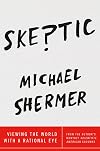
Shermer spent time as the author of a regular feature on "scientific skepticism" in the magazine Scientific American, which he's spun into a career as "That Skeptic Guy." This is a collection of his Scientific American essays (each ~2 pgs long, designed for quick reading), which he's divided into the following themes:
* Science - Essays that explore the strengths and corruptions of scientific method
* Skepticism - Essays about the challenges of pseudoscience and the art of skepticism
* show more Pseudoscience/quackery - Essays about why people believe weird things
* Paranormal/supernatural - Essays debunking ESP, Atlantis, spiritualism, and more
* Aliens/UFOs - Essays debunking UFOs and claims of extraterrestrial intelligence
* Alternative medicines - Essays debunking a range of health fads and trends
* Psychology & the brain - Essays debunking pop psychology and exploring the science behind intuition, luck, bias, and more
* Human nature - Essays exploring misconceptions about human nature
* Evolution and creationism - Essays exploring evolution denialism
* Science, religion, miracles and God - Essays endeavoring to define the space in which religion and science can coexist
One important thing to know before picking this up is that these essays are getting long in tooth. The book was published in 2016, which means the essays are even older. Many of the things that were high profile back in the late 1900s/early 2000s (ESP, cryonics) hit as dated now, while many of today's most controversial topics - climate change, vaccine denial, election denial - are unaddressed. Nor are they very "deep," but not sure that's his fault - how deep can you get in 1000 words or less?
Another issue I had was growing skepticism that Shermer isn't always as skeptical as he likes to represent. Couldn't help but note a tendency to give things the *he* believes in - nutritional supplements, favorite colleagues/authors - a bit of a pass.
The good news is that you don't need a lot of scientific background to access these essays, many of which are as entertaining as they are information.
In the main, would characterize this as a worthwhile read, and a timeless reminder of the many ways in which culture, cognitive bias, rhetoric, and misrepresentation can circumvent critical thinking. show less
* Science - Essays that explore the strengths and corruptions of scientific method
* Skepticism - Essays about the challenges of pseudoscience and the art of skepticism
* show more Pseudoscience/quackery - Essays about why people believe weird things
* Paranormal/supernatural - Essays debunking ESP, Atlantis, spiritualism, and more
* Aliens/UFOs - Essays debunking UFOs and claims of extraterrestrial intelligence
* Alternative medicines - Essays debunking a range of health fads and trends
* Psychology & the brain - Essays debunking pop psychology and exploring the science behind intuition, luck, bias, and more
* Human nature - Essays exploring misconceptions about human nature
* Evolution and creationism - Essays exploring evolution denialism
* Science, religion, miracles and God - Essays endeavoring to define the space in which religion and science can coexist
One important thing to know before picking this up is that these essays are getting long in tooth. The book was published in 2016, which means the essays are even older. Many of the things that were high profile back in the late 1900s/early 2000s (ESP, cryonics) hit as dated now, while many of today's most controversial topics - climate change, vaccine denial, election denial - are unaddressed. Nor are they very "deep," but not sure that's his fault - how deep can you get in 1000 words or less?
Another issue I had was growing skepticism that Shermer isn't always as skeptical as he likes to represent. Couldn't help but note a tendency to give things the *he* believes in - nutritional supplements, favorite colleagues/authors - a bit of a pass.
The good news is that you don't need a lot of scientific background to access these essays, many of which are as entertaining as they are information.
In the main, would characterize this as a worthwhile read, and a timeless reminder of the many ways in which culture, cognitive bias, rhetoric, and misrepresentation can circumvent critical thinking. show less
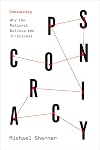
If I were to ask you if you believed that a group of shape-shifting, interstellar lizards posing as humans controlled the US Government, I’m assuming you’d probably say no. I don’t imagine you’d have much trouble explaining why, either. But I bet you'd have a much harder time explaining how it’s possible that around 12 million Americans—according to one Public Policy Polling survey—actually do believe this.
And not only that. In addition to concerns about alien lizard show more overlords, approximately 15 percent (!) of Americans believe that the Democratic Party, along with various Hollywood elites, is involved in a global satanic sex cult and pedophile ring operating out of pizzerias—as endorsed by QAnon conspiracists. Clearly, we don’t think much of our elected politicians. We don’t even believe they are human.
On one hand, it’s tempting to dismiss these beliefs outright and to simply mock conspiracy theorists for their embarrassingly low standards of evidence. But this would be the easy way out. Clearly, more than a few people believe this stuff—people who are otherwise intelligent and successful in other areas of life—so we need to know how and why so many people can fall for, frankly, patently idiotic ideas. Explaining this “conspiracy effect,” or “why smart people believe blatantly wrong things for apparently rational reasons,” is the goal of Michael Shermer’s latest book, Conspiracy: Why the Rational Believe the Irrational.
First, it’s important to get the terminology down. As Shermer defines it, a conspiracy is “two or more people, or a group, plotting or acting in secret to gain an advantage or harm others immorally or illegally.” A conspiracy theory is then “a structured belief about a conspiracy” irrespective of whether the conspiracy is true, and a conspiracy theorist, or conspiracist, is someone who holds such a theory.
Now, based on this definition, it’s obvious that conspiracies can and do occur, and have in fact occurred throughout history. No one would deny this. The prospect that groups of people—particularly those in positions of power—conspire in secret to illegally or immorally gain an advantage over others is not only plausible but likely. That’s why Shermer is correct to point out the key difference between realistic conspiracy theories and paranoid conspiracy theories.
For example, the idea that big pharmaceutical companies sometimes (though not always) prioritize profits over the health of their consumers is a realistic conspiracy theory, considering, for example, that it is widely acknowledged that Big Pharma was largely responsible for the ensuing opioid epidemic. Likewise, the idea that businesspeople and politicians conspire to rig the economy in favor of the wealthy is also realistic, considering current levels of income inequality. The idea, however, that the Democrats are cannibalistic pedophiles who harvest the blood of children for its psychedelic and life-extending benefits is an example of the paranoid variety.
Shermer, in the process of debunking various popular paranoid conspiracy theories—and exploring the real ones—provides a much-needed toolkit to help distinguish between the two. You’ll learn that most conspiracy theories simply involve too many people, and that it’s unrealistic to suppose that so many people could act so competently over time. Moral compulsions, slip-ups, mistakes, leaks, defections, and more all work against any conspiracy’s attempts to keep nefarious details a secret. The sheer improbability of it all is enough to debunk most of the more eccentric theories. The bottom line is that things never go exactly as planned, yet paranoid conspiracy theories depend on the fact that they always do.
Another way to think about it is this: If you’re a QAnon conspiracy theorist, are there any conspiracy theories you wouldn’t believe in? Are there any theories that would make you say, “wow, now that’s crazy”? When you lower your standards of evidence that much, there is no longer any reasonable method to determine between which conspiracy theories might be plausible and which are not. You are basically, at that point, surrendering your critical faculties. This book can help you recover them.
The real question remains, however, how so many people can nevertheless fall for these more outlandish theories. Shermer devotes a large part of the book to answering this question, and, having spent 30 years investigating the psychology of strange beliefs, is in the perfect position to do so. The result is a fascinating (and often unnerving) tour through the mind of the conspiracist.
To oversimplify things—and you should read the book because the details are fascinating—people believe in conspiracy theories, such the QAnon conspiracy theory above, because they (1) are evolutionarily primed to do so (recognizing patterns and agency where there is only randomness and chance), (2) believe in specific conspiracies as proxies for more fundamental or tribal beliefs, and (3) use conspiracy theories as a means of virtue signaling to their chosen group. So, for example, while people may not give much thought to the idea that Democrats harvest the blood of children, they may still profess to believe in it because (1) they distrust the government, liberals, or “elites” in general, (2) other conservatives or people they know believe in it, and (3) they find solidarity and comfort in a simple story that tells them their own group is fighting the good fight against an opposing out-group that is pure evil. This has high entertainment value as well, evidenced by the fact that many conspiracists become noticeably animated when discussing conspiracies.
The reality, of course, is that the world is complex, chaotic, and messy; conspiracy theories tell you the opposite: that the world is simple, predictable, and its evils are entirely solvable—granted you’re in on the “secret” knowledge that a group of bad guys control everything and need to be defeated at all costs. People seem to like the simplicity of this message and the moral superiority they feel from holding it.
But this doesn’t mean that the message is not complete bullshit, and it’s possible that Shermer is giving conspiracists too much credit by going out of his way to defend their beliefs as “apparently rational.” In fact, there’s a possible contradiction in Shermer’s approach that’s worth taking a minute to point out.
In a 2016 study, it was discovered that a large percentage of Americans believe that the government is concealing information about various events such as the 9/11 attacks (54.3%), alien encounters (42.6%), global warming (42.1%), the JFK assassination (49.6%), and the moon landing (24.2%), among others. But what’s interesting is that 33 percent of respondents also believe the government is withholding information concerning the “the North Dakota crash,” an entirely made-up event!
On one hand, this surely lends support to Shermer’s theory of proxy conspiracism, whereby the details of any specific conspiracy theory are deemed less important than the theory’s general correspondence to more deeply held beliefs and dogmas. If someone can believe that the government is covering up an event that never happened, then we know that a fundamental distrust of the government is dictating that individual’s specific beliefs.
But doesn’t proxy conspiracism then contradict Shermer’s “conspiracy effect,” or the idea that “smart people believe blatantly wrong things for apparently rational reasons.” What could possibly be “apparently rational” about believing in something with no information or evidence—or, in the North Dakota crash example—no possibility of evidence? If this isn’t irrational, then what possibly could be irrational? Unlike Shermer, I don’t feel any special need to justify delusional beliefs as being anything other than what they are.
Shermer might counter that the reasons for conspiratorial thinking are rooted in evolution, and that they are therefore rational. But just as we wouldn’t call the behavior of overeating ourselves to death “apparently rational” simply because we evolved in an environment of nutritional scarcity, I wouldn’t call believing in far-fetched conspiracy theories “apparently rational” simply because we evolved in an environment when it made sense to be suspicious of everyone and everything.
Rationality is best defined as the use of reason to override delusional or harmful beliefs. In the same way we would credit someone as being rational for developing healthy eating habits in the presence of an overabundance of food, we should likewise credit someone as being rational for resisting outlandish conspiracy theories in the presence of an overabundance of misinformation. Otherwise, almost anything can be called rational—when justified in evolutionary terms—and the term loses any significant meaning. So why the hesitation to call belief in QAnon conspiracy theories exactly what it is: manifestly idiotic.
Nevertheless, Shermer has, I believe, correctly identified the reasons why people believe in paranoid conspiracy theories, and I would highly recommend reading the book for the full story and psychology behind the phenomenon. It will help you to make sense of the plethora of delusional beliefs you find all around you. show less
And not only that. In addition to concerns about alien lizard show more overlords, approximately 15 percent (!) of Americans believe that the Democratic Party, along with various Hollywood elites, is involved in a global satanic sex cult and pedophile ring operating out of pizzerias—as endorsed by QAnon conspiracists. Clearly, we don’t think much of our elected politicians. We don’t even believe they are human.
On one hand, it’s tempting to dismiss these beliefs outright and to simply mock conspiracy theorists for their embarrassingly low standards of evidence. But this would be the easy way out. Clearly, more than a few people believe this stuff—people who are otherwise intelligent and successful in other areas of life—so we need to know how and why so many people can fall for, frankly, patently idiotic ideas. Explaining this “conspiracy effect,” or “why smart people believe blatantly wrong things for apparently rational reasons,” is the goal of Michael Shermer’s latest book, Conspiracy: Why the Rational Believe the Irrational.
First, it’s important to get the terminology down. As Shermer defines it, a conspiracy is “two or more people, or a group, plotting or acting in secret to gain an advantage or harm others immorally or illegally.” A conspiracy theory is then “a structured belief about a conspiracy” irrespective of whether the conspiracy is true, and a conspiracy theorist, or conspiracist, is someone who holds such a theory.
Now, based on this definition, it’s obvious that conspiracies can and do occur, and have in fact occurred throughout history. No one would deny this. The prospect that groups of people—particularly those in positions of power—conspire in secret to illegally or immorally gain an advantage over others is not only plausible but likely. That’s why Shermer is correct to point out the key difference between realistic conspiracy theories and paranoid conspiracy theories.
For example, the idea that big pharmaceutical companies sometimes (though not always) prioritize profits over the health of their consumers is a realistic conspiracy theory, considering, for example, that it is widely acknowledged that Big Pharma was largely responsible for the ensuing opioid epidemic. Likewise, the idea that businesspeople and politicians conspire to rig the economy in favor of the wealthy is also realistic, considering current levels of income inequality. The idea, however, that the Democrats are cannibalistic pedophiles who harvest the blood of children for its psychedelic and life-extending benefits is an example of the paranoid variety.
Shermer, in the process of debunking various popular paranoid conspiracy theories—and exploring the real ones—provides a much-needed toolkit to help distinguish between the two. You’ll learn that most conspiracy theories simply involve too many people, and that it’s unrealistic to suppose that so many people could act so competently over time. Moral compulsions, slip-ups, mistakes, leaks, defections, and more all work against any conspiracy’s attempts to keep nefarious details a secret. The sheer improbability of it all is enough to debunk most of the more eccentric theories. The bottom line is that things never go exactly as planned, yet paranoid conspiracy theories depend on the fact that they always do.
Another way to think about it is this: If you’re a QAnon conspiracy theorist, are there any conspiracy theories you wouldn’t believe in? Are there any theories that would make you say, “wow, now that’s crazy”? When you lower your standards of evidence that much, there is no longer any reasonable method to determine between which conspiracy theories might be plausible and which are not. You are basically, at that point, surrendering your critical faculties. This book can help you recover them.
The real question remains, however, how so many people can nevertheless fall for these more outlandish theories. Shermer devotes a large part of the book to answering this question, and, having spent 30 years investigating the psychology of strange beliefs, is in the perfect position to do so. The result is a fascinating (and often unnerving) tour through the mind of the conspiracist.
To oversimplify things—and you should read the book because the details are fascinating—people believe in conspiracy theories, such the QAnon conspiracy theory above, because they (1) are evolutionarily primed to do so (recognizing patterns and agency where there is only randomness and chance), (2) believe in specific conspiracies as proxies for more fundamental or tribal beliefs, and (3) use conspiracy theories as a means of virtue signaling to their chosen group. So, for example, while people may not give much thought to the idea that Democrats harvest the blood of children, they may still profess to believe in it because (1) they distrust the government, liberals, or “elites” in general, (2) other conservatives or people they know believe in it, and (3) they find solidarity and comfort in a simple story that tells them their own group is fighting the good fight against an opposing out-group that is pure evil. This has high entertainment value as well, evidenced by the fact that many conspiracists become noticeably animated when discussing conspiracies.
The reality, of course, is that the world is complex, chaotic, and messy; conspiracy theories tell you the opposite: that the world is simple, predictable, and its evils are entirely solvable—granted you’re in on the “secret” knowledge that a group of bad guys control everything and need to be defeated at all costs. People seem to like the simplicity of this message and the moral superiority they feel from holding it.
But this doesn’t mean that the message is not complete bullshit, and it’s possible that Shermer is giving conspiracists too much credit by going out of his way to defend their beliefs as “apparently rational.” In fact, there’s a possible contradiction in Shermer’s approach that’s worth taking a minute to point out.
In a 2016 study, it was discovered that a large percentage of Americans believe that the government is concealing information about various events such as the 9/11 attacks (54.3%), alien encounters (42.6%), global warming (42.1%), the JFK assassination (49.6%), and the moon landing (24.2%), among others. But what’s interesting is that 33 percent of respondents also believe the government is withholding information concerning the “the North Dakota crash,” an entirely made-up event!
On one hand, this surely lends support to Shermer’s theory of proxy conspiracism, whereby the details of any specific conspiracy theory are deemed less important than the theory’s general correspondence to more deeply held beliefs and dogmas. If someone can believe that the government is covering up an event that never happened, then we know that a fundamental distrust of the government is dictating that individual’s specific beliefs.
But doesn’t proxy conspiracism then contradict Shermer’s “conspiracy effect,” or the idea that “smart people believe blatantly wrong things for apparently rational reasons.” What could possibly be “apparently rational” about believing in something with no information or evidence—or, in the North Dakota crash example—no possibility of evidence? If this isn’t irrational, then what possibly could be irrational? Unlike Shermer, I don’t feel any special need to justify delusional beliefs as being anything other than what they are.
Shermer might counter that the reasons for conspiratorial thinking are rooted in evolution, and that they are therefore rational. But just as we wouldn’t call the behavior of overeating ourselves to death “apparently rational” simply because we evolved in an environment of nutritional scarcity, I wouldn’t call believing in far-fetched conspiracy theories “apparently rational” simply because we evolved in an environment when it made sense to be suspicious of everyone and everything.
Rationality is best defined as the use of reason to override delusional or harmful beliefs. In the same way we would credit someone as being rational for developing healthy eating habits in the presence of an overabundance of food, we should likewise credit someone as being rational for resisting outlandish conspiracy theories in the presence of an overabundance of misinformation. Otherwise, almost anything can be called rational—when justified in evolutionary terms—and the term loses any significant meaning. So why the hesitation to call belief in QAnon conspiracy theories exactly what it is: manifestly idiotic.
Nevertheless, Shermer has, I believe, correctly identified the reasons why people believe in paranoid conspiracy theories, and I would highly recommend reading the book for the full story and psychology behind the phenomenon. It will help you to make sense of the plethora of delusional beliefs you find all around you. show less
The Moral Arc: How Science and Reason Lead Humanity toward Truth, Justice, and Freedom by Michael Shermer
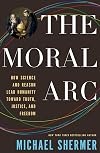
Shermer wants to argue that "morality" is a thing of which there is only one, that it can be objectively ascertained, and (conveniently) that he possesses the ability to judge what that one true morality is. More than that, this one true morality matches perfectly everything he already believes. That should be the first red flag that what Shermer talks about bears no resemblance to "morality." A true deep dive into the contours of moral thinking should leave the author feeling as challenged show more and inadequate as the reader. No such introspection here. Shermer, perhaps ironically, has found true religion (or not ironically: he goes so far as to compose his own Ten Commandments), and he speaks with all the zeal of the smug prophet.
Painting in such bold strokes is an odd strategy given that he also argues that black/white conceptualizing is inferior to viewing situations with more nuance and gradations. He would have been well advised to follow his own counsel. The real world is not as simplistic as he wants to believe, but his text does provide a good example of the kind of self-serving philosophical justifying that Westerners enjoy when rationalizing their blunderings across the world stage. They can do it because they are more "moral" (as Shermer has defined the term) than anyone who opposes them.
A hallmark of this ethical myopia is that, for Shermer, the unqualified unit of moral agency is the (Western) independent individual. This is not an unusual position, to be sure, but Shermer appears to believe that it is a self-evident claim that warrants no defense or consideration of alternative views, or how this posture complicates (or rather, should complicate) his account. For example, something is right or wrong according to the way in which it impacts the survival and flourishing of the individual. However, flourishing is defined in such a way that it necessarily includes "bonding and social relations," so that the individual, in fact, is *not* the relevant unit, or at least not simply so. Communitarianism has a role in this analysis, but not one that the author wants to directly recognize because to do so would undermine his elevation of the atomistic individual as the sole consideration for moral calculations. That such an unfettered individual does not actually exist hinders Shermer not at all.
Even were one disposed to accept his premises, there is still the problem that Shermer is an unrelenting consequentialist: Something is or is not moral not because of any intrinsic virtues, but because it yields outcomes of which Shermer approves. Many others would tend to think that the ends do not justify the means. He attempts to argue otherwise when he claims that dropping the atom bombs in WWII was the moral thing to do not because it was right in some objective sense, but because, according to some analyses, to have done otherwise would have yielded more casualties in a direct invasion of Japan. So thumbs up on nuclear attack; nuclear war is today "immoral" only because this practical summing of casualties does not similarly favor its use. But should that calculus change, then bombs away.
We have recently seen a related debate (http://www.samharris.org/blog/item/the-limits-of-discourse) highlighting the distinction I'm drawing here. Sam Harris argues with Noam Chomsky that the 9/11 attacks were worse, although killing less, than Clinton's decision to bomb the Al-Shifa pharmaceutical plant in Sudan, although killing more, because the former casualties were "intended" and the latter were not. Most commentators conclude that Chomsky's position came out better than Harris's. The problem for Shermer (who favorably refers to Harris in the book) is that Harris's position favors learned ignorance whereby I can retain my moral superiority by preserving my ignorance about the likely consequences of my actions. This undercuts Shermer's primary thesis that morality is advanced by learning. While not specifically a consequentialist argument, they share a common interest in defending prized outcomes arrived at through other means by giving them the veneer of being objectively rational. They are not.
He seems unable to separate a pragmatic consideration from a moral one, and goes so far as to equate them. This is not what most people mean by "morality," and in fact, given his views, it is unfortunate that he begins with an anecdote about MLK Jr. MLK did not argue that racial equality was the moral choice because it would be good for the economy or some such instrumental reason that Shermer would recognize as the basis of morality, but because racial inequality was an inherent evil. Equality would have been the right thing to do even if it had resulted in dreadful practical outcomes. But that is not Shermer's position, and frankly I found his consequentialism a poor basis on which to make broadly sweeping claims about "morality."
These threads combine to lead Shermer to assert that moral progress is inevitable with the advance of scientific knowledge. Thus, any potential extraterrestrial life we might encounter will necessarily be morally superior than we are: "any advanced civilization that survives long enough for us to make contact with it will also be a morally advanced civilization." The leap to this absurd conclusion, assuming as it does that every life form will have the same moral standards as we do, and that science is not a tool to be used according to our ethical choices but a force that independently forms moral consciousness, is staggering.
The book is not a difficult read, although it is probably much longer than it needed to be. At times his tone is condescending when speaking of other cultures whose traditions he disapproves. The reader is probably best advised to slide quickly over any mentions of supposed morality. The book may nonetheless be serviceable as a general overview of some themes in intellectual history and sociology and political science (all having little to do with ethics). To give Shermer credit, he recognizes this gap and tries to bridge it with an unsuccessful discussion on the naturalistic fallacy, as shown by his not fully understanding the advice given him by a Hume scholar. You can't get to 'ought' from 'is' because one can construct a link between any 'is' with any 'ought' (e.g., the empirical observation that animals engage in homosexual behavior can argue equally well that homosexuality is wrong because it's "animalistic" or that it is good because it is "natural"). Shermer sees only that, because he can construct arguments that lead to his favored outcomes, he has found a way around the logical prohibition. He hasn't. show less
Painting in such bold strokes is an odd strategy given that he also argues that black/white conceptualizing is inferior to viewing situations with more nuance and gradations. He would have been well advised to follow his own counsel. The real world is not as simplistic as he wants to believe, but his text does provide a good example of the kind of self-serving philosophical justifying that Westerners enjoy when rationalizing their blunderings across the world stage. They can do it because they are more "moral" (as Shermer has defined the term) than anyone who opposes them.
A hallmark of this ethical myopia is that, for Shermer, the unqualified unit of moral agency is the (Western) independent individual. This is not an unusual position, to be sure, but Shermer appears to believe that it is a self-evident claim that warrants no defense or consideration of alternative views, or how this posture complicates (or rather, should complicate) his account. For example, something is right or wrong according to the way in which it impacts the survival and flourishing of the individual. However, flourishing is defined in such a way that it necessarily includes "bonding and social relations," so that the individual, in fact, is *not* the relevant unit, or at least not simply so. Communitarianism has a role in this analysis, but not one that the author wants to directly recognize because to do so would undermine his elevation of the atomistic individual as the sole consideration for moral calculations. That such an unfettered individual does not actually exist hinders Shermer not at all.
Even were one disposed to accept his premises, there is still the problem that Shermer is an unrelenting consequentialist: Something is or is not moral not because of any intrinsic virtues, but because it yields outcomes of which Shermer approves. Many others would tend to think that the ends do not justify the means. He attempts to argue otherwise when he claims that dropping the atom bombs in WWII was the moral thing to do not because it was right in some objective sense, but because, according to some analyses, to have done otherwise would have yielded more casualties in a direct invasion of Japan. So thumbs up on nuclear attack; nuclear war is today "immoral" only because this practical summing of casualties does not similarly favor its use. But should that calculus change, then bombs away.
We have recently seen a related debate (http://www.samharris.org/blog/item/the-limits-of-discourse) highlighting the distinction I'm drawing here. Sam Harris argues with Noam Chomsky that the 9/11 attacks were worse, although killing less, than Clinton's decision to bomb the Al-Shifa pharmaceutical plant in Sudan, although killing more, because the former casualties were "intended" and the latter were not. Most commentators conclude that Chomsky's position came out better than Harris's. The problem for Shermer (who favorably refers to Harris in the book) is that Harris's position favors learned ignorance whereby I can retain my moral superiority by preserving my ignorance about the likely consequences of my actions. This undercuts Shermer's primary thesis that morality is advanced by learning. While not specifically a consequentialist argument, they share a common interest in defending prized outcomes arrived at through other means by giving them the veneer of being objectively rational. They are not.
He seems unable to separate a pragmatic consideration from a moral one, and goes so far as to equate them. This is not what most people mean by "morality," and in fact, given his views, it is unfortunate that he begins with an anecdote about MLK Jr. MLK did not argue that racial equality was the moral choice because it would be good for the economy or some such instrumental reason that Shermer would recognize as the basis of morality, but because racial inequality was an inherent evil. Equality would have been the right thing to do even if it had resulted in dreadful practical outcomes. But that is not Shermer's position, and frankly I found his consequentialism a poor basis on which to make broadly sweeping claims about "morality."
These threads combine to lead Shermer to assert that moral progress is inevitable with the advance of scientific knowledge. Thus, any potential extraterrestrial life we might encounter will necessarily be morally superior than we are: "any advanced civilization that survives long enough for us to make contact with it will also be a morally advanced civilization." The leap to this absurd conclusion, assuming as it does that every life form will have the same moral standards as we do, and that science is not a tool to be used according to our ethical choices but a force that independently forms moral consciousness, is staggering.
The book is not a difficult read, although it is probably much longer than it needed to be. At times his tone is condescending when speaking of other cultures whose traditions he disapproves. The reader is probably best advised to slide quickly over any mentions of supposed morality. The book may nonetheless be serviceable as a general overview of some themes in intellectual history and sociology and political science (all having little to do with ethics). To give Shermer credit, he recognizes this gap and tries to bridge it with an unsuccessful discussion on the naturalistic fallacy, as shown by his not fully understanding the advice given him by a Hume scholar. You can't get to 'ought' from 'is' because one can construct a link between any 'is' with any 'ought' (e.g., the empirical observation that animals engage in homosexual behavior can argue equally well that homosexuality is wrong because it's "animalistic" or that it is good because it is "natural"). Shermer sees only that, because he can construct arguments that lead to his favored outcomes, he has found a way around the logical prohibition. He hasn't. show less
 This review was written for LibraryThing Early Reviewers.
Lists
Awards


You May Also Like


Associated Authors
Statistics
- Works
- 148
- Also by
- 7
- Members
- 9,573
- Popularity
- #2,513
- Rating
- 3.8
- Reviews
- 192
- ISBNs
- 125
- Languages
- 12
- Favorited
- 27

