
Joseph Robert Lewis
Author of Assassins of the Steam Age
About the Author
Series
Works by Joseph Robert Lewis
Elf Saga: Solarpunk (Book 4) 1 copy
To Reign In Heaven 1 copy
Elf Saga: Doomsday (Book 1) 1 copy
Elf Saga, Book 4: Solarpunk 1 copy
Associated Works
Tagged
Common Knowledge
- Other names
- Llewelyn, Joss
- Birthdate
- 1979-06-12
- Gender
- male
- Education
- University of Maryland (English Literature)
- Occupations
- author
technical writer
technical editor - Nationality
- USA
- Birthplace
- Annapolis, Maryland, USA
- Associated Place (for map)
- Maryland, USA
Members
Discussions
Raziel's Shadow, Joseph Robert Lewis in World Reading Circle (October 2013)
Reviews

A Superhero Straight out of the Occupy Movement
(Full disclosure: I received a free electronic copy of this book for review through Library Thing's Member Giveaway program. Also, minor spoilers below.)
Sixteen-year-old Carmen Reyes Zhao should have been on top of the world. Not a year out of college and just two months after being canned from her lucrative engineering job at 3D printer megacorp Cygnus, Carmen invented something big. Like change-the-world big. Instead of stumbling all over show more themselves to rehire Carmen, her former bosses are chasing her down. Carmen not only unwittingly violated the Corporate Espionage Act by continuing her research after she was fired from Cygnus - but her invention is so revolutionary that it poses a serious threat to Cygnus's monopoly on, well, everything.
In Ultraviolet, Lewis imagines a dystopia that's so chilling precisely because it feels so real and believable - so terribly possible. The advent of 3D printers led to 30% unemployment in just a few years. Since most people can manufacture their own goods at the push of a printer button, the bulk of blue collar jobs are in garbage and recycling for the feedstock industries - dirty and dangerous work. High school ends early so that kids can go to work at fifteen. Only a "lucky" few teenagers attend college, and those who do don't waste time on "frivolous" subjects like humanities and the social sciences. The turnaround time on an engineer? Six months.
Unsurprisingly, the American government has been bought and paid for by a handful of uber-rich corporations, which craft laws and shape morality to protect their own selfish interests (money, power, market shares). Businesses like Cygnus have a vested interest in keeping people poor, uneducated, and dependent on their products. When Carmen figures out how to turn light (a free resource, as opposed to Cygnus's expensive feedstock) into physical objects, Cygnus claims ownership of her hologram projection suit so that it can bury the tech - and Carmen, in a federal prison. Luckily, she's got an entire armory at her fingertips. Literally. (My favorite is the over-the-top sword and armor based on designs from a video game, Gyroware's Demon Age 3. Lewis has an uncanny sense of pop culture trends, which makes Ultraviolet all the more fun.)
Overnight, Carmen joins the ranks of other criminal scientists. We meet Felix, another ex-Cygnus employee who discovered a new, less expensive kind of aluminum, and was swiftly fired for his ambition, as well as the mythical Dean, who created his own game changer, a recycling machine that spits out feedstock for free. Too bad Carmen and her peers were unlucky enough to be born into a country where inventing tools to help the starving masses lift themselves out of poverty is frowned upon, rather than lauded. (Spoiler alert: in this world, it's America that's backwards. Everyone else already has access to organic printers that make food out of dirt and grass, and has had for four years.) With a little help from Felix and her growing fan base, Carmen sets out to take on not just Cygnus, but the system itself.
Exciting, original, and fast-paced, Ultraviolet is a highly enjoyable read - and one with a distinctly anti-capitalist bent. It's hard to watch more than just a few minutes of Fox News - the utter contempt for the working poor, the defense of corporate welfare, and the demands to treat corporations as people, except when it comes to punishing them for criminal activity - and not think of Cygnus and its ilk. When Carmen and Felix set up camp in an abandoned Baltimore suburb, the Occupy Our Homes movement sprang to mind. Millions of people eking out a miserable existence while the one percent gets rich and then richer and then obscenely, unfathomably rich. Ultraviolet is the best kind of science fiction - one that challenges existing power structures and entreats the reader to imagine a different way of life.
And oh, how it turns American nationalism on its head! Presumably at the megacorps' request, the American government has closed the internet, thus blocking citizen access to potentially revolutionary information: Carmen's hologram projector, Dean's recycler, and the much-coveted food printer. Whereas citizens from Canada ("I hear the Mounties shoot Yankees on sight now") to Nigeria are independent and self-sufficient, acquiescence to corporate demands have all but ruined America. Yup, we're still exceptional in this 'verse - but here, American exceptionalism is a mark of shame.
Ultraviolet features a remarkably diverse cast. Carmen was born to a Chinese American father and a Latina mother; while she speaks Spanish, her inability to pick up Cantonese from dad is commented upon in passing. Best friend Mercedes ("Mercy") Ortiz is also Latina, and Felix may be read as Latino as well. (His last name is James, but he's described as having thick, curly black hair.) This doesn't seem like a lot, but the main cast of characters is rather small: Carmen, Felix, Agent Frost, Brian, Mercedes, and Dom.
In the "About the Author" page, Lewis says that he "likes writing about heroines that his daughters can respect and admire, characters who blaze their own paths with bright minds and unbreakable spirits." (Parenting, you're doing it right!) In Carmen and Ultraviolet, Lewis has most definitely succeeded. Carmen is a complex and realistic character. She's flawed, doesn't always look before she leaps, and at least initially is content to play the game in order to ensure the safety of her friends and family. Over the course of the story Carmen grows and matures; she begins to imagine a brighter future not just for her and her own, but for all of humanity. Though she's willing to fight the powers that be, she's plagued by self-doubt: is it possible to fight monsters without becoming a monster yourself?
There's even an especially awesome scene wherein Carmen bests would-be street harassers with her giant ultraviolet sword. Can I get a Hollaback! Baltimore?
The romance between Carmen and Felix is a bit awkward, but in a good way. A realistic and believable way. I hope those crazy kids make it. (The sexy scenes are a PG-13 at most. Pretty tame stuff. Ditto the violence, which frequently veers towards the cartoonish.)
I even love the chapter titles, which are mostly based on industry terms and marketing lingo ("Acquisitions," "Cold Calling," "Early Adopters"). They give little of the plot away yet still manage to impart a sense of story progression.
On the downside, I did find several editing errors (mostly the wrong tense), but nothing egregious. There are also a few plot holes - Isn't Cygnus able to track Carmen's debit card? What about Felix's stolen ID badge? And is any company dumb enough to house all its data in one place, without any off-site backups? - but nothing I wasn't willing and able to overlook. The optimistic, even utopian ending is probably the single most unrealistic part of the story. Still, it fits. Anything else would have felt wrong.
Ultraviolet is my first Joseph Robert Lewis book, but it won't be my last. The dude can write, and I am a sucker for science fiction and fantasy featuring kickass heroines.
First line: "It's easy to remember the day when my whole life changed because that's the day people started shooting at me."
Favorite line: "Africa is not a country, people."
Tearjerkiest line: "This is a new world."
http://www.easyvegan.info/2014/03/26/ultraviolet-by-joseph-robert-lewis/ show less
(Full disclosure: I received a free electronic copy of this book for review through Library Thing's Member Giveaway program. Also, minor spoilers below.)
Sixteen-year-old Carmen Reyes Zhao should have been on top of the world. Not a year out of college and just two months after being canned from her lucrative engineering job at 3D printer megacorp Cygnus, Carmen invented something big. Like change-the-world big. Instead of stumbling all over show more themselves to rehire Carmen, her former bosses are chasing her down. Carmen not only unwittingly violated the Corporate Espionage Act by continuing her research after she was fired from Cygnus - but her invention is so revolutionary that it poses a serious threat to Cygnus's monopoly on, well, everything.
In Ultraviolet, Lewis imagines a dystopia that's so chilling precisely because it feels so real and believable - so terribly possible. The advent of 3D printers led to 30% unemployment in just a few years. Since most people can manufacture their own goods at the push of a printer button, the bulk of blue collar jobs are in garbage and recycling for the feedstock industries - dirty and dangerous work. High school ends early so that kids can go to work at fifteen. Only a "lucky" few teenagers attend college, and those who do don't waste time on "frivolous" subjects like humanities and the social sciences. The turnaround time on an engineer? Six months.
Unsurprisingly, the American government has been bought and paid for by a handful of uber-rich corporations, which craft laws and shape morality to protect their own selfish interests (money, power, market shares). Businesses like Cygnus have a vested interest in keeping people poor, uneducated, and dependent on their products. When Carmen figures out how to turn light (a free resource, as opposed to Cygnus's expensive feedstock) into physical objects, Cygnus claims ownership of her hologram projection suit so that it can bury the tech - and Carmen, in a federal prison. Luckily, she's got an entire armory at her fingertips. Literally. (My favorite is the over-the-top sword and armor based on designs from a video game, Gyroware's Demon Age 3. Lewis has an uncanny sense of pop culture trends, which makes Ultraviolet all the more fun.)
Overnight, Carmen joins the ranks of other criminal scientists. We meet Felix, another ex-Cygnus employee who discovered a new, less expensive kind of aluminum, and was swiftly fired for his ambition, as well as the mythical Dean, who created his own game changer, a recycling machine that spits out feedstock for free. Too bad Carmen and her peers were unlucky enough to be born into a country where inventing tools to help the starving masses lift themselves out of poverty is frowned upon, rather than lauded. (Spoiler alert: in this world, it's America that's backwards. Everyone else already has access to organic printers that make food out of dirt and grass, and has had for four years.) With a little help from Felix and her growing fan base, Carmen sets out to take on not just Cygnus, but the system itself.
Exciting, original, and fast-paced, Ultraviolet is a highly enjoyable read - and one with a distinctly anti-capitalist bent. It's hard to watch more than just a few minutes of Fox News - the utter contempt for the working poor, the defense of corporate welfare, and the demands to treat corporations as people, except when it comes to punishing them for criminal activity - and not think of Cygnus and its ilk. When Carmen and Felix set up camp in an abandoned Baltimore suburb, the Occupy Our Homes movement sprang to mind. Millions of people eking out a miserable existence while the one percent gets rich and then richer and then obscenely, unfathomably rich. Ultraviolet is the best kind of science fiction - one that challenges existing power structures and entreats the reader to imagine a different way of life.
And oh, how it turns American nationalism on its head! Presumably at the megacorps' request, the American government has closed the internet, thus blocking citizen access to potentially revolutionary information: Carmen's hologram projector, Dean's recycler, and the much-coveted food printer. Whereas citizens from Canada ("I hear the Mounties shoot Yankees on sight now") to Nigeria are independent and self-sufficient, acquiescence to corporate demands have all but ruined America. Yup, we're still exceptional in this 'verse - but here, American exceptionalism is a mark of shame.
Ultraviolet features a remarkably diverse cast. Carmen was born to a Chinese American father and a Latina mother; while she speaks Spanish, her inability to pick up Cantonese from dad is commented upon in passing. Best friend Mercedes ("Mercy") Ortiz is also Latina, and Felix may be read as Latino as well. (His last name is James, but he's described as having thick, curly black hair.) This doesn't seem like a lot, but the main cast of characters is rather small: Carmen, Felix, Agent Frost, Brian, Mercedes, and Dom.
In the "About the Author" page, Lewis says that he "likes writing about heroines that his daughters can respect and admire, characters who blaze their own paths with bright minds and unbreakable spirits." (Parenting, you're doing it right!) In Carmen and Ultraviolet, Lewis has most definitely succeeded. Carmen is a complex and realistic character. She's flawed, doesn't always look before she leaps, and at least initially is content to play the game in order to ensure the safety of her friends and family. Over the course of the story Carmen grows and matures; she begins to imagine a brighter future not just for her and her own, but for all of humanity. Though she's willing to fight the powers that be, she's plagued by self-doubt: is it possible to fight monsters without becoming a monster yourself?
There's even an especially awesome scene wherein Carmen bests would-be street harassers with her giant ultraviolet sword. Can I get a Hollaback! Baltimore?
The romance between Carmen and Felix is a bit awkward, but in a good way. A realistic and believable way. I hope those crazy kids make it. (The sexy scenes are a PG-13 at most. Pretty tame stuff. Ditto the violence, which frequently veers towards the cartoonish.)
I even love the chapter titles, which are mostly based on industry terms and marketing lingo ("Acquisitions," "Cold Calling," "Early Adopters"). They give little of the plot away yet still manage to impart a sense of story progression.
On the downside, I did find several editing errors (mostly the wrong tense), but nothing egregious. There are also a few plot holes - Isn't Cygnus able to track Carmen's debit card? What about Felix's stolen ID badge? And is any company dumb enough to house all its data in one place, without any off-site backups? - but nothing I wasn't willing and able to overlook. The optimistic, even utopian ending is probably the single most unrealistic part of the story. Still, it fits. Anything else would have felt wrong.
Ultraviolet is my first Joseph Robert Lewis book, but it won't be my last. The dude can write, and I am a sucker for science fiction and fantasy featuring kickass heroines.
First line: "It's easy to remember the day when my whole life changed because that's the day people started shooting at me."
Favorite line: "Africa is not a country, people."
Tearjerkiest line: "This is a new world."
http://www.easyvegan.info/2014/03/26/ultraviolet-by-joseph-robert-lewis/ show less
This review was written for LibraryThing Member Giveaways.

This was my second LibraryThing Member Giveaway by Joss Llewelyn; the first, Daphne and the Silver Ash, was so good I pounced on this the moment I saw it. (Unfortunately, it took me a lot longer to get around to it than I'd have liked. Story of my life, lately.)
This was wonderful fun. Except for that, it couldn't be much more different from its predecessor. It's much lighter and quicker than Daphne; whereas that was like an illuminated manuscript of a fairy tale, this is a present-day show more steampunk extravaganza, and a joy.
Zelda, a young entrepreneur, begins the book by robbing the Smithsonian. It becomes obvious pretty quickly that this is not an ordinary heist – this is my first experience of steampunk in the present day (as opposed to the 19th century), and the integration is beautifully done. The gadgets are clever, both in concept and name:
It's a pity no one made or used Callahan's Razor, based on Callahan's Law: "Shared pain is lessened; shared joy, increased—thus do we refute entropy." show less
This was wonderful fun. Except for that, it couldn't be much more different from its predecessor. It's much lighter and quicker than Daphne; whereas that was like an illuminated manuscript of a fairy tale, this is a present-day show more steampunk extravaganza, and a joy.
Zelda, a young entrepreneur, begins the book by robbing the Smithsonian. It becomes obvious pretty quickly that this is not an ordinary heist – this is my first experience of steampunk in the present day (as opposed to the 19th century), and the integration is beautifully done. The gadgets are clever, both in concept and name:
It's a pity no one made or used Callahan's Razor, based on Callahan's Law: "Shared pain is lessened; shared joy, increased—thus do we refute entropy." show less
This review was written for LibraryThing Member Giveaways.

This book rather surprised me as I was expecting something along with a steam-punk flavor as I found in the first book in the series. Instead this particular book was pure fantasy with a very Nordic flavor. Once I got over that particular shock, I very much enjoyed FREYA THE HUNTRESS.
In fact in my opinion FREYA THE HUNTRESS is the superior book. This book has a classic fantasy plotline that draws heavily from Nordic mythology, interesting characters and a wonderful blend of horror and show more humor. Freya is a strong heroine whose motivations are plain. Erik, her husband, is her silent supporter. But my favorite character has to be Wren. Some of her one sided conversations with Wodan are hilarious.
I don’t often come across fantasies with such a Nordic influence and this one is well worth reading. I would recommend this book to anyone who enjoys epic battles between good and evil. I rate it a 4.1
***I received this book at no charge from the author in exchange for an honest review. show less
In fact in my opinion FREYA THE HUNTRESS is the superior book. This book has a classic fantasy plotline that draws heavily from Nordic mythology, interesting characters and a wonderful blend of horror and show more humor. Freya is a strong heroine whose motivations are plain. Erik, her husband, is her silent supporter. But my favorite character has to be Wren. Some of her one sided conversations with Wodan are hilarious.
I don’t often come across fantasies with such a Nordic influence and this one is well worth reading. I would recommend this book to anyone who enjoys epic battles between good and evil. I rate it a 4.1
***I received this book at no charge from the author in exchange for an honest review. show less
This review was written for LibraryThing Member Giveaways.
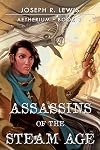
I'm not sure what a "steampunk thriller" is, exactly, but if this is an example of the genre, then I want more! This is a stunning novel of suspense, technology, and human strength. The characters draw you in and the plot keeps you hooked. This is an epic example of perfect action-adventure meets science-fiction writing. I can't wait to read more about this seemingly real world in which everything is slightly different from our reality but not always in a worse way. So much of the technology show more is fascinating and the government setup reflects the unending improvements of civilization. A truly exciting story that sneaks up on you with its wisdom and creativity. Not for the feint of heart (kind of gore-filled and at times the descriptions of animal cruelty seem all too real), this book literally has something for everyone. show less
This review was written for LibraryThing Member Giveaways.
You May Also Like


Associated Authors
Statistics
- Works
- 50
- Also by
- 3
- Members
- 981
- Popularity
- #26,256
- Rating
- 4.0
- Reviews
- 332
- ISBNs
- 35
- Favorited
- 6
