
Raymond William Postgate (1896–1971)
Author of The Outline of history: The Whole Story of Man, Volume 2
About the Author
Raymond Postgate (1896-1971) was a journalist, author, socialist, and founder of the Good Food Guide. An early advocate for communism, he broke from the Moscow directed Communist International in 1922 and became a leading figure in the independent British Labour movement. He was an astute and show more prolific commentator whose many books and articles were influential in twentieth-century British political theory and policy. show less
Works by Raymond William Postgate
Recipes from the Good Food Guide 2 copies
THE AGAMEMNON OF AESCHYLUS 2 copies
Dear Robert Emmet 2 copies
England goes to press; the English people's opinion on foreign affairs as reflected in their newspapers since Waterloo (1937) 2 copies
Every Man is God 1 copy
Pervigilivm Veneris, incerti auctoris carmen de vere : The eve of Venus in Latin and in English 1 copy
What to do with the B.B.C. 1 copy
The Bolshevik Theory (1920) 1 copy
Robert Emmet 1 copy
Associated Works
Lilliput Magazine. November - December 1952. Vol. 31 no. 6. Issue no. 186. — Contributor — 1 copy
Tagged
Common Knowledge
- Legal name
- Postgate, Raymond William
- Birthdate
- 1896-11-06
- Date of death
- 1971-03-29
- Gender
- male
- Education
- University of Oxford (St. John's College)
- Occupations
- journalist
writer
editor - Organizations
- Daily Herald
- Relationships
- Cole, Margaret (sister)
Lansbury, George (father-in-law)
Postgate, Oliver (son)
Postgate, John (son)
Postgate, John Percival (father) - Nationality
- UK
- Birthplace
- Cambridge, England, UK
- Place of death
- Canterbury, England, UK
- Associated Place (for map)
- England, UK
Members
Discussions
Collection as part of a Publishers Series? in Librarything Series (October 2021)
Reviews
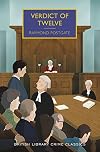
Verdict of Twelve by Raymond Postgate is a courtroom crime classic that was originally published in 1940 and now has been re-issued as a British Library Crime Classic. I have a confession to make in that I don’t usually like courtroom drama but I have to say, this book kept me glued to the pages from start to finish.
In the beginning we are introduced to the varied members of the jury and given a short history about each of them. This personality sketch comes in handy when the jury is in show more deliberation and each juror’s personality plays a part in whether or not they think the defendant is guilty. The mystery itself is intriguing and I was interested to see how this would play out as there really was a significant doubt as to what actually happened.
This is a story of human behavior and the nature of justice. It is rather frightening how much of this jury’s opinion was formed by the appearance of the defendant and the various witnesses. Their own position in society seems to determine whether or not they would vote guilty. Verdict of Twelve is original, clever and I thoroughly enjoyed this read. show less
In the beginning we are introduced to the varied members of the jury and given a short history about each of them. This personality sketch comes in handy when the jury is in show more deliberation and each juror’s personality plays a part in whether or not they think the defendant is guilty. The mystery itself is intriguing and I was interested to see how this would play out as there really was a significant doubt as to what actually happened.
This is a story of human behavior and the nature of justice. It is rather frightening how much of this jury’s opinion was formed by the appearance of the defendant and the various witnesses. Their own position in society seems to determine whether or not they would vote guilty. Verdict of Twelve is original, clever and I thoroughly enjoyed this read. show less
Raymond Postgate’s name is virtually unknown today, but in his day, no less than Raymond Chandler lauded this novel, first published in 1940. Postgate makes his intention clear from the epigraph, which is by Karl Marx: “It is not the consciousness of men that determines their existence, but, on the contrary, their social existence determines their consciousness.” In other words, people make decisions emotionally based on their own histories and experiences, not on evidence and show more reason.
Rosalie van Beer, a selfish, social-climbing widow, is accused of poisoning to death her 11-year-old nephew, Philip Arkwright, whom she heartily disliked. (The feeling was, understandably, mutual.) His death left her a very wealthy woman. So did she kill the boy? Or is there another explanation? Postgate gives you the background of all 12 jurors — 10 men and two women — as well as of the accused and those around her, but it intensifies the tension rather than bogs down the suspenseful story.The ending is maddening, as many have pointed out, but, in Postgate’s defense, it makes his point admirably.
In the interest of full disclosure, I received this book from NetGalley, Poisoned Pen Press and British Library Publishing in exchange for an honest review. Special thanks to Poisoned Pen Press for reissuing this British crime classic. show less
Rosalie van Beer, a selfish, social-climbing widow, is accused of poisoning to death her 11-year-old nephew, Philip Arkwright, whom she heartily disliked. (The feeling was, understandably, mutual.) His death left her a very wealthy woman. So did she kill the boy? Or is there another explanation? Postgate gives you the background of all 12 jurors — 10 men and two women — as well as of the accused and those around her, but it intensifies the tension rather than bogs down the suspenseful story.
In the interest of full disclosure, I received this book from NetGalley, Poisoned Pen Press and British Library Publishing in exchange for an honest review. Special thanks to Poisoned Pen Press for reissuing this British crime classic. show less

I love the fact that the British Library Crime Classics, featuring lesser-known mysteries from the Golden Age, are being made available to a wider audience. I’ve read a number of these and this terrific police procedural of murder during World War 2 is among the best I’ve read in this series.
Grayling, a man on his way home from work in a train in wartime England, sits in a railway compartment with neighbors and coworkers. When he is later found dead (and the company payroll missing), show more many of the people in his compartment are found to have great reason to want to kill the man. This mystery wonderfully tells their stories, including the relationships each had with Grayling, and why each had a reason to want Grayling dead.
This is a well-written police procedural which sheds light on wartime life. I thoroughly enjoyed it and would highly recommend it. show less
Grayling, a man on his way home from work in a train in wartime England, sits in a railway compartment with neighbors and coworkers. When he is later found dead (and the company payroll missing), show more many of the people in his compartment are found to have great reason to want to kill the man. This mystery wonderfully tells their stories, including the relationships each had with Grayling, and why each had a reason to want Grayling dead.
This is a well-written police procedural which sheds light on wartime life. I thoroughly enjoyed it and would highly recommend it. show less

CONTENT WARNING: Cruelty to animals :(
Spoilers abound!
Mrs. Rosalie Van Beer is on trial for the murder of her nephew, Philip, whom she professed to adore but who seemed to suffer more than flourish under her guardianship. It’s up to the jury to decide: was she guilty of his murder, or not guilty?
The book is structured very well and reads quickly. It illustrates how little context may be at jurors’ disposal when they have to decide the fate of another individual, and how dangerous it show more could be to sentence someone to death when you don’t have all the facts (or even when you do). However, it was horrific to read about how Mrs. Van Beer killed Philip’s pet rabbit and it was upsetting that she faced no consequences for it. So if you’re looking for a courtroom mystery, I would not necessarily recommend this one. show less
Spoilers abound!
Mrs. Rosalie Van Beer is on trial for the murder of her nephew, Philip, whom she professed to adore but who seemed to suffer more than flourish under her guardianship. It’s up to the jury to decide: was she guilty of his murder, or not guilty?
The book is structured very well and reads quickly. It illustrates how little context may be at jurors’ disposal when they have to decide the fate of another individual, and how dangerous it show more could be to sentence someone to death when you don’t have all the facts (or even when you do). However, it was horrific to read about how Mrs. Van Beer killed Philip’s pet rabbit and it was upsetting that she faced no consequences for it. So if you’re looking for a courtroom mystery, I would not necessarily recommend this one. show less
Lists
Awards


You May Also Like


Associated Authors
Statistics
- Works
- 44
- Also by
- 4
- Members
- 1,328
- Popularity
- #19,368
- Rating
- 3.7
- Reviews
- 33
- ISBNs
- 55
- Languages
- 5