
Rem Koolhaas
Author of Delirious New York: A Retroactive Manifesto for Manhattan
About the Author
Rem Koolhaas is principal of the Office for Metropolitan Architecture, Rotterdam, and the author of Delirious New York and S,M,L,XL. He is the recipient of the 2000 Pritzker Prize. (Bowker Author Biography)
Image credit: Roberto Santoroni (2005)
Series
Works by Rem Koolhaas
The Harvard Design School Guide to Shopping / Harvard Design School Project on the City 2 (2001) — Editor — 174 copies, 1 review
Rem Koolhaas & Hans-Ulrich Obrist: The Conversation Series: Volume 4 (Conversation (Verlag Der Buchhandlung)) (Pt. 4) (2006) 34 copies
Fundamentals: 14th International Architecture Exhibition-- La Biennale di Venezia (2014) 18 copies, 1 review
Rem Koolhaas & Hans Ulrich Obrist 13 copies
Sendas oníricas de Singapur : retrato de una metrópolis potemkin ... o treinta años de tabla rasa (2010) 12 copies
Atlanta 3 copies
Casa da Musica / Porto 2 copies
Al Manakh 1 copy
Six Projets 1 copy
Associated Works
Architectural Theory: From the Renaissance to the Present (2003) — Contributor — 330 copies, 3 reviews
Tagged
Common Knowledge
- Canonical name
- Koolhaas, Rem
- Legal name
- Koolhaas, Remmert Lucas
- Birthdate
- 1944-11-17
- Gender
- male
- Education
- Netherlands Film and Television Academy
Architectural Association School of Architecture
Cornell University
Institute for Architecture and Urban Studies - Occupations
- architect
architectural theorist
urbanist - Organizations
- Harvard University
- Awards and honors
- Pritzker Prize (2000)
Légion d'Honneur (Chevalier, 2001)
Praemium Imperiale (2003)
Royal Institute of British Architects Gold Medal (2004)
Honorary Doctorate (Katholieke Universiteit Leuven ∙ 2007)
American Academy of Arts and Letters (Foreign Honorary ∙ Art ∙ 2000) (show all 10)
Leone d'oro alla carriera (2010)
Honorary Fellow of the American Institute of Architects (1999)
Golden Lion of the Venice Biennale of Architecture for lifetime achievement (2010)
Ordre des Arts et des Lettres (Commandeur, 2018) - Relationships
- Koolhaas, Anton (father)
- Nationality
- Netherlands
- Birthplace
- Rotterdam, Netherlands
- Places of residence
- Rotterdam, Netherlands
Amsterdam, Netherlands
Jakarta, Indonesia - Associated Place (for map)
- Netherlands
Members
Reviews
Junkspace is one of the most entertaining things I've read this year. I love Koolhaas's prose, and his disregard for any type of critical distance. Foster's add on to Junkspace is helpful to see the essay in context, but a little repetitive and I don't think his ending remarks felt grounded in the points he'd made before--pretty much the main reasons why this wasn't a five stars for me.
I remember reading 'The Generic City' by Rem Koolhaas (pdf) when I was a masters student and greatly enjoying it. His analysis is entertainingly idiosyncratic and yet curiously illuminating. His selective account of New York’s architectural history is likewise fragmentary yet instructive. It contains a wealth of strange anecdotes, a forest of illustrations, and several underlying theses about the nature of New York City. Inevitably, the most memorable elements are weird details, such as show more Gaudi’s never-built skyscraper (pictured here), everything about Dreamland on Coney Island (which deserves the many pages Koolhaas devotes to it), the 1931 costume ball at which architects dressed as the skyscrapers they designed, and Dali’s arrival in NYC:
Theoretical points are raised in a similar, vaguely impressionistic fashion. The concept of ‘reality shortage’ was particularly intriguing, as were the culture of congestion and the analogy between hotels and movies. Much like Lefebvre in [b:Writings on Cities|1010140|Writings on Cities|Henri Lefebvre|https://images.gr-assets.com/books/1347635147s/1010140.jpg|996264], Koolhaas is no great fan of Le Corbusier, although he discusses his views on New York in some detail. This description is both acute and comical:
The most alarming unrealised proposal in the whole book, though, is Harvey Wiley Corbett’s vision of traffic planning. He thought not only that pedestrians should be relegated to first floor walkways to leave the entire street for cars, but that the front of buildings should be cut into for additional parking and traffic lanes, culminating in twenty lane streets. Can you imagine if this dystopian scheme had materialised.
'delirious new york' is by no means a systematic or full history of its architecture and planning, nor is it meant to be. Koolhaas provides detailed insight into the antecedents of iconic buildings such as the Rockefeller Centre and a real sense of the spirit of the city in the first three decades of the twentieth century, in his inimitable style. show less
For shock effect on arrival, Dali decides to realise - retroactively - a Surrealist project originally intended to upset Paris, the baking of ‘a fifteen metre loaf of bread’.
The baker on board ship offers to bake a version 2.5 metres long (the maximum capacity of the ship’s oven) with ‘a wood armature inside it so that it would not break into two the moment it began to dry…’ But when Dali disembarks an ‘utterly disconcerting thing’ happens: “Not one of the reporters [of a waiting group] asked me a single question about the loaf of bread which I held conspicuously during the whole interview either in my arm or resting on the ground as if it was a large cane…”
The disconcerter disconcerted: Dali’s first discovery is that in Manhattan Surrealism is invisible. His Reinforced Dough is just another false act among the multitudes.
Theoretical points are raised in a similar, vaguely impressionistic fashion. The concept of ‘reality shortage’ was particularly intriguing, as were the culture of congestion and the analogy between hotels and movies. Much like Lefebvre in [b:Writings on Cities|1010140|Writings on Cities|Henri Lefebvre|https://images.gr-assets.com/books/1347635147s/1010140.jpg|996264], Koolhaas is no great fan of Le Corbusier, although he discusses his views on New York in some detail. This description is both acute and comical:
The Parisian authorities do not take the Radiant proposal seriously. Their rejection forces Le Corbusier to become a Cartesian carpetbagger, peddling his horizontal glass Skyscraper like a furious prince dragging a colossal glass slipper on an Odyssey from Metropolis to Metropolis.
The most alarming unrealised proposal in the whole book, though, is Harvey Wiley Corbett’s vision of traffic planning. He thought not only that pedestrians should be relegated to first floor walkways to leave the entire street for cars, but that the front of buildings should be cut into for additional parking and traffic lanes, culminating in twenty lane streets. Can you imagine if this dystopian scheme had materialised.
'delirious new york' is by no means a systematic or full history of its architecture and planning, nor is it meant to be. Koolhaas provides detailed insight into the antecedents of iconic buildings such as the Rockefeller Centre and a real sense of the spirit of the city in the first three decades of the twentieth century, in his inimitable style. show less
Architecture under the microscope
Rem Koolhaas’s essential toolkit to building anatomies
“A resource that can be revisited over and over again, one that will arm the current and future designers of our built world with the knowledge they’ll need to address the issues they have yet to even confront.”
–ArchDaily
Architecture is a compelling mixture of stability and flux. In its solid forms, time and space collide, amalgamating distant influences, elements that have been around for over show more 5,000 years and others that were (re-)invented yesterday.
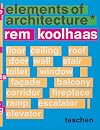
Elements of Architecture focuses on the fragments of the rich and complex architectural collage. Window, facade, balcony, corridor, fireplace, stair, escalator, elevator: The book seeks to excavate the micro-narratives of building detail. The result is no single history, but rather the web of origins, contaminations, similarities, and differences in architectural evolution, including the influence of technological advances, climactic adaptation, political calculation, economic contexts, regulatory requirements, and new digital regimes.
Derived from Koolhaas’ exhaustive and much-lauded exhibition at the 2014 Venice Architecture Biennale, this is an essential toolkit to understanding the pieces, parts, and fundamentals that comprise structure around the globe. Designed by Irma Boom, the book contains essays from Rem Koolhaas, Stephan Trueby, Manfredo di Robilant, and Jeffrey Inaba; interviews with Werner Sobek and Tony Fadell (of Nest); and an exclusive photo essay by Wolfgang Tillmans.
“A mammoth undertaking: smashing open the last 100 years of architecture and ripping out its innards for forensic analysis.”
— The Guardian show less
Rem Koolhaas’s essential toolkit to building anatomies
“A resource that can be revisited over and over again, one that will arm the current and future designers of our built world with the knowledge they’ll need to address the issues they have yet to even confront.”
–ArchDaily
Architecture is a compelling mixture of stability and flux. In its solid forms, time and space collide, amalgamating distant influences, elements that have been around for over show more 5,000 years and others that were (re-)invented yesterday.
Elements of Architecture focuses on the fragments of the rich and complex architectural collage. Window, facade, balcony, corridor, fireplace, stair, escalator, elevator: The book seeks to excavate the micro-narratives of building detail. The result is no single history, but rather the web of origins, contaminations, similarities, and differences in architectural evolution, including the influence of technological advances, climactic adaptation, political calculation, economic contexts, regulatory requirements, and new digital regimes.
Derived from Koolhaas’ exhaustive and much-lauded exhibition at the 2014 Venice Architecture Biennale, this is an essential toolkit to understanding the pieces, parts, and fundamentals that comprise structure around the globe. Designed by Irma Boom, the book contains essays from Rem Koolhaas, Stephan Trueby, Manfredo di Robilant, and Jeffrey Inaba; interviews with Werner Sobek and Tony Fadell (of Nest); and an exclusive photo essay by Wolfgang Tillmans.
“A mammoth undertaking: smashing open the last 100 years of architecture and ripping out its innards for forensic analysis.”
— The Guardian show less
This is a non-fiction book focusing on the history of New York's architecture, explaining how this city architectually exploded into what it is now. It's from the 70's so it's not exactly up to date, and the writing style lives up to it's "delirious" title sometimes.
Not every chapter is captivating, but altogether it's a very interesting history lesson on New York. I was especially surprised by the rich history of Coney Island, considering the sad (but somehow beautiful) little beach it is show more nowadays. show less
Not every chapter is captivating, but altogether it's a very interesting history lesson on New York. I was especially surprised by the rich history of Coney Island, considering the sad (but somehow beautiful) little beach it is show more nowadays. show less
Lists
Awards


You May Also Like


Associated Authors
Statistics
- Works
- 100
- Also by
- 3
- Members
- 3,153
- Popularity
- #8,105
- Rating
- 4.1
- Reviews
- 32
- ISBNs
- 122
- Languages
- 11
- Favorited
- 5