
Steve Hagen
Author of Buddhism Plain and Simple
About the Author
Steve Hagen, Roshi, has been a student and practitioner of Zen since 1967. For fifteen years he studied with Dainin Katagiri, Roshi, from whom he received Dharma Transmission (endorsement to teach) in 1989. He is the founder of the Dharma Field Zen Center in Minneapolis, Minnesota, and the author show more of such works as Buddhism Is Not What You Think (2004), Meditation Now or Never (2007) and Why the World Doesn't Seem to Make Sense (2012). show less
Image credit: Steve Hagen of Dharma Field Zen Center in Minneapolis By Jose Palmieri - Steve Hagen (copyright owner), CC BY 3.0, https://commons.wikimedia.org/w/index.php?curid=18226475
Works by Steve Hagen
How the World Can Be the Way It Is: An Inquiry for the New Millennium into Science, Philosophy, and Perception (1995) 96 copies, 1 review
Why the World Doesn't Seem to Make Sense: An Inquiry into Science, Philosophy, and Perception (2012) 56 copies, 9 reviews
El budismo explicado con sencillez : la práctica de la consciencia, aquí y ahora, todos los días (2023) 2 copies
Buddishm Without Baloney 1 copy
Associated Works
Tagged
Common Knowledge
- Birthdate
- 1945
- Gender
- male
- Occupations
- Zen priest
dharma teacher - Organizations
- Dharma Field Meditation and Learning Center
- Relationships
- Katagiri, Dainin (Zen teacher, transmission)
- Nationality
- USA
- Places of residence
- Minneapolis, Minnesota, USA
- Associated Place (for map)
- Minnesota, USA
Members
Reviews
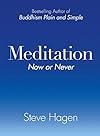
This book has 36 short chapters. I read perhaps a chapter a week. Each chapter is easy to read - ten or fifteen minutes is surely enough. I often took this book along to the video store to read it while my sweetheart looked for something to watch. It was not difficult to read even with all those distractions.
Reading a chapter and then waiting a week to read the next, that is probably a good way to read this book. This kind of teaching is deceptively simple. I imagine one could read the show more whole book in a single sitting - but get very little out of it. By allowing time to absorb each chapter, each next chapter just keeps the thread flowing, connecting through one's life. This is meditation instruction, meant to be practiced, to permeate one's whole experience.
This book is essentially focussed on shikantaza, cultivating awareness with as little formal structure as possible. It's a very curious puzzle, whether this practice is effective, or how often is it effective, under what circumstance. Hagen defends it, arguing that formal structure introduces distractions. That is surely true, I will respond, but sometimes a distraction can actually enhance awareness. With a practice of simply letting go, there can be an opportunity to quietly slip little knots of confusion under the carpet. Really letting go entirely just might require first picking up the carpet and shaking it.
Another metaphor is that of soap. To let go of dirt, it can be more effective to add extra material first, it that extra material not only rinses easily, but dissolves dirt too and allows the dirt to be rinsed away more easily.
The kind of very straight clear sitting that Hagen teaches here is an exquisite jewel and surely plays an essential role on the path to liberation. Hagen provides a wonderfully clear explanation and inspiration. This book reminds me a lot of Sunryu Suzuki's classic Zen Mind, Beginner's Mind. Hagen's book I think is a little simpler, a little easier, and therefore perhaps has a little more temptation to letting one think one has grasped something - it's a bit less elusive. The argument against structure, paradoxically enough, is just part of that simplifying structure that makes the presentation graspable, surely a sword with two edges.
Anyway, this is a great book, well worth reading for any practitioner. Read it, experience it, and then just let it go, too! show less
Reading a chapter and then waiting a week to read the next, that is probably a good way to read this book. This kind of teaching is deceptively simple. I imagine one could read the show more whole book in a single sitting - but get very little out of it. By allowing time to absorb each chapter, each next chapter just keeps the thread flowing, connecting through one's life. This is meditation instruction, meant to be practiced, to permeate one's whole experience.
This book is essentially focussed on shikantaza, cultivating awareness with as little formal structure as possible. It's a very curious puzzle, whether this practice is effective, or how often is it effective, under what circumstance. Hagen defends it, arguing that formal structure introduces distractions. That is surely true, I will respond, but sometimes a distraction can actually enhance awareness. With a practice of simply letting go, there can be an opportunity to quietly slip little knots of confusion under the carpet. Really letting go entirely just might require first picking up the carpet and shaking it.
Another metaphor is that of soap. To let go of dirt, it can be more effective to add extra material first, it that extra material not only rinses easily, but dissolves dirt too and allows the dirt to be rinsed away more easily.
The kind of very straight clear sitting that Hagen teaches here is an exquisite jewel and surely plays an essential role on the path to liberation. Hagen provides a wonderfully clear explanation and inspiration. This book reminds me a lot of Sunryu Suzuki's classic Zen Mind, Beginner's Mind. Hagen's book I think is a little simpler, a little easier, and therefore perhaps has a little more temptation to letting one think one has grasped something - it's a bit less elusive. The argument against structure, paradoxically enough, is just part of that simplifying structure that makes the presentation graspable, surely a sword with two edges.
Anyway, this is a great book, well worth reading for any practitioner. Read it, experience it, and then just let it go, too! show less
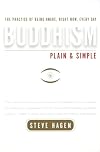
A book I've carried with me for decades, a really great short introduction to buddhism principles that sheds the usual obscurantist language or appeals to traditionalism, in favour of leapfrogging the affectations of buddhist practice and making you realize those too are only stumbling blocks. The biggest strength is that the author works very hard to explain the fundamental mystery of seeing and striving, while keeping the history and complexity of actual buddhist practice and the show more confusingly religious reality of buddhism in the east at bay. show less

Best for:
Those interested in Buddhism.
In a nutshell:
Zen priest Hagen offers his take on Buddha’s observations.
Worth quoting:
“First, you must truly realize that life is fleeting. Next, you must understand that you are already complete, worthy, whole. Finally, you must see that you are your own refuge, your own sanctuary, your own salvation.”
Why I chose it:
Continuing my spiritual journey. (I’ve always assumed I’m way too sarcastic for that level of sincerity, but here we are.)
What it show more left me feeling:
Content
Review:
This book is both extremely straightforward and also challenging. Not because of the writing, but because of the concepts. And even that isn’t the best way for me to describe it.
Hagen breaks the book into three parts. In the first, he looks at what he calls ‘The Perennial Problem’, basically the human condition as most people experience it. In the second, called ‘The Way to Wake Up,’ he explores different concepts: wisdom, morality, practice, and freedom. In the final section, ‘Free Mind,’ he looks deeper into Truth and Reality.
This is the kind of book that I’m still processing, and that I’ll read again. I think that’s kind of the case with books of this type - it’s not something that one just reads and sets up on the shelf, or put in the donation bin. The way the information is presented generally worked for me - the chapters were fairly short, and there are some good examples to help solidify the ideas. But it requires a lot of thinking from me. I think that’s the point, though. Not that it requires a lot of thinking (one might even argue that goes against the main points of the book!), but that it’s got me thinking in the right direction.
Recommend to a Friend / Keep / Donate it / Toss it:
Keep show less
Those interested in Buddhism.
In a nutshell:
Zen priest Hagen offers his take on Buddha’s observations.
Worth quoting:
“First, you must truly realize that life is fleeting. Next, you must understand that you are already complete, worthy, whole. Finally, you must see that you are your own refuge, your own sanctuary, your own salvation.”
Why I chose it:
Continuing my spiritual journey. (I’ve always assumed I’m way too sarcastic for that level of sincerity, but here we are.)
What it show more left me feeling:
Content
Review:
This book is both extremely straightforward and also challenging. Not because of the writing, but because of the concepts. And even that isn’t the best way for me to describe it.
Hagen breaks the book into three parts. In the first, he looks at what he calls ‘The Perennial Problem’, basically the human condition as most people experience it. In the second, called ‘The Way to Wake Up,’ he explores different concepts: wisdom, morality, practice, and freedom. In the final section, ‘Free Mind,’ he looks deeper into Truth and Reality.
This is the kind of book that I’m still processing, and that I’ll read again. I think that’s kind of the case with books of this type - it’s not something that one just reads and sets up on the shelf, or put in the donation bin. The way the information is presented generally worked for me - the chapters were fairly short, and there are some good examples to help solidify the ideas. But it requires a lot of thinking from me. I think that’s the point, though. Not that it requires a lot of thinking (one might even argue that goes against the main points of the book!), but that it’s got me thinking in the right direction.
Recommend to a Friend / Keep / Donate it / Toss it:
Keep show less
Why the World Doesn't Seem to Make Sense: An Inquiry into Science, Philosophy, and Perception by Steve Hagen
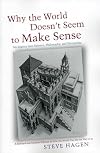
I simply do not know how to fairly appraise this book. I can't decide if I am unable to grasp the concepts from Zen Buddhism, or if I am not following the theories of quantum mechanics and modern physics, or if the author is unclear in either his thinking or presentation. The book seeks to describe Zen Buddhism concepts in terms of quantum physics.
I read the introduction and first chapter enthusiastically, believing it would be an important book making Zen concepts accessible to Western show more thinkers. I have long been intrigued by a definition of wisdom as "seeing past the illusion". This book often repeats the advice to just see. He seems to be saying that we depart from reality the moment we move from perception to conception. This is an important insight. I was looking forward to breaking through to a new level of understanding as the book would go on to further develop these ideas.
The book then delves into several scientific theories and results that challenge our conceptual abilities. These include John Barrows challenges to the presuppositions of science, the Heisenberg uncertainty principle, the nature of paradox, the twin paradox, the double slit experiment, Schrödinger's cat, the Thompson lamp, Carvello's paradox, Nagarjuna's tetralemma, complex variables, chaos theory, expansion of the universe, the Mandelbrot set, Bohm's fish, Bell's theorem, Wheeler's delayed choice experiment, spin, and quantum vacuum.
I was unable to follow the detailed connections the author strives to make between these finding from physics and corresponding Zen-like interpretations. I hold Bachelor's and Master's degrees in electrical engineering. I completed college courses in formal logic, complex variables, and quantum mechanics. Yet I am unable to see how the conclusions he draws follow from the physics and complex mathematics used in the later chapters of the book. I wrote to the author attempting to clear up several questions. He was kind enough to answer all of my questions in detail, yet I am still unable to follow his ideas.
I am willing to believe that the universe is not only more strange that we do imagine, but it is more strange than we can imagine. However I am not willing to grant that what is obscure must be profound.
The author is at his best when making statements such as: "Awareness of Reality is seeing, not conceptualizing" or "Truth reveals itself only in the moment we stop making up a story", and loses credibility with statements such as: "spin is the delineating relationship between a thing or idea—i.e., any conceptualized entity (r)—and everything else that exists (i)" and "In other words, spin, or conceptualization, is the manifestation of things as they appear in opposition to all other."
Perhaps the fundamental flaw in the construct of this book is claiming we make an error the moment we move from perception to conception and then going on to attempt to provide us a conceptual framework for understanding reality.
This book may be full of brilliant insights that are too profound for me to grasp, or it may be just another confused collection of unclear thinking. show less
I read the introduction and first chapter enthusiastically, believing it would be an important book making Zen concepts accessible to Western show more thinkers. I have long been intrigued by a definition of wisdom as "seeing past the illusion". This book often repeats the advice to just see. He seems to be saying that we depart from reality the moment we move from perception to conception. This is an important insight. I was looking forward to breaking through to a new level of understanding as the book would go on to further develop these ideas.
The book then delves into several scientific theories and results that challenge our conceptual abilities. These include John Barrows challenges to the presuppositions of science, the Heisenberg uncertainty principle, the nature of paradox, the twin paradox, the double slit experiment, Schrödinger's cat, the Thompson lamp, Carvello's paradox, Nagarjuna's tetralemma, complex variables, chaos theory, expansion of the universe, the Mandelbrot set, Bohm's fish, Bell's theorem, Wheeler's delayed choice experiment, spin, and quantum vacuum.
I was unable to follow the detailed connections the author strives to make between these finding from physics and corresponding Zen-like interpretations. I hold Bachelor's and Master's degrees in electrical engineering. I completed college courses in formal logic, complex variables, and quantum mechanics. Yet I am unable to see how the conclusions he draws follow from the physics and complex mathematics used in the later chapters of the book. I wrote to the author attempting to clear up several questions. He was kind enough to answer all of my questions in detail, yet I am still unable to follow his ideas.
I am willing to believe that the universe is not only more strange that we do imagine, but it is more strange than we can imagine. However I am not willing to grant that what is obscure must be profound.
The author is at his best when making statements such as: "Awareness of Reality is seeing, not conceptualizing" or "Truth reveals itself only in the moment we stop making up a story", and loses credibility with statements such as: "spin is the delineating relationship between a thing or idea—i.e., any conceptualized entity (r)—and everything else that exists (i)" and "In other words, spin, or conceptualization, is the manifestation of things as they appear in opposition to all other."
Perhaps the fundamental flaw in the construct of this book is claiming we make an error the moment we move from perception to conception and then going on to attempt to provide us a conceptual framework for understanding reality.
This book may be full of brilliant insights that are too profound for me to grasp, or it may be just another confused collection of unclear thinking. show less
 This review was written for LibraryThing Early Reviewers.
Lists
You May Also Like


Associated Authors
Statistics
- Works
- 11
- Also by
- 2
- Members
- 2,106
- Popularity
- #12,227
- Rating
- 3.9
- Reviews
- 29
- ISBNs
- 43
- Languages
- 4
- Favorited
- 4
