
Julia Serano
Author of Whipping Girl: A Transsexual Woman on Sexism and the Scapegoating of Femininity
About the Author
Works by Julia Serano
Whipping Girl: A Transsexual Woman on Sexism and the Scapegoating of Femininity (2007) 1,369 copies, 32 reviews
Either/Or 2 copies
On the outside looking in 2 copies
Draw Blood 2 copies
Associated Works
BITCHfest: Ten Years of Cultural Criticism from the Pages of Bitch Magazine (2006) — Contributor — 719 copies, 10 reviews
Yes Means Yes!: Visions of Female Sexual Power and A World Without Rape (2008) — Contributor — 639 copies, 12 reviews
Trans/Love: Radical Sex, Love & Relationships Beyond the Gender Binary (2011) — Contributor — 117 copies, 2 reviews
Tagged
Common Knowledge
- Canonical name
- Serano, Julia
- Legal name
- Serano, Julia Michelle
- Birthdate
- 1967
- Gender
- female
- Education
- Columbia University (Ph.D, Biochemistry and Molecular Biophysics)
- Occupations
- biologist
writer
spoken-word performer
activist - Organizations
- Femina Potens
Camp Trans
Gender Enders
University of California, Berkeley - Nationality
- USA
- Places of residence
- Oakland, California, USA
- Associated Place (for map)
- California, USA
Members
Reviews

Serano does an excellent job with 201-level feminism and trans work. She is really thinking through how, for example, cis lesbians can be oppressed by homophobia and sexism but still be transphobic and to use her term, "monosexist" toward, say, a bi trans woman. Some of her analysis is brilliant, especially about how biology and culture are just too intertwined in a human personality. I am not 100% with her on solutions just because I think the systemic aspect of traditional sexism goes show more beyond individuals confronting their gender entitlement. Which is not to say I don't think that's a worthy pursuit; it definitely is, but getting rid of my gender entitlement ain't gonna fix the Texas legislature. (Serano seems aware of this. I think it's more that she's trying to look at gender/sex/sexuality-related isms and those are particularly prone to intersectional levels of privilege and oppression)
In general, this is a book I've been looking for; something for people who are in for feminism but don't know too much about it. Worth your time. show less
In general, this is a book I've been looking for; something for people who are in for feminism but don't know too much about it. Worth your time. show less
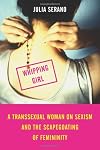
Whipping Girl is an eminently readable collection of essays about femininity, sexism and privilege, and the way these play out on our bodies. Julia Serano argues that even feminism still buys into "oppositional sexism" and continues to privilege the male/masculine over the female/feminine (with the obvious example being the difference in attention paid to male-to-female vs. female-to-male transsexuals currently and throughout history). She explains how society and feminism work to uphold the show more boundaries between the sexes, but avoids jumping onto the "all genders are only performances and represent nothing inherent in people" bandwagon. Her book is an attempt to add a trans voice to a conversation about gender, sex, feminism, and society, and she succeeds admirably in providing another well-reasoned perspective on gender issues and why things are the way they are.
I honestly very much enjoyed this book, although I'm not sure the essays should be read straight through the way I did. Some of her analyses were wonderfully insightful; one that will stick with me is the observation that the media whenever writing about trans people almost always runs pictures of transwomen putting on makeup or getting dressed and ready to go for the day. The content of the story is irrelevant; it could be about healthcare or physical battery, and the images on the side will be a woman doing her morning toilet. Serano argues, quite rightfully I believe, that this is a symptom of the social need to position trans women as engaging in a female performance, and therefore as not being "true" women (because although all kinds of women put on lipstick and mascara and whatever before going out in public, this process is only highlighted for trans women, and it's highlighted even in story contexts where it's utterly irrelevant).
Highly recommended for anyone interested in gender (what is essential vs. what is constructed), or in feminism as a construct, as well as for people working to understand privilege and intersectional privilege. Also highly recommended for anyone who finds themselves drawn to those TLC or Dateline shows about "the trans experience". show less
I honestly very much enjoyed this book, although I'm not sure the essays should be read straight through the way I did. Some of her analyses were wonderfully insightful; one that will stick with me is the observation that the media whenever writing about trans people almost always runs pictures of transwomen putting on makeup or getting dressed and ready to go for the day. The content of the story is irrelevant; it could be about healthcare or physical battery, and the images on the side will be a woman doing her morning toilet. Serano argues, quite rightfully I believe, that this is a symptom of the social need to position trans women as engaging in a female performance, and therefore as not being "true" women (because although all kinds of women put on lipstick and mascara and whatever before going out in public, this process is only highlighted for trans women, and it's highlighted even in story contexts where it's utterly irrelevant).
Highly recommended for anyone interested in gender (what is essential vs. what is constructed), or in feminism as a construct, as well as for people working to understand privilege and intersectional privilege. Also highly recommended for anyone who finds themselves drawn to those TLC or Dateline shows about "the trans experience". show less

This is an important book. Its analysis of the role of misogyny in trans-misogyny was groundbreaking at the time, and it also helped popularize the idea that gendering/misgendering people is an active process on the part of the observer rather than the "passing" paradigm that puts the onus on us and presumes the observer is a passive party. There is some uncomfortably outdated language (repeated uses of "male-bodied" etc being possibly the worst offenders), but I'm not even going to complain show more about that because I get it. My biggest complaint is something far more big picture.
Every time this book talks about how privileged nonbinary people are in trans spaces I feel like I'm reading an account from a parallel universe. (It also does that super annoying thing where it mentions intersex people and gender variant people from other cultures but only to make points about white trans people, despite paying lip service to that being a bad thing when other people do it.)
Look, I'm not even going to get into HALF of this book's bizarre statements about nonbinary and transmasc people (it would get really repetitive), I'm just gonna hit you with a couple passages.
The moment when I decided this had gone beyond something that pinged my radar and into the realm of Something I Was Going To Talk About is a particular passage where in literally the same paragraph the book says "masculine girls can grow up to be lesbians, trans men, or heterosexual women" and "trans women can be bisexual, straight, or lesbian." And just. Wow. Weird how you knew not to call all AMAB people "men" but didn't do the same for AFAB people. There's also a passage that insists that the main point of friction between binary trans people and enbies is that enbies "feel that identifying outside of the male/female binary is superior to, or more enlightened than, identifying within it." Uhhhhhh sure. Enbies bullying binary trans people is a very common and real problem that is definitely happening in real life. Definitely. TOTALLY not usually the reverse. Nailed it.
Also, I was really excited to learn that transmasc people being objectified and misgendered by lesbians is (checks notes) "preferential treatment." Seriously. That's a real thing this book explicitly argues.
I'm inclined to say the book helps more than it hurts, and it's basically impossible to be taken seriously in trans academia if you haven't read it, but wow we can do better. And there are a lot of other arguments that don't hold water or seem to be coming from a very strange place, but I'm not even going to try to catalog every single one of them (it would be pretty unfair since I'm not trying to catalog every single argument I agree with, either). But none of those bother me as much as the fact that every time it mentions enbies or transmasc spectrum people I just find myself bracing myself to be its whipping enby. show less
Every time this book talks about how privileged nonbinary people are in trans spaces I feel like I'm reading an account from a parallel universe. (It also does that super annoying thing where it mentions intersex people and gender variant people from other cultures but only to make points about white trans people, despite paying lip service to that being a bad thing when other people do it.)
Look, I'm not even going to get into HALF of this book's bizarre statements about nonbinary and transmasc people (it would get really repetitive), I'm just gonna hit you with a couple passages.
The moment when I decided this had gone beyond something that pinged my radar and into the realm of Something I Was Going To Talk About is a particular passage where in literally the same paragraph the book says "masculine girls can grow up to be lesbians, trans men, or heterosexual women" and "trans women can be bisexual, straight, or lesbian." And just. Wow. Weird how you knew not to call all AMAB people "men" but didn't do the same for AFAB people. There's also a passage that insists that the main point of friction between binary trans people and enbies is that enbies "feel that identifying outside of the male/female binary is superior to, or more enlightened than, identifying within it." Uhhhhhh sure. Enbies bullying binary trans people is a very common and real problem that is definitely happening in real life. Definitely. TOTALLY not usually the reverse. Nailed it.
Also, I was really excited to learn that transmasc people being objectified and misgendered by lesbians is (checks notes) "preferential treatment." Seriously. That's a real thing this book explicitly argues.
I'm inclined to say the book helps more than it hurts, and it's basically impossible to be taken seriously in trans academia if you haven't read it, but wow we can do better. And there are a lot of other arguments that don't hold water or seem to be coming from a very strange place, but I'm not even going to try to catalog every single one of them (it would be pretty unfair since I'm not trying to catalog every single argument I agree with, either). But none of those bother me as much as the fact that every time it mentions enbies or transmasc spectrum people I just find myself bracing myself to be its whipping enby. show less

this is such a fabulous take. honestly even just her introduction to this edition was fantastic enough to warrant the rating and the read.
she dives deep into the idea (or at least this is my main takeaway) that transphobia stems from woman-hating in general and sexism and patriarchy in particular. really really well done. no wonder this is taught in universities and has been such a staple for years. fantastic work, very impressive.
"...the media's and audience's fascination with the show more feminization of trans women is a byproduct of their sexualization of all women."
"The fact that we perceive two major categories of gender enables us to view women and men as opposites, a premise that is founded on a series of egregiously incorrect assumptions. First, in order for the two sexes to be opposites, they must first be mutually exclusive. Therefore, on a societal level, we purposefully ignore the variation that exists in sex characteristics and create the illusion that there is absolutely no overlap between the physical sexes. Second, we ignore the reality that intrinsic inclinations produce a continuous range of possibilities and instead assume that each inclination produces only one of two possible outcomes, mirroring the two sexes. Thus we assume that people can only be attracted to women or men, not both; they can only be feminine or masculine, not both; and they can only identify as female or male, not both. The third assumption we make is to presume that the typical inclination for each sex holds true for all people of that sex. Thus all female-bodied people are assumed to be feminine, to be attracted to men, and to identify as female and vice versa for male-bodied people. The very idea that there are opposite sexes unnecessarily polarizes women and men. It isolates us from one another and exaggerates our differences. It provides a framework for us to project other opposite pairs onto female and male, and femininity and masculinity. Thus we assume that men are aggressive and women are passive; men are tough and women are weak; men are practical and women are emotional; men are big and women are small, and so on. As a culture, we regularly buy into this way of thinking despite the fact that we all encounter countless exceptions that prove these assumptions incorrect: women who are aggressive, tough, practical, and/or big; and men who are passive, weak, emotional, and/or small. This idea of opposites creates expectations for femaleness and femininity and maleness and masculinity that all people are encouraged to meet and simultaneously delegitimizes all behaviors that do not fit these ideals."
"An additional problem with the word 'pass' is that it is typically only used in reference to a transsexual's identified sex, rather than their assigned sex. This gives the impression that transsexuals only begin managing other people's perceptions after we transition. Consider that people will talk about the fact that I now 'pass' as a woman, but nobody ever asked me about how difficult it must have been for me to 'pass' as a man before. Personally, I found it infinitely more difficult and stressful to manage my perceived gender back when people presumed that I was male than I do now, as female. However, once we start thinking in terms of whether a transsexual is being misgendered or appropriately gendered in accordance with their understanding of themselves as opposed to whether they are 'passing' or not in the eyes of others, then we start to gain a more accurate and realistic appreciation for the transsexual experience. In fact, you could say that most transsexuals have the experience of being misgendered throughout their childhoods and sometimes well into their adulthoods. The extent to which this constant misgendering during our formative years shapes our relationship with gender and our own self-perception cannot be underestimated." show less
she dives deep into the idea (or at least this is my main takeaway) that transphobia stems from woman-hating in general and sexism and patriarchy in particular. really really well done. no wonder this is taught in universities and has been such a staple for years. fantastic work, very impressive.
"...the media's and audience's fascination with the show more feminization of trans women is a byproduct of their sexualization of all women."
"The fact that we perceive two major categories of gender enables us to view women and men as opposites, a premise that is founded on a series of egregiously incorrect assumptions. First, in order for the two sexes to be opposites, they must first be mutually exclusive. Therefore, on a societal level, we purposefully ignore the variation that exists in sex characteristics and create the illusion that there is absolutely no overlap between the physical sexes. Second, we ignore the reality that intrinsic inclinations produce a continuous range of possibilities and instead assume that each inclination produces only one of two possible outcomes, mirroring the two sexes. Thus we assume that people can only be attracted to women or men, not both; they can only be feminine or masculine, not both; and they can only identify as female or male, not both. The third assumption we make is to presume that the typical inclination for each sex holds true for all people of that sex. Thus all female-bodied people are assumed to be feminine, to be attracted to men, and to identify as female and vice versa for male-bodied people. The very idea that there are opposite sexes unnecessarily polarizes women and men. It isolates us from one another and exaggerates our differences. It provides a framework for us to project other opposite pairs onto female and male, and femininity and masculinity. Thus we assume that men are aggressive and women are passive; men are tough and women are weak; men are practical and women are emotional; men are big and women are small, and so on. As a culture, we regularly buy into this way of thinking despite the fact that we all encounter countless exceptions that prove these assumptions incorrect: women who are aggressive, tough, practical, and/or big; and men who are passive, weak, emotional, and/or small. This idea of opposites creates expectations for femaleness and femininity and maleness and masculinity that all people are encouraged to meet and simultaneously delegitimizes all behaviors that do not fit these ideals."
"An additional problem with the word 'pass' is that it is typically only used in reference to a transsexual's identified sex, rather than their assigned sex. This gives the impression that transsexuals only begin managing other people's perceptions after we transition. Consider that people will talk about the fact that I now 'pass' as a woman, but nobody ever asked me about how difficult it must have been for me to 'pass' as a man before. Personally, I found it infinitely more difficult and stressful to manage my perceived gender back when people presumed that I was male than I do now, as female. However, once we start thinking in terms of whether a transsexual is being misgendered or appropriately gendered in accordance with their understanding of themselves as opposed to whether they are 'passing' or not in the eyes of others, then we start to gain a more accurate and realistic appreciation for the transsexual experience. In fact, you could say that most transsexuals have the experience of being misgendered throughout their childhoods and sometimes well into their adulthoods. The extent to which this constant misgendering during our formative years shapes our relationship with gender and our own self-perception cannot be underestimated." show less
Lists
Awards


You May Also Like


Associated Authors
Statistics
- Works
- 18
- Also by
- 7
- Members
- 1,845
- Popularity
- #13,950
- Rating
- 4.2
- Reviews
- 35
- ISBNs
- 23
- Languages
- 2
- Favorited
- 3
