
Richard Tarnas
Author of The Passion of the Western Mind: Understanding the Ideas that Have Shaped Our World View
About the Author
Edited by Richard Tarnas and Sean Kelly, Psyche Unbound is an homage to one of the greatest clinicians in history and his powerful legacy of healing the soul and evolving human consciousness.
Image credit: Credit: Ginaloganphotography
Works by Richard Tarnas
The Passion of the Western Mind: Understanding the Ideas that Have Shaped Our World View (1991) 1,821 copies, 10 reviews
Prometheus the Awakener: an Essay on the Archetypal Meaning of the Planet Uranus (Dunquin Series 21) (1998) 51 copies
Forms & Archetypes: The Passion of the Western Mind, Understanding the Ideas That Have Shaped Our World View (folder of marked papers) — Author — 2 copies
Associated Works
Revisioning Transpersonal Theory: A Participatory Vision of Human Spirituality (2001) — Foreword, some editions — 51 copies
The Birth of a New Discipline: Archai: The Journal of Archetypal Cosmology, Issue 1 (2009) — Contributor — 9 copies
Tagged
Common Knowledge
- Canonical name
- Tarnas, Richard
- Legal name
- Tarnas, Richard Theodore
- Birthdate
- 1950-02-21
- Gender
- male
- Education
- University of Detroit Jesuit High School and Academy
Harvard University (BA|1972)
Saybrook Institute (PhD|1976) - Occupations
- cultural historian
depth psychologist
professor of philosophy and psychology
astrologer - Organizations
- Esalen Institute
California Institute of Integral Studies - Nationality
- USA
Switzerland (birth) - Birthplace
- Geneva, Geneva, Switzerland
- Places of residence
- Detroit, Michigan, USA
Big Sur, California, USA - Associated Place (for map)
- USA
Members
Reviews
The Passion of the Western Mind: Understanding the Ideas that Have Shaped Our World View by Richard Tarnas

As you can see from the title, this book purports to be an intellectual history of the west. This turns out to mean basically western philosophy. Unfortunately it is dry as dust. I found myself slogging through it ten or so pages at a time.
Meanwhile I noticed that it consistently used "man" for "human". I presumed that meant it was fairly old - 1975 or earlier, maybe 1980 in a pinch - but when I checked, the book turned out to be copyright 1991. This caused me to hypothesize the author was show more middle aged or older when writing the book, or a hidebound reactionary.
As it turned out, he was something I find even worse. He was using this language to make a point, which he explains later on. And he shifts to normal language both in his notes and when he reached something resembling his present day. This male author regards "feminine" and "masculine" as well defined principles, presumably not culturally contingent. He sees the entirety of western cultural development as being masculine-centric, until "now", with the brilliant discoveries and innovations of psychologists like Stanislav Grof. Grof is, to put it politely, rather "fringe" in his theories, which have AFAICT become even less popular now than they were in 1991. Few people would discuss him in terms of "discoveries".
But that's only the start of my issues with Tarnas. AFAICT, he manages to give a fairly objective account of just about everything before 1900, maybe even a bit later. But after that, he writes like a true believer. He starts teaching about "truth" and "discovery" rather than "beliefs" and "theories" some time in the twentieth century, but the shift is gradual. Most of these "discoveries" come from psychiatry, and involve people like Freud, Jung, etc.
Among Tarnas' exotic beliefs: people who speak languages with grammatical gender, inevitably suffer from the same confusion of "man" with "human" common among English authors writing before the 1970s. If the word for "human being" is masculine gendered, such as the Greek anthropos, people who use it will inevitably and only somewhat consciously confuse it with the word for adult human male (andros in Greek). Their cultures will therefore be patriarchal, etc. etc. etc. (See p. 441.)
But my "throw this book across the room" moment was when, after telling me that centuries of androcentric bias were essential to the evolution of western ideas (p. 441), it was all going to be better now. All this masculinity had produced a masculine crisis, being resolved by "a tremendous emergence of the feminine in our culture" (p. 442) including the emergence of feminism. Also such feminine things as a sense of unity with the planet. "And this dramatic development is not just a compensation, not just a return of the repressed, ... [it has] ... been all along the underlying goal of Western intellectual and spiritual evolution." As I read it, women will now be useful for more than just making babies; they'll be valued for providing the "feminine principle" that more enlightened western men now recognize that they need. Wow! Such freedom! Women get new ways to serve the needs of men. (Yes, in spite of the obligatory claim that both principles are in all people, he's back to using "man" for "human", so I don't think he really means that women count as more than vessels of femininity.)
Don't read this book. If you skip the epilogue, which presents the author's theories, and use caution once it reaches the 20th century, it's probably adequate as an intellectual history. But such books are not especially rare; there are surely many competitors which are much more readable. show less
Meanwhile I noticed that it consistently used "man" for "human". I presumed that meant it was fairly old - 1975 or earlier, maybe 1980 in a pinch - but when I checked, the book turned out to be copyright 1991. This caused me to hypothesize the author was show more middle aged or older when writing the book, or a hidebound reactionary.
As it turned out, he was something I find even worse. He was using this language to make a point, which he explains later on. And he shifts to normal language both in his notes and when he reached something resembling his present day. This male author regards "feminine" and "masculine" as well defined principles, presumably not culturally contingent. He sees the entirety of western cultural development as being masculine-centric, until "now", with the brilliant discoveries and innovations of psychologists like Stanislav Grof. Grof is, to put it politely, rather "fringe" in his theories, which have AFAICT become even less popular now than they were in 1991. Few people would discuss him in terms of "discoveries".
But that's only the start of my issues with Tarnas. AFAICT, he manages to give a fairly objective account of just about everything before 1900, maybe even a bit later. But after that, he writes like a true believer. He starts teaching about "truth" and "discovery" rather than "beliefs" and "theories" some time in the twentieth century, but the shift is gradual. Most of these "discoveries" come from psychiatry, and involve people like Freud, Jung, etc.
Among Tarnas' exotic beliefs: people who speak languages with grammatical gender, inevitably suffer from the same confusion of "man" with "human" common among English authors writing before the 1970s. If the word for "human being" is masculine gendered, such as the Greek anthropos, people who use it will inevitably and only somewhat consciously confuse it with the word for adult human male (andros in Greek). Their cultures will therefore be patriarchal, etc. etc. etc. (See p. 441.)
But my "throw this book across the room" moment was when, after telling me that centuries of androcentric bias were essential to the evolution of western ideas (p. 441), it was all going to be better now. All this masculinity had produced a masculine crisis, being resolved by "a tremendous emergence of the feminine in our culture" (p. 442) including the emergence of feminism. Also such feminine things as a sense of unity with the planet. "And this dramatic development is not just a compensation, not just a return of the repressed, ... [it has] ... been all along the underlying goal of Western intellectual and spiritual evolution." As I read it, women will now be useful for more than just making babies; they'll be valued for providing the "feminine principle" that more enlightened western men now recognize that they need. Wow! Such freedom! Women get new ways to serve the needs of men. (Yes, in spite of the obligatory claim that both principles are in all people, he's back to using "man" for "human", so I don't think he really means that women count as more than vessels of femininity.)
Don't read this book. If you skip the epilogue, which presents the author's theories, and use caution once it reaches the 20th century, it's probably adequate as an intellectual history. But such books are not especially rare; there are surely many competitors which are much more readable. show less
The Passion of the Western Mind: Understanding the Ideas That Have Shaped Our World View by Richard Tarnas
This is a relatively comprehensive survey of Western thought from the early Greeks through modern times. Tarnas takes us through the several stages of Greek thought, through the rise of Christianity and and the evolution of Westerners' view of themselves and their place in the universe over the centuries. Tarnas also does a good job of taking us through our various changes as science, on the one hand, and spirituality (outside of organized religion), on the other, become sort of dually show more transcendent in modern humanity. The writing is clear, meant for "laypersons" rather than academics, although things do get kind of dense, in a way that seemed mostly unavoidable to me, when the concepts become particularly complex.
This is a discussion of relatively mainstream ideas, however. I recall little, if any, discussion, for example, of the religions that Christianity supplanted as is spread through Europe, or of the repression of those religions practiced at the time, so often including the repression (to put it mildly) of women. A look at the index, in fact, reveals that the term "Goddess worship" appears once, and not until page 443. This is the book's very final chapter, when Tarnas finally comes around to discuss these issues and to say . . . "As Jung prophesied, an epochal shift is taking place in the contemporary psyche, a reconciliation between the two great polarities, a union of opposites . . . between the long-dominant but now alienated masculine and the long-suppressed but now ascending feminine. . . . But to achieve this reintegration of the repressed feminine, the masculine must undergo a sacrifice, an ego death. The Western mind must be willing to open itself to a reality the nature of Which could shatter its most established beliefs about itself . . . . And this is the great challenge of our time, the evolutionary imperative for the masculine to see through and overcome its hubris and one-sidedness . . . " As point of reference, Tarnas was writing in 1991. He goes into much more depth in this final chapter of these concepts, but it's too bad that it all had to wait for, basically, a post-script. (And who does he mean precisely when he says, "The Western mind must be willing . . . "?)
So, all in all, this is a very useful, just detailed enough and mostly clearly written survey of the history of patriarchal Western thought. show less
This is a discussion of relatively mainstream ideas, however. I recall little, if any, discussion, for example, of the religions that Christianity supplanted as is spread through Europe, or of the repression of those religions practiced at the time, so often including the repression (to put it mildly) of women. A look at the index, in fact, reveals that the term "Goddess worship" appears once, and not until page 443. This is the book's very final chapter, when Tarnas finally comes around to discuss these issues and to say . . . "As Jung prophesied, an epochal shift is taking place in the contemporary psyche, a reconciliation between the two great polarities, a union of opposites . . . between the long-dominant but now alienated masculine and the long-suppressed but now ascending feminine. . . . But to achieve this reintegration of the repressed feminine, the masculine must undergo a sacrifice, an ego death. The Western mind must be willing to open itself to a reality the nature of Which could shatter its most established beliefs about itself . . . . And this is the great challenge of our time, the evolutionary imperative for the masculine to see through and overcome its hubris and one-sidedness . . . " As point of reference, Tarnas was writing in 1991. He goes into much more depth in this final chapter of these concepts, but it's too bad that it all had to wait for, basically, a post-script. (And who does he mean precisely when he says, "The Western mind must be willing . . . "?)
So, all in all, this is a very useful, just detailed enough and mostly clearly written survey of the history of patriarchal Western thought. show less
The Passion of the Western Mind: Understanding the Ideas that Have Shaped Our World View by Richard Tarnas
It is disconcerting to reach the end of a book and to discover that the author holds a belief that is very odd. This book purports to be a history of western thought, and acquits itself well in the first 400 pages. Tarnas is very convincing but conventional in his understanding of much of western philosophy, but seems to be competently reviewing the ground with an engaging style of writing. In the epilogue, however, he reveals that the problem proposed by Kant, namely, the impossibility of show more verifying an external reality on the basis of reason, will be resolved by a mystical union of "masculine" and "feminine" outlooks on reality. He thinks that the research of a fellow named Grof, who interpreted many strange revelations from people under the influence of LSD as revealing a universal archetype, or memory, of the womb, and the trauma of birth, is the key that will allow western man to overcome the alienation produced by Kantian solipsism. He thinks that recent feminist thought has revealed that the Western approach to the world is largely masculine, thinking of the world as an object to be perceived and mastered, rather than as a holistic and emotional experience. He is very conventional on evolution, modern physics, and physiology, and has not studied these to great effect. The historical parts of the book were very interesting, but the final astonishingly stupid conclusions makes me wonder about the unfamiliar assertions in the early portions of the work. show less
The passion of the western mind : understanding the ideas that have shaped our world view by Richard Tarnas
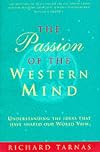
Written with energy - a constant rhythm of amazement. To bad this book is (very) uncritical, it just tells and tells without much arguments. What's worse is are lines like:
"A spontaneous and irreducible revolution of consciousness was taking place, affecting virtually every aspect of Western culture. Amidst high drama and painful convulsions, modern man was born in the Renaissance, "trailing clouds of glory.""
A few paragraphs earlier Tarnas states that this revolution of consciousness show more cannot be explained by the context --- Come on, one can't state this after less then 10 pages summarizing cultural, economical, political, religious factors that are very paradoxical and most of all new. Even Hegel is hard to believe, and he takes 100s of pages to make an argument for a continuous revolution of consciousness.
Still, I would recommend this book to everyone (who is not too scholary) with an interest in a history of the western mind. It is relatively easy to read and because Tarnas gives summaries it is easy to skip the parts that are of no interest for you. show less
"A spontaneous and irreducible revolution of consciousness was taking place, affecting virtually every aspect of Western culture. Amidst high drama and painful convulsions, modern man was born in the Renaissance, "trailing clouds of glory.""
A few paragraphs earlier Tarnas states that this revolution of consciousness show more cannot be explained by the context --- Come on, one can't state this after less then 10 pages summarizing cultural, economical, political, religious factors that are very paradoxical and most of all new. Even Hegel is hard to believe, and he takes 100s of pages to make an argument for a continuous revolution of consciousness.
Still, I would recommend this book to everyone (who is not too scholary) with an interest in a history of the western mind. It is relatively easy to read and because Tarnas gives summaries it is easy to skip the parts that are of no interest for you. show less
Lists
You May Also Like


Associated Authors
Statistics
- Works
- 24
- Also by
- 3
- Members
- 2,358
- Popularity
- #10,880
- Rating
- 4.0
- Reviews
- 14
- ISBNs
- 31
- Languages
- 6
- Favorited
- 3
