
Benvenuto Cellini (1500–1571)
Author of The Autobiography of Benvenuto Cellini
About the Author
Benvenuto Cellini was born in Florence, Italy, on November 1, 1500. He became a celebrated sculptor, goldsmith, and author, but his fierce temper caused him to be exiled and imprisoned for numerous crimes, the most serious being murder. Among Cellini's best work as a sculptor was a gold saltcellar show more made for Francis I of France, and a colossal bronze statue titled Perseus and Medusa. Other significant works include a bust of Cosimo I de Medici and Ganymede on the Eagle, both of which are now housed in the Bargello Museum in Florence. Cellini is best known for his memoirs, The Autobiography of Benvenuto Cellini, which he wrote from 1558 to 1562 and was published after his death. He died on February 13, 1571. (Bowker Author Biography) show less
Works by Benvenuto Cellini
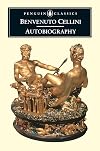
The Autobiography of Benvenuto Cellini [abridgement by Charles Hope and Alessandro Nova of the Symonds translation] (1728) 35 copies
Grolier Classics: Gulliver's Travels, Autobiography of Cellini, Decline and Fall of the Roman Empire, Aeneid (1956) 15 copies
Opere di Baldassare Castiglione, Giovanni Della Casa, Benvenuto Cellini — Author — 6 copies
Benvenuto Cellinis liv. 1 3 copies
Die saliera des Benvenuto Cellini : ein goldenes Tafelgerät für König Franz I. von Frankreich = The salt cellar of Benvenuto Cellini : a golden table utensil for King Francis I… (2006) — Artist — 2 copies
Cellinis Saliera — Artist — 2 copies
Associated Works
Tagged
Common Knowledge
- Canonical name
- Cellini, Benvenuto
- Birthdate
- 1500-11-03
- Date of death
- 1571-02-13
- Gender
- male
- Occupations
- goldsmith
sculptor
painter
soldier
musician - Nationality
- Italy
- Birthplace
- Florence, Italy
- Places of residence
- Rome, Italy
Paris, France - Place of death
- Florence, Italy
- Burial location
- church of the Annunziata, Florence, Italy
- Associated Place (for map)
- Florence, Italy
Members
Reviews

This story of a man 500 years dead is burgeoning with life. Benvenuto Cellini is not so well known for his artistry today as Leonardo or Michaelangelo, but he was close to their echelon. It is primarily his autobiography that secured him lasting fame. He was a goldsmith in Florence and Rome, and a master of several related fields besides. The products of supreme artists in this period made a splash comparable to a blockbuster Hollywood movie or top-earning concert today, and Cellini pleased show more his audiences without fail.
It seems at that time it was nothing to settle one's differences by violence in the street, preferably in front of witnesses who could attest it had been a matter of honour. Benvenuto was not one to stand down from a confrontation with anyone, not even a pope or duke whose favour he enjoyed, if pride was on the line. Unfortunately he could not apply that solution to contractors, who could be as frustrating then as now to deal with, "like shouting at a collection of lame donkeys led by a blind boy", or to the many others who took advantage of him, often including his patrons.
Interspersed scenes like the necromancy at the colosseum cast a shade of doubt over some of the proceedings. I wish a stronger shade of doubt could be cast over his confessed treatment of women and underage girls. Otherwise the degree of detail with which he recalls a sequence of events, or the conversations he had and the places he went, is astounding. My edition's footnotes back up a enormous amount of it. There's not a chapter break to be seen and it reads like one single unrolling memory, life as story, suitably ending as if only pausing for breath. show less
It seems at that time it was nothing to settle one's differences by violence in the street, preferably in front of witnesses who could attest it had been a matter of honour. Benvenuto was not one to stand down from a confrontation with anyone, not even a pope or duke whose favour he enjoyed, if pride was on the line. Unfortunately he could not apply that solution to contractors, who could be as frustrating then as now to deal with, "like shouting at a collection of lame donkeys led by a blind boy", or to the many others who took advantage of him, often including his patrons.
Interspersed scenes like the necromancy at the colosseum cast a shade of doubt over some of the proceedings. I wish a stronger shade of doubt could be cast over his confessed treatment of women and underage girls. Otherwise the degree of detail with which he recalls a sequence of events, or the conversations he had and the places he went, is astounding. My edition's footnotes back up a enormous amount of it. There's not a chapter break to be seen and it reads like one single unrolling memory, life as story, suitably ending as if only pausing for breath. show less
A more or less linear, tale-by-tale recounting of Cellini's life.
Look, you will either love this book because it gives a glimpse into life in the late Italian Renaissance, through the eyes of an extremely colorful character whose personality takes center stage, or you will dislike it for being repetitive, one-sided, and possibly offensive to modern sensibilities.
The typical story in this memoir involves someone becoming jealous of Cellini's immense talents, and using their influence to show more turn powerful people (multiple Popes, a handful of different Cardinals, the King of France, etc.) against him. Usually, Cellini's innate morality will, by the grace of God, prove him innocent. Occasionally, he will be thrown in prison, flee the city, or murder his enemy in cold blood. According to the man himself, everyone is out to get him, and only his virtue, bravery, and sheer genius keep him going. In no case will Cellini admit to a fault, or stop to wonder why this kind of thing seems to happen to him so often.
Treating him as a character in a story, I found Cellini's self-aggrandizement and lack of self-awareness funny, though in real life he'd probably be insufferable! show less
Look, you will either love this book because it gives a glimpse into life in the late Italian Renaissance, through the eyes of an extremely colorful character whose personality takes center stage, or you will dislike it for being repetitive, one-sided, and possibly offensive to modern sensibilities.
The typical story in this memoir involves someone becoming jealous of Cellini's immense talents, and using their influence to show more turn powerful people (multiple Popes, a handful of different Cardinals, the King of France, etc.) against him. Usually, Cellini's innate morality will, by the grace of God, prove him innocent. Occasionally, he will be thrown in prison, flee the city, or murder his enemy in cold blood. According to the man himself, everyone is out to get him, and only his virtue, bravery, and sheer genius keep him going. In no case will Cellini admit to a fault, or stop to wonder why this kind of thing seems to happen to him so often.
Treating him as a character in a story, I found Cellini's self-aggrandizement and lack of self-awareness funny, though in real life he'd probably be insufferable! show less
What a raucous soap opera this book was! Cellini is best known as being a master goldsmith as well as a sculptor. His first noted great work was a silver salt cellar for the King of France. Cellini was a juvenile delinquent from the age of 12 when he roamed the streets of Florence. His parents were musicians and tried to reign him in and apprentice him to musicians, but he rebelled, and he was finally apprenticed to a goldsmith. He didn't like the instruction so at age 19 he ran away to show more Rome. While there he found an old friend who lent him a workspace and gave him a piece of silver which began his career. Cellini tells fantastic stories, although I'm not sure all are believable. According to his own writings, he took part in the sack of Rome in 1527, was sued four times for sodomy, and committed murder several times. He writes that he found those who sued him and "stabbed him so badly in the arms and the legs, that he would not be mobile again." He sought out the second subject for the same, but as the man repented during the stabbing, Cellini did not injure him as badly. Cellini also believed he could conjure up devils to do his bidding. He was imprisoned several times while in Rome and believed that he had a halo around his head indicating divine protection. Eventually, he was exiled from Rome and returned to Florence where Cosimo Medici became his patron. Per his own story, Cellini was quite a narcissist who exploited almost everyone with which he came into contact. 465 pages show less
Benvenuto Cellini’s Autobiography is interesting in that it’s a rare Renaissance artist’s account of his own life. Benvenuto Cellini was a goldsmith and sculptor, who worked for numerous Popes and even the king of France – Francois I. While describing his various patrons, fellow artists, and common citizens of all statuses, the figure that looms largest is that of Benvenuto himself. A larger than life, arrogant, cantankerous, yet somehow also striking figure, he presents his life show more boldly, not bothering to deny his part in murders, petty quarrels, and sexual escapades.
He weaves an almost legendary account of his life, similar in many ways to the stories of medieval saints, starting with miracles surrounding his birth and childhood. In Cellini’s account, there’s no middle ground – all people fall into the categories of either friend or enemy, all events are either tragic or blissful.
It’s interesting how he describes the ideas and circumstances behind his masterpieces, such as the famous statue of Perseus (in Florence) and his Salt Cellar (Vienna). Although definitely biased (Benvenuto almost directly calls himself a genius), the autobiography is a fascinating read for anyone interested in Renaissance art. show less
He weaves an almost legendary account of his life, similar in many ways to the stories of medieval saints, starting with miracles surrounding his birth and childhood. In Cellini’s account, there’s no middle ground – all people fall into the categories of either friend or enemy, all events are either tragic or blissful.
It’s interesting how he describes the ideas and circumstances behind his masterpieces, such as the famous statue of Perseus (in Florence) and his Salt Cellar (Vienna). Although definitely biased (Benvenuto almost directly calls himself a genius), the autobiography is a fascinating read for anyone interested in Renaissance art. show less
Lists
Awards


You May Also Like


Associated Authors
Statistics
- Works
- 28
- Also by
- 9
- Members
- 3,105
- Popularity
- #8,230
- Rating
- 3.9
- Reviews
- 32
- ISBNs
- 131
- Languages
- 13
- Favorited
- 6


