
Christopher Moore (3) (1950–)
Author of 1867: How the Fathers Made a Deal
For other authors named Christopher Moore, see the disambiguation page.
About the Author
Christopher Moore writes about Canadian history. He has won numerous awards including a Governor General's Award for Louisbourg Portraits; the Secretary of State's Prize for Excellence in Canadian Studies for The Loyalists: Revolution, Exile, Settlement; and the Mister Christie Award for Children's show more Books with Janet Lunn for The Story of Canada. His other works include The Law Society of Upper Canada and Ontario's Lawyers, and 1867: How the Fathers Made a Deal. (Bowker Author Biography) show less
Series
Works by Christopher Moore
The Big Book of Canada (Updated Edition): Exploring the Provinces and Territories (2017) 35 copies, 12 reviews
The History of Canada Series: Three Weeks in Quebec City: The Meeting That Made Canada (2015) 15 copies, 1 review
A Catalogue of Memoires 1 copy
Associated Works
Tagged
Common Knowledge
- Canonical name
- Moore, Christopher
- Birthdate
- 1950-06-09
- Gender
- male
- Education
- University of British Columbia
University of Ottawa (MA, History) - Occupations
- writer
historian - Organizations
- Parks Canada
Canadian Broadcasting Corporation - Awards and honors
- Governor General's Literary Award
- Nationality
- Canada
- Birthplace
- Stoke-on-Trent, Staffordshire, England, UK
- Places of residence
- Toronto, Ontario, Canada
Nelson, British Columbia, Canada
Vancouver, British Columbia, Canada - Associated Place (for map)
- Canada
Members
Reviews
The Big Book of Canada (Updated Edition): Exploring the Provinces and Territories by Christopher Moore

This gazetteer is delightful, not only because of the information it includes, but because of the addition of charming illustrations by Bill Slavin. For each province and territory, you will find a brief history, a report on the geography of the region, biographies of some famous residents, a timeline (called “Moments”), a sketch of the ethnic groups living there, a description of the work they do, a look at local government, a page of trivia, and a page with something extra, unique to show more the area. It may be a local recipe (examples include Figgy duff, nanaimo bars, blueberry grunt, and bannock - I read about bannock all the time, but never knew how to make it!), or amusing place names (Skoodawabskooksis in New Brunswick!), the regional official song or a characteristic poem, or as with Newfoundland, a fun selection of regional vocabulary - who knew “dumbledore” meant “bumblebee” or that blind man’s bluff is called “bonna winkie”?
Best of all, the facts included are not dry at all; the author did an outstanding job in reporting essentials in an engaging way, as well as including very fun additional information. I loved learning about Ogopogo - the creature in Lake Okanagan in British Columbia; where one might find the only place outside the Arctic you can spot the white beluga whale; a description of the various “daredevils of Niagara” who have performed stunts over Niagara Falls (such as going over in a barrel); background on the sport of curling; and the fact that Canola oil was actually invented by Canadians (or even the fact that canola is a “crop”). And how could I not know the names for the stone markers I see all the time? It turns out names for Inuit stone markers include “Inuksuk” “Aulaqut” “Niugvaliruluit," and “Pirujaqarvik” to name just some of them.
As if all that is in the book couldn’t keep you entertained for a very long time, an annotated list is given for more books about or set in each area. (Naturally, for Prince Edward Island the Anne of Green Gables books are listed prominently.)
Evaluation: This book will provide hours of entertainment and enlightenment, and is perfect for people like me who harbor shame over not knowing much about our neighbor to the north, even while professing the desire to move there. show less
Best of all, the facts included are not dry at all; the author did an outstanding job in reporting essentials in an engaging way, as well as including very fun additional information. I loved learning about Ogopogo - the creature in Lake Okanagan in British Columbia; where one might find the only place outside the Arctic you can spot the white beluga whale; a description of the various “daredevils of Niagara” who have performed stunts over Niagara Falls (such as going over in a barrel); background on the sport of curling; and the fact that Canola oil was actually invented by Canadians (or even the fact that canola is a “crop”). And how could I not know the names for the stone markers I see all the time? It turns out names for Inuit stone markers include “Inuksuk” “Aulaqut” “Niugvaliruluit," and “Pirujaqarvik” to name just some of them.
As if all that is in the book couldn’t keep you entertained for a very long time, an annotated list is given for more books about or set in each area. (Naturally, for Prince Edward Island the Anne of Green Gables books are listed prominently.)
Evaluation: This book will provide hours of entertainment and enlightenment, and is perfect for people like me who harbor shame over not knowing much about our neighbor to the north, even while professing the desire to move there. show less
 This review was written for LibraryThing Early Reviewers.
The Big Book of Canada (Updated Edition): Exploring the Provinces and Territories by Christopher Moore
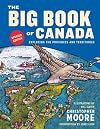
I used to love reading through encyclopedias when I was in elementary school. Before Google and Wikipedia, these big books of geography, history and more were the only way to discover interesting facts and learn about the world. Today, most people just use their computer to look for information. However, computer searching can be narrow or present incorrect material. I liked the big books that I could leaf through the pages and perhaps discover something that I wasn't looking for initially. show more The Big Book of Canada is an updated version of the 2002 book. There are maps and photos that cover every aspect of life in Canada's provinces and territories. The history sections do address problems and injustices in Canadian history. Each section provides information on geography, history, biography, significant dates and some interesting facts, recipes or poems. I enjoyed this book because it reminds me of the very pleasant hours I spent looking through books like this in when I was a child. I welcome this edition as an opportunity for today's young readers to have the experience of discovery by exploring a good book. show less
This review was written for LibraryThing Early Reviewers.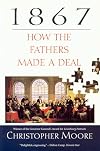
Christopher Moore writes about the confederation debates in the 1860s, and relates them to the constitutional conferences of the 1980s and 1990s. He explains the context in which the "fathers [of confederation] made a deal", and contrasts that with modern-days processes and politics. Especially interesting, to me, was the changing role of Parliament. In the 1860s, members of paliament were expected to function as representatives, not delegates. They were to bring their best judgement to show more issues, and there was no perceived need to consult the public through referenda or other means. Responsible government meant responsible to the House, and party discipline did not prevent individual members from voting as they saw best.
Today, democracy has come to mean direct democracy. As Christopher Moore puts in, everyone in Canada has an opinion on major issues, except those elected to the House of Commons, who must toe the party line.
So, not only a fine history of Canada's origins, but also a thought-provoking commentary of today's political landscape. Well worth the read. show less
Today, democracy has come to mean direct democracy. As Christopher Moore puts in, everyone in Canada has an opinion on major issues, except those elected to the House of Commons, who must toe the party line.
So, not only a fine history of Canada's origins, but also a thought-provoking commentary of today's political landscape. Well worth the read. show less

This is a solid book. The historical facts are accurate and well-written. The artwork is very nice. There wasn't a whole lot going on here that I didn't already know, but I did really enjoy the little tidbits of interesting information provided in colored boxes every few pages. At 184 pages, it was not an overwhelming read; however, at 184 pages, it was not terribly enlightening. And at 25cm tall and 21cm long, it's definitely a coffee-table book and not anything I think I would have found show more occasion to read otherwise. show less
This review was written for LibraryThing Early Reviewers.Lists
Awards


You May Also Like


Associated Authors
Statistics
- Works
- 20
- Also by
- 3
- Members
- 534
- Popularity
- #46,619
- Rating
- 3.8
- Reviews
- 30
- ISBNs
- 595
- Languages
- 15
- Favorited
- 1
