
Henry Alford (2) (1962–)
Author of How to Live: A Search for Wisdom from Old People
For other authors named Henry Alford, see the disambiguation page.
About the Author
Henry Alford has written for the New Yorker and the New York Times for two decades. His other books include How to Live and Big Kiss, which won a Thurber Prize for American Humor.
Image credit: http://henryalford.com/
Works by Henry Alford
Municipal Bondage: One Man's Anxiety-Producing Adventures in the Big City (1993) 46 copies, 2 reviews
Associated Works
Eat, Memory: Great Writers at the Table: A Collection of Essays from the New York Times (2008) — Contributor — 179 copies, 6 reviews
Money Changes Everything: Twenty-Two Writers Tackle the Last Taboo with Tales of Sudden Windfalls, Staggering Debts, and (2007) — Contributor — 51 copies, 1 review
The Artists' and Writers' Cookbook: A Collection of Stories with Recipes (2016) — Contributor — 19 copies
Tagged
Common Knowledge
- Birthdate
- 1962-02-13
- Gender
- male
- Education
- New York University
Simon's Rock College
Hotchkiss School, Lakeville, Connecticut, USA - Occupations
- humorist
journalist - Organizations
- Spy
- Nationality
- USA
- Places of residence
- Worcester, Massachusetts, USA
New York, New York, USA - Associated Place (for map)
- USA
Members
Reviews
How to Live: A Search for Wisdom from Old People (While They Are Still on This Earth) by Henry Alford
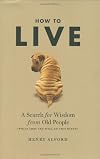
I'll be quite frank and say that although I'm madly in love with Henry Alford and am a Henry Alford completist (that is, I make a point to read pretty much everything he writes), I wasn't expecting to like this one all that much. Generally, I don't care much for books about One Man's Search for Wisdom -- they tend toward the maudlin and self-satisfied.
But I loved this one without reservation, and although I'm refraining from a five-star rating solely because I try to save that rating for show more life-changing classics, I wouldn't foreclose giving it that rating in the future after I've had a chance to digest it a little more.
Alford skillfully mixes autobiography (an account of his elderly mother's divorce from his elderly stepfather) with celebrity interview (Phyllis Diller, Sylvia Miles, Edward Albee, Ram Dass) with common-man interview, without descending into the self-involvement that so often afflicts this genre. As you might imagine, the common-man interviews are by far the most affecting -- I dare you to read Alford's interview with Althea Washington without tearing up at least once. And the people reading this who know me in real life know that I'm a pretty hardened cynic, so when I say I cried enough while reading this book on the subway that I had to duck my head a bunch of times so as not to embarrass the other passengers -- well, take from that what you will.
And of course, as to be expected in any of Alford's books, it's often knowing and funny, as in this passage:
"It occurs to me that there are some kinds of wisdom that I can't get a purchase on, perhaps because I am too callow to do so -- as in the Jean Cocteau directive, 'Whatever the public criticizes in you, cultivate. It is you.' I once actually sat and wrote down all the criticisms that have come my way over the years, in an effort to understand what Cocteau was getting at. When I contemplated emphasizing all of them, I thought, This might be a fascinating exercise. Thirty seconds later I thought, Are you out of your fucking mind?"
Of course, Alford doesn't find wisdom -- at least not in the sense that he comes to any sort of definitive answers -- and he doesn't pretend to. As with the most worthwhile endeavors, it's the journey that counts, and embarking on this journey with Alford is a genuine pleasure. show less
But I loved this one without reservation, and although I'm refraining from a five-star rating solely because I try to save that rating for show more life-changing classics, I wouldn't foreclose giving it that rating in the future after I've had a chance to digest it a little more.
Alford skillfully mixes autobiography (an account of his elderly mother's divorce from his elderly stepfather) with celebrity interview (Phyllis Diller, Sylvia Miles, Edward Albee, Ram Dass) with common-man interview, without descending into the self-involvement that so often afflicts this genre. As you might imagine, the common-man interviews are by far the most affecting -- I dare you to read Alford's interview with Althea Washington without tearing up at least once. And the people reading this who know me in real life know that I'm a pretty hardened cynic, so when I say I cried enough while reading this book on the subway that I had to duck my head a bunch of times so as not to embarrass the other passengers -- well, take from that what you will.
And of course, as to be expected in any of Alford's books, it's often knowing and funny, as in this passage:
"It occurs to me that there are some kinds of wisdom that I can't get a purchase on, perhaps because I am too callow to do so -- as in the Jean Cocteau directive, 'Whatever the public criticizes in you, cultivate. It is you.' I once actually sat and wrote down all the criticisms that have come my way over the years, in an effort to understand what Cocteau was getting at. When I contemplated emphasizing all of them, I thought, This might be a fascinating exercise. Thirty seconds later I thought, Are you out of your fucking mind?"
Of course, Alford doesn't find wisdom -- at least not in the sense that he comes to any sort of definitive answers -- and he doesn't pretend to. As with the most worthwhile endeavors, it's the journey that counts, and embarking on this journey with Alford is a genuine pleasure. show less
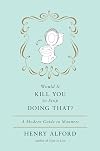
I had no idea that this book would be so funny, although I suppose the title should have given me a clue. For example, these two lines: "We are, all of us, every day, adding to the Wikipedia entry for humanity. We are, all of us, eternally, inheriting and bequeathing the toilet seat" (27). With good humor and funny anecdotes, Alford argues that "contrary to popular opinion, manners are not a luxury good that's interesting only to those who can afford to think about them... to practice good show more manners is to confer upon others not just consideration but esteem" (32). show less
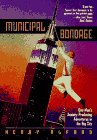
This is one of the most hilarious books I have ever read bar none.
First, Alford provides some incredibly witty accounts of different "investigations" he conducts in New York City, such as hiring a clutter consultant, trying to get some fake heirlooms auctioned off at Sotheby's, trying to find a good bed and breakfast in Manhattan, hiring a nude housecleaning service, etc. In between each of these stories are some hilarious lists, such as "What if Frank Sinatra taught acting at UCLA" or "What show more if unemployed actors worked at banks instead of restaurants". The whole thing is great.
I found myself consistently laughing at some of the things Alford did in his investigations, such as gauging what happened when he asked the nude housecleaners to do things like bleach his tub or wash his windows from the outside. All in all, this is a very satisfying book for any fan of humor. show less
First, Alford provides some incredibly witty accounts of different "investigations" he conducts in New York City, such as hiring a clutter consultant, trying to get some fake heirlooms auctioned off at Sotheby's, trying to find a good bed and breakfast in Manhattan, hiring a nude housecleaning service, etc. In between each of these stories are some hilarious lists, such as "What if Frank Sinatra taught acting at UCLA" or "What show more if unemployed actors worked at banks instead of restaurants". The whole thing is great.
I found myself consistently laughing at some of the things Alford did in his investigations, such as gauging what happened when he asked the nude housecleaners to do things like bleach his tub or wash his windows from the outside. All in all, this is a very satisfying book for any fan of humor. show less
I love Henry Alford almost beyond reason. This book, his first, contains one of the funniest essays I've ever read: Alford, annoyed that all his friends are getting to sign up for gift registries when they get married and so forth, signs up for a registry just because, asking for items such as one white plastic mug, a bag of potato chips, and Garfield underpants. (Trust me, it's a lot funnier when Alford tells it.) The fabulous Jessica and I still quote this one at each other from time to show more time.
Get this book and read it RIGHT THIS SECOND. show less
Get this book and read it RIGHT THIS SECOND. show less
Awards


You May Also Like


Associated Authors
Statistics
- Works
- 6
- Also by
- 5
- Members
- 478
- Popularity
- #51,586
- Rating
- 3.3
- Reviews
- 29
- ISBNs
- 67