
Sara Lawrence-Lightfoot
Author of Balm in Gilead: Journey of a Healer
About the Author
Sara Lawrence-Lightfoot, a MacArthur Prize-winning sociologist, is the Emily Hargroves Fisher Professor of Education at Harvard University, where she has been on the faculty since 1972. Educator, researcher, author, and public intellectual, Lawrence-Lightfoot has written nine books, including show more Respect: An Exploration and The Essential Conversation: What Parents and Teachers Can Learn from Each Other. Her book Balm in Gilead: Journey of a Healer won the 1988 Christopher Award, given for "literary merit and humanitarian achievement." show less
Works by Sara Lawrence-Lightfoot
The Third Chapter: Passion, Risk, and Adventure in the 25 Years After 50 (2009) 151 copies, 2 reviews
The Essential Conversation: What Parents and Teachers Can Learn from Each Other (2003) 102 copies, 1 review
Associated Works
A World of Ideas : Conversations With Thoughtful Men and Women About American Life Today and the Ideas Shaping Our Future (1989) — Interviewee — 603 copies, 1 review
Tagged
Common Knowledge
- Canonical name
- Lawrence-Lightfoot, Sara
- Birthdate
- 1944-08-22
- Gender
- female
- Relationships
- Lawrence, Margaret Morgan (mother)
Wehmiller, Paula Lawrence (sister)
Lawrence III, Charles R. (brother) - Nationality
- USA
- Associated Place (for map)
- USA
Members
Reviews
The Essential Conversation: What Parents and Teachers Can Learn from Each Other by Sara Lawrence-Lightfoot
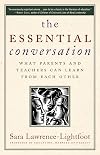
Beautifully written, attentive to nuance, and deeply knowledgeable, this book sets a very high standard for teachers. Experienced as a teacher, parent, researcher, and influential scholar and theorist of education, Lawrence-Lightfoot sought out, interviewed, and observed teachers (all women) who were particularly strong at negotiating the family-school boundary. She focused most intently on parent-teacher conferences, which she refers to as a microcosm that reveals the macrocosmic effects of show more institutional and cultural forces.
As a retired teacher of many years' experience with parent teacher conferences on both sides of the fence, I read the book with increasing gloom. The author, to counteract the effect of a literature that focuses on the deficiencies of teachers, chose to seek out and focus on teachers who are not typical because of the outstanding efficacy of their communication with parents. And as I read the accounts of these wonderful people, who devoted tremendous effort, time, emotional availability, and wisdom to their efforts, I remembered how I felt just before I retired. I had gotten really good at multitasking, but I was still working many more hours and months than my apparent schedule. I was exhausted. And anxious. All the time.
I sat on both sides of many parent-teacher conferences myself. I was pretty good at it. I was a lifelong member of the community where my school was situated, and a graduate of similar schools. I had a Ph.D. in education and a strong reputation. I knew the limits of schooling's scope, from both sides of the fence, and I was good at making parents feel safe and able, often, to hear what their children's experience of school was like during the day. But by the end of the parent conference day, I was always exhausted and emotionally wrung out.
As Lawrence-Lightfoot says, "There is something peculiarly American about the extraordinary aspirations that we citizens--whether rich or poor--have for our schools." We believe that schools can fix every social ill, provide opportunity for every child, remediate every wrong, and do it on the backs of saintly, devoted, highly professional idealized teachers. We are therefore endlessly being disappointed, and blaming it on teachers whom we increasingly treat like unskilled workers.
The book is worth reading, for the light it casts on the tensions and boundaries between the role of teacher and the role of parent and for the good advice and excellent examples it provides. But I am troubled by the implicit message it gives, in spite of itself (Lawrence-Lightfoot does say she believes schools should back off from many of their loftier claims to provide achievement) that teachers must shoulder even more responsibility. Teachers are not--and should not be--saints or nuns. And school, for all our fervent hopes, is rarely a site of transformational redemption for our students. We all do the best we can most of the time; some of the time we don't; and things happen. Life is uncomfortable. And if we insist, as Lawrence-Lightfoot points out repeatedly, on re-fighting our own childhood traumas and failures through our children and our students on the battlefield of school, we aren't doing our kids any favors. show less
As a retired teacher of many years' experience with parent teacher conferences on both sides of the fence, I read the book with increasing gloom. The author, to counteract the effect of a literature that focuses on the deficiencies of teachers, chose to seek out and focus on teachers who are not typical because of the outstanding efficacy of their communication with parents. And as I read the accounts of these wonderful people, who devoted tremendous effort, time, emotional availability, and wisdom to their efforts, I remembered how I felt just before I retired. I had gotten really good at multitasking, but I was still working many more hours and months than my apparent schedule. I was exhausted. And anxious. All the time.
I sat on both sides of many parent-teacher conferences myself. I was pretty good at it. I was a lifelong member of the community where my school was situated, and a graduate of similar schools. I had a Ph.D. in education and a strong reputation. I knew the limits of schooling's scope, from both sides of the fence, and I was good at making parents feel safe and able, often, to hear what their children's experience of school was like during the day. But by the end of the parent conference day, I was always exhausted and emotionally wrung out.
As Lawrence-Lightfoot says, "There is something peculiarly American about the extraordinary aspirations that we citizens--whether rich or poor--have for our schools." We believe that schools can fix every social ill, provide opportunity for every child, remediate every wrong, and do it on the backs of saintly, devoted, highly professional idealized teachers. We are therefore endlessly being disappointed, and blaming it on teachers whom we increasingly treat like unskilled workers.
The book is worth reading, for the light it casts on the tensions and boundaries between the role of teacher and the role of parent and for the good advice and excellent examples it provides. But I am troubled by the implicit message it gives, in spite of itself (Lawrence-Lightfoot does say she believes schools should back off from many of their loftier claims to provide achievement) that teachers must shoulder even more responsibility. Teachers are not--and should not be--saints or nuns. And school, for all our fervent hopes, is rarely a site of transformational redemption for our students. We all do the best we can most of the time; some of the time we don't; and things happen. Life is uncomfortable. And if we insist, as Lawrence-Lightfoot points out repeatedly, on re-fighting our own childhood traumas and failures through our children and our students on the battlefield of school, we aren't doing our kids any favors. show less
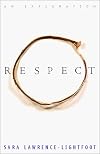
Dr. Sara Lawrence-Lightfoot learned early from experience the meaning of respect. Her book, “Respect” is a series of stories about people she calls “practitioners of respect”. I love this phrase; it’s an elegant expression, elevating respect to the level of learned professionalism. Her insights come from hours of collaboration with and observations of these practitioners as they went about their daily activity, each one revealing different “dimensions of respect” that often go show more unnoticed.
Think of “learned professionalism” as the lawyer who learns how to practice law or the doctor who learns the practice of health care or the person who excels at being a motivational speaker. In these examples and many others they are regarded as professionals in their field. Likewise, we should consider respect as a learned skill; a behavior, that when steadily practiced becomes professionalized.
Dr. Lawrence-Lightfoot captures respectful behaviors with individual stories of two health-care providers, a school teacher, an artist-photographer, an Episcopal priest and a law school professor. Each story reveals a dimension of respect through either: empowerment; healing; dialogue; curiosity; self-respect or attention. show less
Think of “learned professionalism” as the lawyer who learns how to practice law or the doctor who learns the practice of health care or the person who excels at being a motivational speaker. In these examples and many others they are regarded as professionals in their field. Likewise, we should consider respect as a learned skill; a behavior, that when steadily practiced becomes professionalized.
Dr. Lawrence-Lightfoot captures respectful behaviors with individual stories of two health-care providers, a school teacher, an artist-photographer, an Episcopal priest and a law school professor. Each story reveals a dimension of respect through either: empowerment; healing; dialogue; curiosity; self-respect or attention. show less
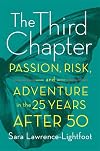
An inspiring look at the possibilities for aging people who have the courage and the wherewithal to be creative and passionate about their possibilities in this period of their lives. The writing is fine- the main limitation of the message for me and my friends and acquaintances is that most of us need to be concerned about maintaining our basics- income and health insurance. For myself, I also see a hesitation to learn new things- when those new things involve technology. But there is show more plenty of possibilities outside of technology that I could embrace- if I would only I would muster up the energy. In all, a book that provides plenty of food for thought. show less
It's good to give, it's good to get. Respect: An Exploration (2000) by Sara Lawrence-Lightfoot works at understanding this crucial aspect of human relationships through the stories of six people. Each of these messengers works in a field where respect is vital and represents a different qualities of respect:
Each portrait is part interview, part Lawrence-Lightfoot's observations of that person at work, and part biography. The case study method lends itself to a bit of cheesiness, but not too much, and not in a negative fashion.
I find it hard to summarize the book any further as it is through the interplay of these many factors where respect is teased out. Read it yourself to find out. show less
- Empowerment: Jennifer Dohrn, a nurse-midwife who founded and directs a childbearing clinic in the South Bronx.
- Healing: Johnye Ballenger, a pediatrician.
- Dialogue: Kay Cottle, a middle
- and high school teacher.
- Curiosity: Dawoud Bey, a photographer/artist.
- Self-Respect: David Wilkins, a law professor.
- Attention: Bill Wallace, pastoral therapy to the dying in hospice.
Each portrait is part interview, part Lawrence-Lightfoot's observations of that person at work, and part biography. The case study method lends itself to a bit of cheesiness, but not too much, and not in a negative fashion.
I find it hard to summarize the book any further as it is through the interplay of these many factors where respect is teased out. Read it yourself to find out. show less
Awards


You May Also Like


Associated Authors
Statistics
- Works
- 13
- Also by
- 1
- Members
- 808
- Popularity
- #31,570
- Rating
- 3.9
- Reviews
- 7
- ISBNs
- 34
- Languages
- 2