
Andrew Dickson (1) (1979–)
Author of The Rough Guide to Shakespeare
For other authors named Andrew Dickson, see the disambiguation page.
About the Author
Image credit: Guardian
Works by Andrew Dickson
Tagged
Common Knowledge
- Birthdate
- 1979
- Gender
- male
- Short biography
- From The Guardian's website (www.guardian.co.uk):
Andrew Dickson is guardian.co.uk's arts editor, responsible for theatre, visual arts and classical music coverage online. His Rough Guide to Shakespeare came out in 2005, and he makes regular appearances on Radio 4's Front Row - Nationality
- UK
- Associated Place (for map)
- UK
Members
Reviews
First, I'll just say that I love Early Reviewers! Something about knowing that I may not get the book I request frees me to ask for books that I might not otherwise pick up. I thought, "World's Elsewhere looks interesting." It was! It was! Thank you, ER!
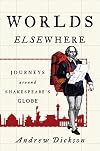
Now. Andrew Dickson sets out to explore how Shakespeare has been appropriated, commandeered, stretched, accommodated, and staged across the years and across the globe. He visits Germany, the USA, India, South Africa, and China in his two-year show more quest and finds fascinating facts to fill every one of the 454 pages.
I am fascinated to find that near contemporaries of Shakespeare were acting his plays on the continent. In fact, Germany has so appropriated "unser Shakespeare" that they felt, especially in the Nazi era, that Shakespeare was German except for the accident of his birth in England. Dickson sees Hamlet as Germany's play; Richard the Third as America's; The Merchant of Venice as China's. I was pleased to learn something of the challenge of trying to translate Shakespeare's poetry into any Chinese language, and to find that in the 1950s, the goal of Chinese performance was to be as Western as possible - hence the actors wore huge noses.
Is Shakespeare universal? I would have said so, but certain African elders in South Africa reject the reality of Hamlet's father's ghost (a figment from the curse of a witch) and castigate Hamlet for being ungrateful to his uncle who takes on his support.
My conservative little heart quails at the descriptions of some productions but thrills at the flexibility and integrity of the plays that stand up to such treatment. In short, I loved this book, and I'm happy to let it lead me back to the Bard. show less
Now. Andrew Dickson sets out to explore how Shakespeare has been appropriated, commandeered, stretched, accommodated, and staged across the years and across the globe. He visits Germany, the USA, India, South Africa, and China in his two-year show more quest and finds fascinating facts to fill every one of the 454 pages.
I am fascinated to find that near contemporaries of Shakespeare were acting his plays on the continent. In fact, Germany has so appropriated "unser Shakespeare" that they felt, especially in the Nazi era, that Shakespeare was German except for the accident of his birth in England. Dickson sees Hamlet as Germany's play; Richard the Third as America's; The Merchant of Venice as China's. I was pleased to learn something of the challenge of trying to translate Shakespeare's poetry into any Chinese language, and to find that in the 1950s, the goal of Chinese performance was to be as Western as possible - hence the actors wore huge noses.
Is Shakespeare universal? I would have said so, but certain African elders in South Africa reject the reality of Hamlet's father's ghost (a figment from the curse of a witch) and castigate Hamlet for being ungrateful to his uncle who takes on his support.
My conservative little heart quails at the descriptions of some productions but thrills at the flexibility and integrity of the plays that stand up to such treatment. In short, I loved this book, and I'm happy to let it lead me back to the Bard. show less
 This review was written for LibraryThing Early Reviewers.
In what is going to be a year full of Shakespeare books, exhibitions, and celebrations, Andrew Dickson's Worlds Elsewhere: Journeys Around Shakespeare's Globe seems likely to prove a standout. Drawing inspiration from the 2012 World Shakespeare Festival in London, Dickson determined to try and explore why and how Shakespeare came to be "the world's most performed playwright, its most translated secular author" (xxiii). The resulting book makes for fascinating reading, and I suspect that even show more the most well-versed Shakespearean will learn much from it.
The five main sections of the book take Dickson to Germany, the United States, India, South Africa, and China, but within each he visits multiple locations and themes, from translation to book collecting to various types of adaptations. He interviews a wide range of scholars, curators, actors, translators, and others, managing to weave their very different perspectives (and his own experiences during this travels) into a very satisfying narrative.
Recommended for anyone with even a passing interest. show less
The five main sections of the book take Dickson to Germany, the United States, India, South Africa, and China, but within each he visits multiple locations and themes, from translation to book collecting to various types of adaptations. He interviews a wide range of scholars, curators, actors, translators, and others, managing to weave their very different perspectives (and his own experiences during this travels) into a very satisfying narrative.
Recommended for anyone with even a passing interest. show less
This review was written for LibraryThing Early Reviewers.As I sat down to read this quite wonderful book, Hamlet was being performed in English to the war and travel weary Syrian refugees in a camp on the edge of France. Hardly anyone in attendance could understand much of what was being said and some commentators thought this was an odd almost offensive choice of entertainment for these men and women adrift and alone in a foreign land. But they loved it. They were rapt and attentive and something moved them deeply - whether it was Shakespeare or show more simply the effort made by their hosts to give them an evening of distracted pleasure I do not know. The camp has now been dismantled amid much controversy but perhaps the moment will linger in the minds of the refugees as they struggle on elsewhere. The book under review is about that and much much more. Well-written and expansive, Worlds Elsewhere travels, probes and sings the tales of Shakespeare with such a thoughtful and unique perspective that it deserves a wide readership and Andrew Dickson a sustained applause. Bravo show less
This review was written for LibraryThing Early Reviewers.I had read and studied King Lear in classes, but the first time I actually saw a performance of that famous play was an eye-opener. As we took our seats, the stage was inky dark. We sat and sat and gradually, slowly, we noticed something on the stage, but it was impossible to make out what. Very dimly, the lights picked out the object - it was the figure of a man, sitting on a chair. The lights, almost imperceptibly, grew brighter. The man was naked! I wondered if I had mistaken the night my show more reservation was for and was attending the performance of some other play. I checked my ticket and no, it was the right night, the right play, but I was very confused. The lights were now bright enough to see all of the stage - it was just the man and his chair. Then a couple of other characters came out and, silently, they carefully dressed the nude man, dressed him in finery, finishing with a royal ermine furred cape, a crown and a sceptre. Ah - it was Lear! But what was the point of him being naked?
Of course, when the end of the play arrived and King Lear had his famous mad scene in which he tears off pieces of clothing (a detail I hadn't really thought much about when I read the script for a class), the staging at the beginning became more meaningful. I realized the arc the play's director was taking - the transformation of Lear from a common, vulnerable man to a regal powerful king back to a common man - the error-prone human he had been throughout, even when he had been bedecked with regal trappings and carelessly wielding his power, caught up in the role he was taking rather than being the true person that he was.
With a burst of awe I realized for the first time that the director of a play could layer on additional, powerful meaning without changing a line of dialogue. He had added a bit of acting that wasn't prescribed in the script and thereby drastically shaped the play's context. True, Shakespeare's scripts gave very sparse directions on how actors should actually comport themselves, but that was also something that I hadn't paid much attention to in my studies. (It should be obvious that I was not a seasoned theater-goer!) The notion of interpreting a play beyond its scripted dialog was a real insight to me.
What does this have to do with Worlds Elsewhere? Andrew Dickson, the author and a very seasoned theater-goer and erudite Shakespearean scholar, found himself also experiencing flashes of insight - his on the notion of the interpretability and adaptability of Shakespeare in the world's many cultures. Themes and ideas that usually went by unnoticed or thought of minor importance took on real meaning and major significance for him when Dickson attended the World Shakespeare Festival, watching Shakespearean plays performed in translation to their native languages by troops from Afghanistan, Brazil, South Africa, Zimbabwe - nearly fifty different countries. The heady mixture of new meanings and directions prompted in Dickson a desire to explore this international interest in Shakespeare in more depth.
The notion of the universality of Shakespeare has been bandied about so much it is cliché. The question in Dickson's mind was not if he was universally appreciated, but why? What was the context for such popularity? How had the barely travelled Shakespeare ended up in such far-reaching places and not only appreciated, but adopted as an honorary citizen by many of those populations?
So, suffused with new insights and aglow with the energy of a quest, Dickson spends the next five years traveling all over the world, from California to Cape Town, from Gdańsk to Kolkata, San Diego to Shanghai, watching plays and movies, reading and interviewing. Worlds Elsewhere is a journalistic account of his experiences and his attempt to untangle the many themes that have influenced Shakespeare's assimilation into the various countries and cultures.
Interviews with actors, theater impresarios, politicians, audience members and authors and critics are detailed, historical context is delineated, ranging from Chinese opium wars and the role of the British East India Trading company to the California gold rush to the politics that affected traveling players in 17th century Poland. Shakespeare in the South African Robben Island prison while Nelson Mandela was held captive is explored and the interest held by the Nazi party is discussed.
The account of Dickson's travels, itself, is absorbing - the transportation, food, hotels - the difficulties faced and how these, too, became fodder for many insights on travel and the clash of cultures as detailed in Shakespeare's plays. But does this huge amount of data gleaned from interviews with fascinating people, the details of Bollywood movies and their predecessors, the history behind Abigail Adams' and Thomas Jefferson's (and Washington's and John Adams', et al) interest in Shakespeare, how the plays were adapted for gold-rush era tent cities, that Ulysses S. Grant rehearsed the role of Desdemona while a lieutenant in Texas - does all of this fascinating data actually answer Dickson's question of why Shakespeare is so globally popular (and, where he isn't, why not)?
I think the value of this account of Dickson's research is not in his conclusion, which, after all, must be entirely subjective, but may be captured best in another tired cliché: the journey's the thing (attributed, possibly spuriously, to Homer). The account of his travels and the process of his research hold more interest than the question of why Shakespeare is so popular. Dickson has travelled all over the world, talked with fascinating people, watched exotic productions of familiar plays, read and absorbed so much history and politics, and he has described those experiences in an articulate, occasionally poetic, fashion. The volume contains a comprehensive index and an extensive bibliography, but, surprisingly, no footnotes. It fits - this was not about the crusty and oft-times arcane discussion of Shakespeare's meaning and intention when he said xxx in his play YYY at line nn in the first folio version. This account was a live, animated view of the experience of Shakespeare in live cultures, with all their history and politics and ethos tossed in the pot and given a good stir. Dickson's conclusions may be supported by the data he derives from his exploration (though the amount of data from five years of focused research is huge and his results rather nebulous), but the account of his exploration is, by far, the most intriguing aspect of Worlds Elsewhere.
I received a free copy of this book from the publisher in exchange for an honest review. show less
Of course, when the end of the play arrived and King Lear had his famous mad scene in which he tears off pieces of clothing (a detail I hadn't really thought much about when I read the script for a class), the staging at the beginning became more meaningful. I realized the arc the play's director was taking - the transformation of Lear from a common, vulnerable man to a regal powerful king back to a common man - the error-prone human he had been throughout, even when he had been bedecked with regal trappings and carelessly wielding his power, caught up in the role he was taking rather than being the true person that he was.
With a burst of awe I realized for the first time that the director of a play could layer on additional, powerful meaning without changing a line of dialogue. He had added a bit of acting that wasn't prescribed in the script and thereby drastically shaped the play's context. True, Shakespeare's scripts gave very sparse directions on how actors should actually comport themselves, but that was also something that I hadn't paid much attention to in my studies. (It should be obvious that I was not a seasoned theater-goer!) The notion of interpreting a play beyond its scripted dialog was a real insight to me.
What does this have to do with Worlds Elsewhere? Andrew Dickson, the author and a very seasoned theater-goer and erudite Shakespearean scholar, found himself also experiencing flashes of insight - his on the notion of the interpretability and adaptability of Shakespeare in the world's many cultures. Themes and ideas that usually went by unnoticed or thought of minor importance took on real meaning and major significance for him when Dickson attended the World Shakespeare Festival, watching Shakespearean plays performed in translation to their native languages by troops from Afghanistan, Brazil, South Africa, Zimbabwe - nearly fifty different countries. The heady mixture of new meanings and directions prompted in Dickson a desire to explore this international interest in Shakespeare in more depth.
The notion of the universality of Shakespeare has been bandied about so much it is cliché. The question in Dickson's mind was not if he was universally appreciated, but why? What was the context for such popularity? How had the barely travelled Shakespeare ended up in such far-reaching places and not only appreciated, but adopted as an honorary citizen by many of those populations?
So, suffused with new insights and aglow with the energy of a quest, Dickson spends the next five years traveling all over the world, from California to Cape Town, from Gdańsk to Kolkata, San Diego to Shanghai, watching plays and movies, reading and interviewing. Worlds Elsewhere is a journalistic account of his experiences and his attempt to untangle the many themes that have influenced Shakespeare's assimilation into the various countries and cultures.
Interviews with actors, theater impresarios, politicians, audience members and authors and critics are detailed, historical context is delineated, ranging from Chinese opium wars and the role of the British East India Trading company to the California gold rush to the politics that affected traveling players in 17th century Poland. Shakespeare in the South African Robben Island prison while Nelson Mandela was held captive is explored and the interest held by the Nazi party is discussed.
The account of Dickson's travels, itself, is absorbing - the transportation, food, hotels - the difficulties faced and how these, too, became fodder for many insights on travel and the clash of cultures as detailed in Shakespeare's plays. But does this huge amount of data gleaned from interviews with fascinating people, the details of Bollywood movies and their predecessors, the history behind Abigail Adams' and Thomas Jefferson's (and Washington's and John Adams', et al) interest in Shakespeare, how the plays were adapted for gold-rush era tent cities, that Ulysses S. Grant rehearsed the role of Desdemona while a lieutenant in Texas - does all of this fascinating data actually answer Dickson's question of why Shakespeare is so globally popular (and, where he isn't, why not)?
I think the value of this account of Dickson's research is not in his conclusion, which, after all, must be entirely subjective, but may be captured best in another tired cliché: the journey's the thing (attributed, possibly spuriously, to Homer). The account of his travels and the process of his research hold more interest than the question of why Shakespeare is so popular. Dickson has travelled all over the world, talked with fascinating people, watched exotic productions of familiar plays, read and absorbed so much history and politics, and he has described those experiences in an articulate, occasionally poetic, fashion. The volume contains a comprehensive index and an extensive bibliography, but, surprisingly, no footnotes. It fits - this was not about the crusty and oft-times arcane discussion of Shakespeare's meaning and intention when he said xxx in his play YYY at line nn in the first folio version. This account was a live, animated view of the experience of Shakespeare in live cultures, with all their history and politics and ethos tossed in the pot and given a good stir. Dickson's conclusions may be supported by the data he derives from his exploration (though the amount of data from five years of focused research is huge and his results rather nebulous), but the account of his exploration is, by far, the most intriguing aspect of Worlds Elsewhere.
I received a free copy of this book from the publisher in exchange for an honest review. show less
This review was written for LibraryThing Early Reviewers.You May Also Like


Associated Authors
Statistics
- Works
- 3
- Members
- 320
- Popularity
- #73,922
- Rating
- 4.0
- Reviews
- 22
- ISBNs
- 19
