

David Bowman (1) (1957–2012)
Author of Let the Dog Drive
For other authors named David Bowman, see the disambiguation page.
About the Author
David Bowman was born in Racine, Wisconsin on December 8, 1957. His interest in writing first emerged while studying music at the Interlochen Arts Academy High School in Interlochen, Michigan. He briefly attended Putney College in Vermont, before moving to New York to write while working as a show more bartender and as a clerk at a bookstore. His works include Let the Dog Drive, Bunny Modern, and This Must Be the Place. He died from a cerebral hemorrhage on February 27, 2012 at the age of 54. (Bowker Author Biography) show less
Works by David Bowman
This Must Be the Place: The Adventures of Talking Heads in the Twentieth Century (2001) 130 copies, 2 reviews
Tagged
Common Knowledge
- Legal name
- Bowman, David Anthony
- Birthdate
- 1957-12-08
- Date of death
- 2012-02-27
- Gender
- male
- Short biography
- Born in Racine, Wisconsin on December 8, 1957, David Bowman's interest in writing first emerged while studying music at the Interlochen Arts Academy High School. He briefly attended Putney College in Vermont, before moving to New York to write while working as a bartender and as a clerk at a bookstore. His works include Let the Dog Drive, Bunny Modern, and This Must Be the Place. He died from a cerebral hemorrhage in 2012 at the age of 54.
- Nationality
- USA
- Birthplace
- Racine, Wisconsin, USA
- Place of death
- Manhattan, New York, USA
- Associated Place (for map)
- USA
Members
Reviews
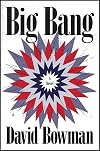
Big Bang by David Bowman is a fairly long read that seems longer because it is not your typical straightforward narrative. While the comparison I have been seeing the most is to Delillo's Underworld (which I think is a fair comp) I would also include Pynchon's Gravity's Rainbow. Big Bang is similar to both yet is distinctive from each.
The novel spans the years 1950 to 1963 and is, in that sense, very chronological, contrary to what some seem to think. As events happen during this chronology show more Bowman jumps both backward and forward to let us know what these people have done or, most often, will do. These asides are not difficult to follow. Within each chapter, which covers roughly 6 months to 2 years each, there are multiple snippets, for lack of a better term, each taking place in a different location. These may run from a couple of paragraphs to several pages. As you read you will find yourself making the transitions much more smoothly than at first. There are several key threads centered around specific figures and you just have to remember who is who. The placing of these snippets where they are do create some interesting juxtapositions.
I came to think of this as a mosaic. Each snippet is a single piece. There are many pieces of one hue and many of another. The hues, here, are the historical figures. While you're reading, especially early in the book, it is like being too close to a mosaic and being unable to discern what is what. Also think of a pointillist painting. Too close in and the picture disappears. As you read further in the book you start to see some form and some shapes. When you are finished, you can reflect on the whole and see a picture that makes far more sense than the individual pieces did while you were reading.
In recommending this book, I would say that if you are willing to be patient and wait for the picture to come into view you may well find it to be a powerful book. But I'm not sure that we are all going to see the same picture, so you may well find the picture to be a disappointment, but it won't be because there is nothing connecting all of the pieces. It is because it simply didn't appeal to you. I do believe that this book will be a rewarding experience for anyone who does more than "peruse" the book and throw out asinine comments like "Delillo fanfiction." At least don't advertise that it went over your head by playing pseudo-intellectual, just say you didn't like it. This will ultimately be one of those books that require more time and effort than some might want to give it. In today's world that makes sense for many people. If you like the challenge, even if there is no guarantee you'll love what you find, this could be a fun read for you. The writing itself is quite straightforward and won't present a problem. The mosaic-like nature of the snippets will be what could prevent an enjoyable read for some.
Reviewed from a copy made available by the publisher via NetGalley. show less
The novel spans the years 1950 to 1963 and is, in that sense, very chronological, contrary to what some seem to think. As events happen during this chronology show more Bowman jumps both backward and forward to let us know what these people have done or, most often, will do. These asides are not difficult to follow. Within each chapter, which covers roughly 6 months to 2 years each, there are multiple snippets, for lack of a better term, each taking place in a different location. These may run from a couple of paragraphs to several pages. As you read you will find yourself making the transitions much more smoothly than at first. There are several key threads centered around specific figures and you just have to remember who is who. The placing of these snippets where they are do create some interesting juxtapositions.
I came to think of this as a mosaic. Each snippet is a single piece. There are many pieces of one hue and many of another. The hues, here, are the historical figures. While you're reading, especially early in the book, it is like being too close to a mosaic and being unable to discern what is what. Also think of a pointillist painting. Too close in and the picture disappears. As you read further in the book you start to see some form and some shapes. When you are finished, you can reflect on the whole and see a picture that makes far more sense than the individual pieces did while you were reading.
In recommending this book, I would say that if you are willing to be patient and wait for the picture to come into view you may well find it to be a powerful book. But I'm not sure that we are all going to see the same picture, so you may well find the picture to be a disappointment, but it won't be because there is nothing connecting all of the pieces. It is because it simply didn't appeal to you. I do believe that this book will be a rewarding experience for anyone who does more than "peruse" the book and throw out asinine comments like "Delillo fanfiction." At least don't advertise that it went over your head by playing pseudo-intellectual, just say you didn't like it. This will ultimately be one of those books that require more time and effort than some might want to give it. In today's world that makes sense for many people. If you like the challenge, even if there is no guarantee you'll love what you find, this could be a fun read for you. The writing itself is quite straightforward and won't present a problem. The mosaic-like nature of the snippets will be what could prevent an enjoyable read for some.
Reviewed from a copy made available by the publisher via NetGalley. show less
My Sixth Grade class was in the library that Friday afternoon when Mr. Saffronoff led us back through Northwood Elementary School's ancient hallways to our classroom. We were being let out of school early. The president had been shot. As I walked home alone down the tree-lined street I was filled with vague and unsettling fears. Was America vulnerable and unprotected without the president?
It would be years before I revisited the America I grew up in, hoping to understand as an adult the show more events that had shaken my childhood sense of security--The Cuban Missile Crisis, the assassinations of President Kennedy and later his brother Robert and Martin Luther King, Jr., the Vietnam War and the daily body count on the television news.
At 600+ pages, I was uncertain I wanted to read Big Bang, but the subject matter was too tempting.
The book begins with Jonathan Lethem's essay on his friend David Bowman, calling Big Bang "docu-fiction," "an epic novel about celebrity and power in the postwar twentieth century," a "mammoth project" about "everything and anything" Bowman knew about postwar America. The Foreword ends by telling readers that all of the people and events are based on "true history."
I found a densely woven correlation of events and personages so intricate as to astonish. Bowen had created a literary, "six degrees" link chart of interconnections that is all-embracing. Of course, the Kennedys are central along with all the necessary Washington figures, but also making appearances are J. D. Salinger, William S. Burroughs, Howard Hunt writing pulp fiction and planning the secret invasion of Guatemala, Richard Nixon and his Checkers speech, Carl Djerassi and Robert McNamara in an Ann Arbor book club, Lucille Ball facing the McCarthy House Un-American Activities Committee...
Just to give you a taste.
Bowen suggests that after the Atom Bomb, the second "big bang" to change the world was the Kennedy assassination. It changed a lot of things, for sure. It set off a chain of other political assassinations.
The novel was a journey into the world that shaped me.
I received a free ebook from the publisher in exchange for a fair and unbiased review. show less
It would be years before I revisited the America I grew up in, hoping to understand as an adult the show more events that had shaken my childhood sense of security--The Cuban Missile Crisis, the assassinations of President Kennedy and later his brother Robert and Martin Luther King, Jr., the Vietnam War and the daily body count on the television news.
At 600+ pages, I was uncertain I wanted to read Big Bang, but the subject matter was too tempting.
The book begins with Jonathan Lethem's essay on his friend David Bowman, calling Big Bang "docu-fiction," "an epic novel about celebrity and power in the postwar twentieth century," a "mammoth project" about "everything and anything" Bowman knew about postwar America. The Foreword ends by telling readers that all of the people and events are based on "true history."
I found a densely woven correlation of events and personages so intricate as to astonish. Bowen had created a literary, "six degrees" link chart of interconnections that is all-embracing. Of course, the Kennedys are central along with all the necessary Washington figures, but also making appearances are J. D. Salinger, William S. Burroughs, Howard Hunt writing pulp fiction and planning the secret invasion of Guatemala, Richard Nixon and his Checkers speech, Carl Djerassi and Robert McNamara in an Ann Arbor book club, Lucille Ball facing the McCarthy House Un-American Activities Committee...
Just to give you a taste.
Bowen suggests that after the Atom Bomb, the second "big bang" to change the world was the Kennedy assassination. It changed a lot of things, for sure. It set off a chain of other political assassinations.
The novel was a journey into the world that shaped me.
I received a free ebook from the publisher in exchange for a fair and unbiased review. show less
This was not my type of book, but given that, there was much I enjoyed and it was mostly well-written. I liked the insight and info on the history and I liked the expansive perspective and the interconnectedness of so many disparate parts. I will always feel that books so focused on white men are limited, though, and wonder what I am missing.
Devil in the White City meets The Great Gatsby in the 1950s. Big Bang was mostly entertaining with the many references to famous people, places, poems, novels, and historic events, but at times I felt lost and had no idea where Bowman was going. An incredibly well researched novel that is creative and expanded much farther into anything most humans can imagine. It's amazing, but long and circular.
Lists
You May Also Like


Associated Authors
Statistics
- Works
- 4
- Members
- 423
- Popularity
- #57,687
- Rating
- 3.5
- Reviews
- 12
- ISBNs
- 56
- Languages
- 1