
Greil Marcus
Author of Lipstick Traces: A Secret History of the Twentieth Century
About the Author
Greil Marcus is the author of "Invisible Republic," "Dead Elvis," "Lipstick Traces," & "Mystery Train." His pieces have appeared in a wide range of publications, including "Artforum," "Interview," "The New Yorker," "The New York Times," & "Esquire." He will be teaching at Princeton & Berkeley in show more fall 2000. (Publisher Provided) Greil Marcus was born in San Francisco, California in 1945. He received an undergraduate degree in American studies from the University of California, Berkeley. He has been a rock critic and columnist for Rolling Stone, Creem, The Village Voice, Artforum, and other publications. He has written several books including Mystery Train: Images of America in Rock 'n' Roll Music, Lipstick Traces: A Secret History of the 20th Century, Dead Elvis: A Chronicle of a Cultural Obsession, and When That Rough God Goes Riding: Listening to Van Morrison. (Bowker Author Biography) show less
Image credit: Experience Music Project Pop Conference, April 30, 2006.
Photo by Joe Mabel.
(Wikipedia)
Photo by Joe Mabel.
(Wikipedia)
Works by Greil Marcus
Associated Works
Designing Disney's Theme Parks: The Architecture of Reassurance (1997) — Contributor — 211 copies, 1 review
The Rolling Stone Book of the Beats: The Beat Generation and American Culture (1999) — Contributor — 181 copies, 2 reviews
The Dylan Companion: A Collection of Essential Writing About Bob Dylan (1990) — Contributor, some editions — 103 copies
The Basement Tapes Complete: The Bootleg Series, Vol. 11 [sound recording] (1975) — Liner Notes, some editions — 88 copies
Mid-life Confidential: The Rock Bottom Remainders Tour America with Three Chords and an Attitude (1994) — Contributor — 76 copies, 4 reviews
The Free Speech Movement: Reflections on Berkeley in the 1960s (2002) — Contributor — 45 copies, 1 review
Another Self Portrait (1969-1971) (The Bootleg Series Volume 10) (2013) — Liner Notes — 27 copies, 1 review
Tagged
Common Knowledge
- Canonical name
- Marcus, Greil
- Birthdate
- 1945-06-19
- Gender
- male
- Education
- University of California, Berkeley (BA | American Studies)
- Occupations
- magazine editor
cultural critic
music critic - Nationality
- USA
- Birthplace
- San Francisco, California, USA
- Places of residence
- San Francisco, California, USA
- Map Location
- California, USA
Members
Reviews

How does one write a history of the 20th century? Greil Marcus’s starting point was the Sex Pistols last show at the Winterland Ballroom in 1978. The show was a spectacular flameout of chaotic, confused rage, as the negation that punk rock stood for was swallowed up, pressed onto vinyl and sold back to people for the privilege of paying to consume that rage as if it were their own. The Winterland show is fitting as an apotheosis of an entire century concerned with the alienating experience show more of living in a world that is homogeneously organized by the uncompromising logic of capitalism. It was a century in which “[t]he exchange of a guarantee of dying of boredom for a guarantee of not dying of hunger was a good deal—the only game in town” (47). Negation was the century’s response, articulated in the early part of the 20th century and refined throughout the decades.
At moments, the focus on negation appears to describe a kind of nihilism, but I don’t know that it is. Nihilism might be served by negation as a means of undoing purpose and belief, but the negation practiced by the Dadas, the Lettrists, the Situationists, and by the Punks was in the service of belief and purpose or at least the possibility of those things. I saw in Marcus’s treatment of negation a disruption akin to Descartes’ extreme form of doubt that he made in pursuit of a bedrock rational foundation. Where Descartes asked what is true beyond this world of potentially deceptive experience, the 20th century movements that Marcus chronicled didn’t propose what must be at the bedrock level of human experience, they proposed a way to find out: shock the system out of rhythm and see where you end up. Negation was about claiming agency beyond the ability to choose what brands one will buy or shows one will consume. It is about having experience rather than consuming a “spectacle” of that experience.
The Dadas tried nonsense poetry and art as a way of subverting overarching narratives of interpretation. When that form of negation became its own mode of production and significance, the Lettrists formed and tried further negation. They dove into the syllables and down to the letters, smashing narratives further, seeking the place where experiences are not guided and nudged. The Situationists embraced negation as well, subverting dominant narratives pushed on us through media, architecture, city planning, education, work, etc., but their approach was more strategic, choosing to subvert messaging through techniques like “détournement,” running counter messaging, or denying the narrative pull of city architecture by wandering through the streets in a “dérive.” They sought enlightenment through boredom achieved through negation. They sought to creation of “situations” or moments of rupture and acceleration, “microclimates” in the city as unmarked zones of feeling (361).
The forces of negation manifested as avant-garde art, performances, media production, and discussion but also grew to include work stoppages, occupying buildings, seizing public stages, movements, protests, riots, violence. But that, too, gets packaged up and sold back to us; negation becomes the narrative once again. Where the Sex Pistols’ rage and irreverence might have shocked the system out of its rhythm, momentarily, it settled back into a commodity soon enough, sold back to us, soon after 1978 and continuously since as commemorative t-shirts and nostalgia that we can consume at our workstations. Arguably the forces of negation continue to the modern day with moments like Occupy Wall Street and the Great Resignation showing momentary disruption that give a glimpse of something different.
What makes this a history is that it draws together moments and events and figures that we might recognize in a conventional historical narrative, but Marcus’s work is non-linear, indirect. It is poetry at times more than it is prose. Toward the end of the book he notes about his historicizing process that “I have tried to make the ethos […] into a narrative, to fill in the gaps, to make it at least half as clear as it was to Debord, Wolman, Bernstein, and the rest—inevitably, to make their old papers into something fit for rational consumption. They didn’t.” (398).
Well worth your time. show less
At moments, the focus on negation appears to describe a kind of nihilism, but I don’t know that it is. Nihilism might be served by negation as a means of undoing purpose and belief, but the negation practiced by the Dadas, the Lettrists, the Situationists, and by the Punks was in the service of belief and purpose or at least the possibility of those things. I saw in Marcus’s treatment of negation a disruption akin to Descartes’ extreme form of doubt that he made in pursuit of a bedrock rational foundation. Where Descartes asked what is true beyond this world of potentially deceptive experience, the 20th century movements that Marcus chronicled didn’t propose what must be at the bedrock level of human experience, they proposed a way to find out: shock the system out of rhythm and see where you end up. Negation was about claiming agency beyond the ability to choose what brands one will buy or shows one will consume. It is about having experience rather than consuming a “spectacle” of that experience.
The Dadas tried nonsense poetry and art as a way of subverting overarching narratives of interpretation. When that form of negation became its own mode of production and significance, the Lettrists formed and tried further negation. They dove into the syllables and down to the letters, smashing narratives further, seeking the place where experiences are not guided and nudged. The Situationists embraced negation as well, subverting dominant narratives pushed on us through media, architecture, city planning, education, work, etc., but their approach was more strategic, choosing to subvert messaging through techniques like “détournement,” running counter messaging, or denying the narrative pull of city architecture by wandering through the streets in a “dérive.” They sought enlightenment through boredom achieved through negation. They sought to creation of “situations” or moments of rupture and acceleration, “microclimates” in the city as unmarked zones of feeling (361).
The forces of negation manifested as avant-garde art, performances, media production, and discussion but also grew to include work stoppages, occupying buildings, seizing public stages, movements, protests, riots, violence. But that, too, gets packaged up and sold back to us; negation becomes the narrative once again. Where the Sex Pistols’ rage and irreverence might have shocked the system out of its rhythm, momentarily, it settled back into a commodity soon enough, sold back to us, soon after 1978 and continuously since as commemorative t-shirts and nostalgia that we can consume at our workstations. Arguably the forces of negation continue to the modern day with moments like Occupy Wall Street and the Great Resignation showing momentary disruption that give a glimpse of something different.
What makes this a history is that it draws together moments and events and figures that we might recognize in a conventional historical narrative, but Marcus’s work is non-linear, indirect. It is poetry at times more than it is prose. Toward the end of the book he notes about his historicizing process that “I have tried to make the ethos […] into a narrative, to fill in the gaps, to make it at least half as clear as it was to Debord, Wolman, Bernstein, and the rest—inevitably, to make their old papers into something fit for rational consumption. They didn’t.” (398).
Well worth your time. show less

Ringo Starr isn't in the R&R Hall of Fame as an individual? Who do I write to about that?
The reason I bought this book is the narrator, Henry Rollins. I'm not a fan of punk music, so I didn't know him from the band Black Flag (and – sorry, darlin' – still not a fan). My introduction to him was the History Channel's series Ten Things You Don't Know About. I started watching it because I took it as a challenge (I don't know these things? Yeah? Try me.)(They were often right.) I kept show more watching the show because he is awesome. There is nothing more attractive – in every sense of the word – than honest enthusiasm, and Henry has that by the truckload: he is genuinely, passionately, intelligently enthralled by US history. And it's marvelous. Watch the episode on presidential assassinations: his eyes are on fire, and his voice rises – he is honestly angry. I love it. I've become very fond indeed of Henry Rollins, a little to my surprise, and whither he goest and all that. (Except for his music. Sorry.)
If you can get past the introduction of this book, you should breeze through the rest. In that intro there is a six page sentence, and a lengthy roll call. It grows a bit tedious.
It's a bit odd; I followed along with the book on YouTube, looking for all the performances cited. (And they made me go watch Kelly Clarkson singing at the second Obama inauguration. Damn, girl.) And some of the conjunctions between the descriptions and the realities (or at least the videos of the realities) didn't always quite jibe, or in some cases a disconnect between his thinking and mine. A band that reunites for PBS is described as "all bald" – but one wears a hat throughout all the video I saw. Well, maybe he takes it off in later footage. Then the description of Beyonce at Obama's inauguration doesn't match footage (and boy does the author not like Beyonce). In "Money (that's what I want)", I definitely don't hear what the author hears. Maybe music interpretation and review is just not my forte. I know I would never have chosen to describe a song as "...A crawling version of Viva Las Vegas by Shawn Colvin singing as a hooker just after being pushed down the stairs from an escort service to the street."
But I learned a lot. The relationship between Bing Crosby and Robert Johnson was unexpected and kind of awesome. I watched videos and listened to songs I might not otherwise have sampled – the Flamin Groovies? Not my cuppa. And again I didn't always see what the author was talking about as he spoke about what he pulled from the videos.
One thing I absolutely did see eye to eye with him about: "Why is happiness considered shallow and worthless? Why does it have to be all about pain and loss?" I have always wondered that. All forms of art seems to abide by that philosophy: without conflict and pain there is nothing worth talking about. But every now and then isn't it nice to just celebrate?
But - seriously? No Ringo? I'm appalled. show less
The reason I bought this book is the narrator, Henry Rollins. I'm not a fan of punk music, so I didn't know him from the band Black Flag (and – sorry, darlin' – still not a fan). My introduction to him was the History Channel's series Ten Things You Don't Know About. I started watching it because I took it as a challenge (I don't know these things? Yeah? Try me.)(They were often right.) I kept show more watching the show because he is awesome. There is nothing more attractive – in every sense of the word – than honest enthusiasm, and Henry has that by the truckload: he is genuinely, passionately, intelligently enthralled by US history. And it's marvelous. Watch the episode on presidential assassinations: his eyes are on fire, and his voice rises – he is honestly angry. I love it. I've become very fond indeed of Henry Rollins, a little to my surprise, and whither he goest and all that. (Except for his music. Sorry.)
If you can get past the introduction of this book, you should breeze through the rest. In that intro there is a six page sentence, and a lengthy roll call. It grows a bit tedious.
It's a bit odd; I followed along with the book on YouTube, looking for all the performances cited. (And they made me go watch Kelly Clarkson singing at the second Obama inauguration. Damn, girl.) And some of the conjunctions between the descriptions and the realities (or at least the videos of the realities) didn't always quite jibe, or in some cases a disconnect between his thinking and mine. A band that reunites for PBS is described as "all bald" – but one wears a hat throughout all the video I saw. Well, maybe he takes it off in later footage. Then the description of Beyonce at Obama's inauguration doesn't match footage (and boy does the author not like Beyonce). In "Money (that's what I want)", I definitely don't hear what the author hears. Maybe music interpretation and review is just not my forte. I know I would never have chosen to describe a song as "...A crawling version of Viva Las Vegas by Shawn Colvin singing as a hooker just after being pushed down the stairs from an escort service to the street."
But I learned a lot. The relationship between Bing Crosby and Robert Johnson was unexpected and kind of awesome. I watched videos and listened to songs I might not otherwise have sampled – the Flamin Groovies? Not my cuppa. And again I didn't always see what the author was talking about as he spoke about what he pulled from the videos.
One thing I absolutely did see eye to eye with him about: "Why is happiness considered shallow and worthless? Why does it have to be all about pain and loss?" I have always wondered that. All forms of art seems to abide by that philosophy: without conflict and pain there is nothing worth talking about. But every now and then isn't it nice to just celebrate?
But - seriously? No Ringo? I'm appalled. show less
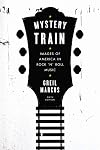
Greil Marcus simultaneously invented and ruined rock criticism. He suffuses his work with literary references (Moby Dick, John Bunyan, et al), humor, and a depth of emotion that makes it both beautiful and gritty. His style is inimitable, and yet he has countless imitators who wish they could write like him, who possess neither his insight nor his instinct, and just end up writing boring pieces that sound like they are trying too hard.
But he cannot and should not be blamed for his imitators. show more Mystery Train is an American classic. I will be poring over the appendix and the discographies (twice as long as the actual book) for weeks to come. show less
But he cannot and should not be blamed for his imitators. show more Mystery Train is an American classic. I will be poring over the appendix and the discographies (twice as long as the actual book) for weeks to come. show less

If Quaaludes are the drug that can turn English into a second language, Flipper is the band.
Equally conversant in American folklore, continental cultural critique, and pop music history, Greil Marcus here provides an indirect chronicle of a pop culture moment that came and went. As he did with the ‘Old Weird America’ conjured up by Harry Smith’s Anthology of American Folk Music in the 1950s, Marcus situates punk in a particular context while continuing to insist that the best show more records—whether by Dock Boggs or the Raincoats—carry “a faraway sense of the absolute.” He can write an ontological analysis of the Gang of Four’s first album, contrast the cultural power of the Mekons with that of Chuck Norris, and lament the juvenile idealism of late-model Joe Strummer—all without sounding haughty, because his exuberance is both wary and genuine.
As Marcus points out, the dichotomies during the punk era were hard to miss: the invigorating energy of the music sprang from the Anglo-American malaise of the late 70s; the ‘anything goes’ ethos of the post-punk milieu coexisted with "entrenched economic and social forces that demanded quietude and conformity." Still, “extremism by means of rock ‘n’ roll” has (had?) the power “to intervene in the symbol system of a listener’s everyday life” (Roland Barthes meets Johnny Rotten)—and Marcus can send you off in search of the old records or the lost outsider masterpieces. I don’t know what it means that much of the more obscure stuff that he cites is now available as bit-streams on the interwebs, but I guess I’m glad for it. Now my kids can hear Liliput in the kitchen, and I know they’re better off for that. show less
Equally conversant in American folklore, continental cultural critique, and pop music history, Greil Marcus here provides an indirect chronicle of a pop culture moment that came and went. As he did with the ‘Old Weird America’ conjured up by Harry Smith’s Anthology of American Folk Music in the 1950s, Marcus situates punk in a particular context while continuing to insist that the best show more records—whether by Dock Boggs or the Raincoats—carry “a faraway sense of the absolute.” He can write an ontological analysis of the Gang of Four’s first album, contrast the cultural power of the Mekons with that of Chuck Norris, and lament the juvenile idealism of late-model Joe Strummer—all without sounding haughty, because his exuberance is both wary and genuine.
As Marcus points out, the dichotomies during the punk era were hard to miss: the invigorating energy of the music sprang from the Anglo-American malaise of the late 70s; the ‘anything goes’ ethos of the post-punk milieu coexisted with "entrenched economic and social forces that demanded quietude and conformity." Still, “extremism by means of rock ‘n’ roll” has (had?) the power “to intervene in the symbol system of a listener’s everyday life” (Roland Barthes meets Johnny Rotten)—and Marcus can send you off in search of the old records or the lost outsider masterpieces. I don’t know what it means that much of the more obscure stuff that he cites is now available as bit-streams on the interwebs, but I guess I’m glad for it. Now my kids can hear Liliput in the kitchen, and I know they’re better off for that. show less
Lists
Awards


You May Also Like


Associated Authors
Statistics
- Works
- 41
- Also by
- 24
- Members
- 5,649
- Popularity
- #4,384
- Rating
- 3.8
- Reviews
- 79
- ISBNs
- 197
- Languages
- 7
- Favorited
- 21