
Eva Hoffman (1) (1945–)
Author of Lost in Translation: A Life in a New Language
For other authors named Eva Hoffman, see the disambiguation page.
About the Author
Eva Hoffman was born in Krakow, Poland and eventually emigrated to Canda with her family. She received a Ph. D. from Harvard University. She taught literature and was the editor of the New York Times Book Review. Hoffman is the author of such books as Lost in Translation: A Life in a New Language show more (1989) and Shtetl: The Life and Death of a Small Town and the World of Polish Jews (1997). (Bowker Author Biography) show less
Image credit: cdn.kingston.ac.uk
Works by Eva Hoffman
Shtetl: The Life and Death of a Small Town and the World of Polish Jews (1997) 333 copies, 6 reviews
Associated Works
Etty Hillesum : An Interrupted Life and Letters from Westerbork (1996) — Foreword, some editions — 689 copies, 17 reviews
The Penguin Book of Migration Literature: Departures, Arrivals, Generations, Returns (2019) — Contributor — 96 copies
Michelangelo in Ravensbruck: One Woman's War Against the Nazis (2001) — Foreword — 87 copies, 1 review
Nothing Makes You Free: Writings by Descendants of Jewish Holocaust Survivors (2002) — Contributor — 72 copies, 1 review
Tagged
Common Knowledge
- Legal name
- Hoffman, Eva Wydra
Wydra, Ewa (born) - Birthdate
- 1945-07-01
- Gender
- female
- Education
- Rice University
Harvard University
Yale School of Music - Occupations
- writer
novelist
professor
essayist
autobiographer
travel writer - Awards and honors
- Whiting Writers' Award (1992)
- Short biography
- Eva Hoffman, née Ewa Wydra, was born in Kracow, Poland, to Jewish Holocaust survivors. In 1959, during a wave of Polish anti-Semitism, the family emigrated to Canada. She originally trained to be a concert pianist but instead became a writer and academic. She moved to the USA at age 19 to attend Rice University in Texas, and then earned a Ph.D. in English and American literature from Harvard. She became a professor of literature and creative writing at several institutions, including Columbia, the University of Minnesota, and Tufts. She has worked as an editor and writer at The New York Times, including as a senior editor of the Book Review in 1987–1990. She has written several critically acclaimed nonfiction works, among them Lost in Translation: A Life in a New Language (1989), Exit Into History (1993), Stetl: The Life and Death of a Small Town and the World of Polish Jews (1997), and After Such Knowledge: Memory, History and the Legacy of the Holocaust (2004). She has also produced two novels. She divides her time between London and Cambridge, Massachusetts, where she is a visiting professor at MIT.
- Nationality
- Poland (birth)
Canada
USA - Birthplace
- Kraków, Poland
- Places of residence
- London, England, UK
Vancouver, British Columbia, Canada
Houston, Texas, USA
Ukraine
Cambridge, Massachusetts, USA
Members
Reviews
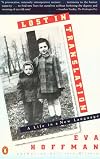
Hoffman is a Polish Jew whose family emigrated to Canada when she was a young teen. The book is divided into three parts - her childhood in Poland, the move and her first experiences of Canadian society, and her musings on her adult life as a non-native North American in New York.
I picked this up after Ariel Dorfman's "Heading South, Looking North", because I thought it would be interesting to read another book which covered the same territory, from a different perspective.
The book is show more beautifully written, and I enjoyed a lot of the first two sections. There's a great passage, for example, on the way that her teachers would unenthusiastically peddle the official line about Russia (whether in Russian language or history lessons) before throwing in a few comments about what they really think. And her analysis of the anthropology of North American dating, from the perspective of a young woman who has grown up being used to being friends with boys and not thinking about it, is very funny. In fact, her consideration of different kinds of femininity in different cultures is very thought-provoking - young Eva grows up aspiring to be a sophisticated, witty, wordly-wise woman, and is very disappointed to realise that this will cut no ice at all with her Canadian college mates.
But Hoffman is, definitively, a neurotic New Yorker, and this became really repetitive in the final third of the book - particularly when she gets irritated with her American friends for some particularly naive viewpoint, and then beats herself up about it. And ultimately I think the book suffered in comparison to "Heading South, Looking North" - while that was about how to live politically, this ends up very much focused on the little details of how to be an intellectual on the Upper West Side, and reading the two one after the other, you wonder if it's really worth expending so much energy on. show less
I picked this up after Ariel Dorfman's "Heading South, Looking North", because I thought it would be interesting to read another book which covered the same territory, from a different perspective.
The book is show more beautifully written, and I enjoyed a lot of the first two sections. There's a great passage, for example, on the way that her teachers would unenthusiastically peddle the official line about Russia (whether in Russian language or history lessons) before throwing in a few comments about what they really think. And her analysis of the anthropology of North American dating, from the perspective of a young woman who has grown up being used to being friends with boys and not thinking about it, is very funny. In fact, her consideration of different kinds of femininity in different cultures is very thought-provoking - young Eva grows up aspiring to be a sophisticated, witty, wordly-wise woman, and is very disappointed to realise that this will cut no ice at all with her Canadian college mates.
But Hoffman is, definitively, a neurotic New Yorker, and this became really repetitive in the final third of the book - particularly when she gets irritated with her American friends for some particularly naive viewpoint, and then beats herself up about it. And ultimately I think the book suffered in comparison to "Heading South, Looking North" - while that was about how to live politically, this ends up very much focused on the little details of how to be an intellectual on the Upper West Side, and reading the two one after the other, you wonder if it's really worth expending so much energy on. show less
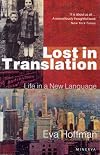
“If all therapy is speaking therapy-a talking cure-then perhaps all neurosis is a speech dis-ease”
Eva Hoffman is fascinated by words and fascinated by language and her autobiographical “Lost in Translation” is at times a brilliant thesis on the situation of an exile living abroad. It is also a lively and extremely well written personal account of a Jewish woman coming to terms with her former life in Poland and the new life she has made for herself in America.
Eva’s book is in show more three parts and the first of these is titled “Paradise” and describes her early life in Poland until as an 11 year old she emigrated to Canada with her parents. Her formative years in Poland takes on a rosy glow as she recounts a very happy childhood, however there is an undercurrent to her memories. Her parents are Jewish and they had fled to the Ukraine to escape the holocaust and now back in Cracow they are outsiders to the mainstream of Polish life. Hoffman creates a feeling of being one step apart from her Polish neighbours through the eyes and thoughts of herself as a child and with the hindsight of an adult, with some seamless writing. Life in Poland is not quite Paradise, but it is comfortably secure in a way that America never is for Eva. The importance of friendships, of family, of an identity and a place in the world comes through, but the other side of this is a recognition that the Jewish community is still under threat and results in the family’s decision to emigrate.
Part two is titled “Exile” and Eva tells of her early teen years in Canada (Vancouver) and her College life at Rice University in Texas and then at Harvard University. She captures perfectly the difficulties of learning a new language and adapting to a new culture. She is a gifted pupil in both literature and music and finds that her peers at school and University are so different that at times she feels like an alien. It is though she is trapped inside herself as the childish behaviour of the young Canadians leaves her bemused. Their values are different and the language and cultural barrier leaves her unable to express herself properly, but her desire to learn and to fit in gets her through. She says:
“But these days, it takes all my will to impose any control on the words that emerge from me. I have to form entire sentences before uttering them; otherwise, I too easily get lost in the middle. My speech I sense, sounds monotonous, deliberate, heavy-an aural mask that doesn't become me or express me at all. This willed self-control is the opposite of real mastery, which comes from a trust in your own verbal powers and leads to a free streaming of speech, for those bursts of spontaneity, the quickness of response that can rise into pleasure and overflow into humour. Laughter is the lightning rod of play, the eroticism of conversation; for now, I’ve lost the ability to make the sparks fly”
Passages like this express perfectly the difficulties and frustrations for immigrants who have to make their way in a country where they need to learn a new language. Hoffman also pins down perfectly the cultural difficulties that appear once progress in the new language has been made; how in conversation with native speakers so many things are 'a given' to them but for the newcomer this is not the case leading to missteps at the least and a comical floundering and even insults at the worst.
Part three “The New World” describes Eva’s adult life and success in America. She finds that she can use her different cultural background to her advantage as well as her new approach to the English language. Her differences can be appealing to others and she forges ahead in a society, whose rules she assiduously learns and uses to her own advantage. It is in this final section of her book that she takes time to reflect on Cultural life in America recognising the differences and the vastness of the country. Life in New York is compared to life in Cracow; Poland and not always to its advantage. As an academic she reflects on cultural differences, on language and the use of words interspersed with snapshots of incidents in her life. The way her writing changes from the real world around her to thoughts on life’s big issues reminded me a little of Robert M Pirsig's wonderful “Zen and the Art of Motorcycle Maintenance”
As an outsider she considers that she is able to stand back and reflect on American life and a visit back to Poland reinforces her thoughts. She can view herself as two people; one whose life would have been so different had she remained in Poland. She is also able to criticise aspects of American life and finds it rather amusing that she ends up going to see a shrink like so many of her American friends. This leads her to thoughts on loss of identity, not just her own, but also something that is endemic in many of her American friends. Finally she attempts to draw some conclusions:
“No, there’s no returning to the point of origin, no regaining of childhood unity. Experience creates style, and style, in turn creates a new woman…….. Like everybody I am the sum of my languages-the languages of my family and childhood, and education and friendship, and love and the larger changing world-though perhaps I tend to be more aware than most of the fractures between them, and of the building blocks…….”
With its concentration on certain aspects of American society, part three did not have the same impact for me as the previous sections of the book, and this I think is because I could not personally relate to all of the issues raised. Hoffman’s views on the American (New York, academic) way of life, might be viewed as antagonistic by some although they seem to chime with more populist views of America, at least with those of outsiders.
As an Englishman now resident in France and struggling to cope with the language and cultural differences, Eva Hoffman’s book really spoke to me. It was chosen as a next read by my English book club group and I am sure that they will all identify with Hoffman’s insightful thoughts on some of the difficulties facing new immigrants. I have to say I loved this book; there were so many “Oh Yes” moments and it is one that I will certainly want to re-read. Unhesitatingly recommended show less
Eva Hoffman is fascinated by words and fascinated by language and her autobiographical “Lost in Translation” is at times a brilliant thesis on the situation of an exile living abroad. It is also a lively and extremely well written personal account of a Jewish woman coming to terms with her former life in Poland and the new life she has made for herself in America.
Eva’s book is in show more three parts and the first of these is titled “Paradise” and describes her early life in Poland until as an 11 year old she emigrated to Canada with her parents. Her formative years in Poland takes on a rosy glow as she recounts a very happy childhood, however there is an undercurrent to her memories. Her parents are Jewish and they had fled to the Ukraine to escape the holocaust and now back in Cracow they are outsiders to the mainstream of Polish life. Hoffman creates a feeling of being one step apart from her Polish neighbours through the eyes and thoughts of herself as a child and with the hindsight of an adult, with some seamless writing. Life in Poland is not quite Paradise, but it is comfortably secure in a way that America never is for Eva. The importance of friendships, of family, of an identity and a place in the world comes through, but the other side of this is a recognition that the Jewish community is still under threat and results in the family’s decision to emigrate.
Part two is titled “Exile” and Eva tells of her early teen years in Canada (Vancouver) and her College life at Rice University in Texas and then at Harvard University. She captures perfectly the difficulties of learning a new language and adapting to a new culture. She is a gifted pupil in both literature and music and finds that her peers at school and University are so different that at times she feels like an alien. It is though she is trapped inside herself as the childish behaviour of the young Canadians leaves her bemused. Their values are different and the language and cultural barrier leaves her unable to express herself properly, but her desire to learn and to fit in gets her through. She says:
“But these days, it takes all my will to impose any control on the words that emerge from me. I have to form entire sentences before uttering them; otherwise, I too easily get lost in the middle. My speech I sense, sounds monotonous, deliberate, heavy-an aural mask that doesn't become me or express me at all. This willed self-control is the opposite of real mastery, which comes from a trust in your own verbal powers and leads to a free streaming of speech, for those bursts of spontaneity, the quickness of response that can rise into pleasure and overflow into humour. Laughter is the lightning rod of play, the eroticism of conversation; for now, I’ve lost the ability to make the sparks fly”
Passages like this express perfectly the difficulties and frustrations for immigrants who have to make their way in a country where they need to learn a new language. Hoffman also pins down perfectly the cultural difficulties that appear once progress in the new language has been made; how in conversation with native speakers so many things are 'a given' to them but for the newcomer this is not the case leading to missteps at the least and a comical floundering and even insults at the worst.
Part three “The New World” describes Eva’s adult life and success in America. She finds that she can use her different cultural background to her advantage as well as her new approach to the English language. Her differences can be appealing to others and she forges ahead in a society, whose rules she assiduously learns and uses to her own advantage. It is in this final section of her book that she takes time to reflect on Cultural life in America recognising the differences and the vastness of the country. Life in New York is compared to life in Cracow; Poland and not always to its advantage. As an academic she reflects on cultural differences, on language and the use of words interspersed with snapshots of incidents in her life. The way her writing changes from the real world around her to thoughts on life’s big issues reminded me a little of Robert M Pirsig's wonderful “Zen and the Art of Motorcycle Maintenance”
As an outsider she considers that she is able to stand back and reflect on American life and a visit back to Poland reinforces her thoughts. She can view herself as two people; one whose life would have been so different had she remained in Poland. She is also able to criticise aspects of American life and finds it rather amusing that she ends up going to see a shrink like so many of her American friends. This leads her to thoughts on loss of identity, not just her own, but also something that is endemic in many of her American friends. Finally she attempts to draw some conclusions:
“No, there’s no returning to the point of origin, no regaining of childhood unity. Experience creates style, and style, in turn creates a new woman…….. Like everybody I am the sum of my languages-the languages of my family and childhood, and education and friendship, and love and the larger changing world-though perhaps I tend to be more aware than most of the fractures between them, and of the building blocks…….”
With its concentration on certain aspects of American society, part three did not have the same impact for me as the previous sections of the book, and this I think is because I could not personally relate to all of the issues raised. Hoffman’s views on the American (New York, academic) way of life, might be viewed as antagonistic by some although they seem to chime with more populist views of America, at least with those of outsiders.
As an Englishman now resident in France and struggling to cope with the language and cultural differences, Eva Hoffman’s book really spoke to me. It was chosen as a next read by my English book club group and I am sure that they will all identify with Hoffman’s insightful thoughts on some of the difficulties facing new immigrants. I have to say I loved this book; there were so many “Oh Yes” moments and it is one that I will certainly want to re-read. Unhesitatingly recommended show less
Time by Eva Hoffman
Time is all at once the most universal, most intangible, most misunderstood concept. We make time, take time, keep time, lose time, waste time, borrow time, but never really understand it. Eva Hoffman’s Time takes a look at time from four different vantage points: physiologically, psychologically, culturally, and contemporaneously. And in each perspective, we see time in a whole new light.
Hoffman manages to steer clear of the marriage of space and time and instead tries to get a more show more clear, personal look at time. All animals, human included have an understanding of biological time. Cicadas, swallows, and even bacteria have internal clocks, guiding their lives into certain patterns. Sunrise and sunset govern a lot of biological processes. From the broadly scientific, Hoffman then progresses to the individual’s perception of time and then the culture’s use of time. Some cultures don’t view time as a single linear thread from one event to the next, but rather as several overlapping cycles that help to describe the moment or the season. Lastly, she investigates how modern history has changed how we interact with time
All throughout this book, there were moments when I had to go over her arguments, but overall, it was quite an intriguing read. We hardly think about time as a construct in both our lives and our society. Hoffman’s writing flows well, which is good for a book on such a heady topic. Those who enjoy a healthy amount of reflection will be right at home here. A delightful read. show less
Hoffman manages to steer clear of the marriage of space and time and instead tries to get a more show more clear, personal look at time. All animals, human included have an understanding of biological time. Cicadas, swallows, and even bacteria have internal clocks, guiding their lives into certain patterns. Sunrise and sunset govern a lot of biological processes. From the broadly scientific, Hoffman then progresses to the individual’s perception of time and then the culture’s use of time. Some cultures don’t view time as a single linear thread from one event to the next, but rather as several overlapping cycles that help to describe the moment or the season. Lastly, she investigates how modern history has changed how we interact with time
All throughout this book, there were moments when I had to go over her arguments, but overall, it was quite an intriguing read. We hardly think about time as a construct in both our lives and our society. Hoffman’s writing flows well, which is good for a book on such a heady topic. Those who enjoy a healthy amount of reflection will be right at home here. A delightful read. show less
I am not musical, nor do I know one whit more about the world of music than I learned (and promptly forgot) during recorder lessons in elementary school. Or if you'd like a more recent musical lesson, during my reading of the exquisite An Equal Music by Vikram Seth. I am also not political, and while I do have some knowledge of the Chechen situation, I live a pretty insular life so my understanding of said situation is sketchy at best. These two holes in my cultural/political knowledge did show more not bode well for this book right off the bat.
This is the story of internationally acclaimed, rising star pianist, Isabel Merton. She travels all over Europe for her concerts but she is adrift and rootless, having left her husband shortly before the tour series. But then she is introduced to a man who is exiled from Chechnya and who tells her he is trying to get support for the exiled government. When he continues to show up at her concerts, they fall into an affair. Isabel dutifully trots along to political meetings where she understands nothing, not only because she doesn't speak the language but because she can't recognize zealotry even when it swirls in the very air surrounding her. Meanwhile, she also continues to call home to her excessively accomodating husband (ex-husband?) and to use up all his good psychic energy in an effort to stay on an even keel herself.
While I didn't understand much that was musical here (as admitted above), I did recognize and dislike the stereotypically narcissistic artist, the center of her own narrow, very specialized world. Despite being a book ostensibly fueled by passion, the descriptions were cold-blooded and I didn't truly believe that the affair was a consuming thing that could only be subsumed to causes even greater than love. Actually, I saw precious little love of any sort in this unless zealotry counts. I would have loved to see real passion rather than wavering insularity. This was a lot of florid philosophizing coupled with tepid characters.
The plot builds to a predictable crescendo but the question is whether I cared at all. And the short answer was no. By that time I already wanted to quit reading. Yes. Me. The compulsive reader who finishes every book she starts. Reading this made for a painful reading experience. I was bored out of my gourd. I don't mind being stretched. I even enjoy being stretched. Hell, I cheerfully signed on for many extra years of school simply for the joy of books, reading, and learning. But this book, this book was brutal. Its cardinal sin? I was bored. Certainly other people disagree with me as the book is a WNBA Great Group Read this year, but in all honesty, of all the reading groups I've been in over the years, from pretentious literary groups to light beachy read groups, there's not a one to which I'd recommend this book. It sucked the very life out of me and briefly extinguished the joy of reading.
Thanks (I think) to The Other Press for sending me a review copy of this book. show less
This is the story of internationally acclaimed, rising star pianist, Isabel Merton. She travels all over Europe for her concerts but she is adrift and rootless, having left her husband shortly before the tour series. But then she is introduced to a man who is exiled from Chechnya and who tells her he is trying to get support for the exiled government. When he continues to show up at her concerts, they fall into an affair. Isabel dutifully trots along to political meetings where she understands nothing, not only because she doesn't speak the language but because she can't recognize zealotry even when it swirls in the very air surrounding her. Meanwhile, she also continues to call home to her excessively accomodating husband (ex-husband?) and to use up all his good psychic energy in an effort to stay on an even keel herself.
While I didn't understand much that was musical here (as admitted above), I did recognize and dislike the stereotypically narcissistic artist, the center of her own narrow, very specialized world. Despite being a book ostensibly fueled by passion, the descriptions were cold-blooded and I didn't truly believe that the affair was a consuming thing that could only be subsumed to causes even greater than love. Actually, I saw precious little love of any sort in this unless zealotry counts. I would have loved to see real passion rather than wavering insularity. This was a lot of florid philosophizing coupled with tepid characters.
The plot builds to a predictable crescendo but the question is whether I cared at all. And the short answer was no. By that time I already wanted to quit reading. Yes. Me. The compulsive reader who finishes every book she starts. Reading this made for a painful reading experience. I was bored out of my gourd. I don't mind being stretched. I even enjoy being stretched. Hell, I cheerfully signed on for many extra years of school simply for the joy of books, reading, and learning. But this book, this book was brutal. Its cardinal sin? I was bored. Certainly other people disagree with me as the book is a WNBA Great Group Read this year, but in all honesty, of all the reading groups I've been in over the years, from pretentious literary groups to light beachy read groups, there's not a one to which I'd recommend this book. It sucked the very life out of me and briefly extinguished the joy of reading.
Thanks (I think) to The Other Press for sending me a review copy of this book. show less
Lists
Awards


You May Also Like


Associated Authors
Statistics
- Works
- 8
- Also by
- 5
- Members
- 1,731
- Popularity
- #14,849
- Rating
- 3.9
- Reviews
- 36
- ISBNs
- 72
- Languages
- 5
- Favorited
- 1
