
John Barron (1) (1930–2005)
Author of KGB: The Secret Work of Soviet Secret Agents
For other authors named John Barron, see the disambiguation page.
Works by John Barron
Tagged
Common Knowledge
- Birthdate
- 1930-01-26
- Date of death
- 2005-02-24
- Gender
- male
- Education
- University of Missouri
- Occupations
- journalist
- Organizations
- Reader's Digest
- Short biography
- John Daniel Barron was an American journalist and investigative writer. He is best remembered as the author of several books dealing with specifics of Soviet espionage via the KGB and other agencies.
He graduated from the University of Missouri and studied Russian at the United States Naval Postgraduate School in Monterey, California. He served in Berlin as a naval intelligence officer.
In 1957, he joined the Washington Star as an investigative reporter. In 1965, Barron joined the Washington bureau of Reader’s Digest. There he wrote more than 100 stories on a wide variety of subjects.
http://www.conservativebookclub.com/a... - Nationality
- USA
- Birthplace
- Wichita Falls, Texas, USA
- Associated Place (for map)
- Texas, USA
Members
Reviews
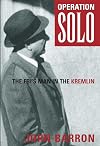
“Operation Solo” by John Barron is an astonishing and well-written book. How is it that name of the the most valuable spy the United States has ever had is practically unknown? This is a great spy story, and it’s true.
Morris Childs, son of Russian Jews who emigrated to Chicago, joined the American Communist Party in 1921 where he rose to become a member of the Central Committee and ran unsuccessfully for US Congress on the Communist Party ticket. His brother Jack later joined the party show more also. After some shabby treatment by the party in 1947 and his health suffering, Morris dropped out, and Jack became inactive also in part to help care for Morris. This sudden withdrawal from party activity triggered a visit to Jack by two FBI agents eager to assess his potential to cooperate.
Here the FBI hit the jackpot. Jack was agreeable to cooperation but pointed out that brother Morris was their ticket to the top. Morris had become wiser about the USSR and realized they were being ruled by a cutthroat band of mass murderers. Two FBI agents appealed successfully to Morris and farsightedly and on their own initiative enabled payment for him to be treated at the Mayo Clinic, where his health was restored.
Now working with the FBI, the brothers re-established their party connections and worked their way up party ranks. Morris became the liaison between the American and the Soviet parties. He made dozens of trips into the Soviet Union, enjoying access to several successive premiers and topmost Soviet intelligence operatives as well as Mao Tse Tung and Fidel Castro. He was fully aware of the horrors awaiting him in Moscow if he were discovered.
Thus the FBI was aware of every move of the American Communist Party and of much information of greatest importance about affairs in the Soviet Union and its top leadership and spy apparatus, until the operation was terminated in 1980.
The information obtained by Morris Childs was of the greatest strategic and tactical assistance in the Cold War. For example, it was Childs who first learned of the widening fracture between Soviet and Chinese Communism, completely unsuspected in the US. Without this information, it would not have occurred to Nixon to arrange his historic visit to China in 1972.
The Soviet Hierarchy is an insulated and paranoid bunch, enjoying their lavish homes and dachas, rarely going outside their own pampered little worlds and scornful of sentiments in the streets of their own country and largely ignorant of the rest of the world. Many start believing their own propaganda. Childs saw the resulting delusional thinking first hand and recognized its dangers. Paranoid minds sometimes decide to strike first in order to forestall an imaginary threat. Childs repeatedly had to provide accurate explanations of American activities and reassure the Soviet hierarchy of the lack of aggressive intent of the United States.
In fact, no sooner had Childs quit traveling to the USSR than a possible nuclear exchange was averted. About 1981, during the Reagan presidency, a British intelligence agent learned that KGB Chairman Yuri Andropov had announced to the Politburo that the Reagan administration was actively preparing for nuclear war and a possible surprise attack on the Soviet Union. Andropov explained that NATO, Japan and China were conniving to initiate World War Three. The KGB set in motion an intelligence operation code named RYAN to gather evidence worldwide of these preparations.
If Childs had been there, he could have correctly explained the meager facts that the KGB had which apparently supported this wild but dangerous notion. As it was, the KGB, operating in its usual paranoid top-down manner, sent out instructions to its intelligence assets around the world to find the evidence of this plot. Thereafter these assets, knowing that when the KGB asked them to find evidence, they had better find evidence (there was none), began producing every little scrap which could conceivably support the theory.
All this was not helped by the fact that for years the Soviet leaders were incapacitated: Brezhnev was a walking zombie, Andropov became deathly ill, and Chernenko was senile and died. A few KGB officers recognized this nuclear scenario as an insane idea, but it enjoyed such patronage at the top that none dared try to stop it. On the other hand, some field bosses tried to gain status by inflaming the paranoia with absurd reports. Some reports of this paranoia made it back to the administration but sounded so bizarre they were dismissed.
When Mikhail Gorbachev took power in 1985, the KGB briefed him that Operation RYAN was a complete failure, having learned nothing about the US position in the matter. But the doomsday notion was still believed. It was not until later in 1985, when Reagan sat down with Gorbachev, declared that the US had no intention of attacking the USSR, and invited him to the US to see for himself, that Operation RYAN ended.
Also of note, it was from Childs that the Johnson administration knew that the USSR was not involved in the assassination of President Kennedy, and another possible serious misunderstanding was averted.
Morris Childs was awarded the Soviet Order of the Red Banner for his services(!) to the Communist Party. He and Jack Childs received the Presidential Medal of Freedom by President Reagan.
The contributions of Morris (and his wife Eva) and Jack Childs should be known and appreciated by everyone. Great heroes, both, and hats off to the FBI and its agents, who ingeniously negotiated multiple perils from within the organization and our own government, as well as from a paranoid and vigilant KGB.
The internal FBI files on Operation Solo are now available free at archiv.org. show less
Morris Childs, son of Russian Jews who emigrated to Chicago, joined the American Communist Party in 1921 where he rose to become a member of the Central Committee and ran unsuccessfully for US Congress on the Communist Party ticket. His brother Jack later joined the party show more also. After some shabby treatment by the party in 1947 and his health suffering, Morris dropped out, and Jack became inactive also in part to help care for Morris. This sudden withdrawal from party activity triggered a visit to Jack by two FBI agents eager to assess his potential to cooperate.
Here the FBI hit the jackpot. Jack was agreeable to cooperation but pointed out that brother Morris was their ticket to the top. Morris had become wiser about the USSR and realized they were being ruled by a cutthroat band of mass murderers. Two FBI agents appealed successfully to Morris and farsightedly and on their own initiative enabled payment for him to be treated at the Mayo Clinic, where his health was restored.
Now working with the FBI, the brothers re-established their party connections and worked their way up party ranks. Morris became the liaison between the American and the Soviet parties. He made dozens of trips into the Soviet Union, enjoying access to several successive premiers and topmost Soviet intelligence operatives as well as Mao Tse Tung and Fidel Castro. He was fully aware of the horrors awaiting him in Moscow if he were discovered.
Thus the FBI was aware of every move of the American Communist Party and of much information of greatest importance about affairs in the Soviet Union and its top leadership and spy apparatus, until the operation was terminated in 1980.
The information obtained by Morris Childs was of the greatest strategic and tactical assistance in the Cold War. For example, it was Childs who first learned of the widening fracture between Soviet and Chinese Communism, completely unsuspected in the US. Without this information, it would not have occurred to Nixon to arrange his historic visit to China in 1972.
The Soviet Hierarchy is an insulated and paranoid bunch, enjoying their lavish homes and dachas, rarely going outside their own pampered little worlds and scornful of sentiments in the streets of their own country and largely ignorant of the rest of the world. Many start believing their own propaganda. Childs saw the resulting delusional thinking first hand and recognized its dangers. Paranoid minds sometimes decide to strike first in order to forestall an imaginary threat. Childs repeatedly had to provide accurate explanations of American activities and reassure the Soviet hierarchy of the lack of aggressive intent of the United States.
In fact, no sooner had Childs quit traveling to the USSR than a possible nuclear exchange was averted. About 1981, during the Reagan presidency, a British intelligence agent learned that KGB Chairman Yuri Andropov had announced to the Politburo that the Reagan administration was actively preparing for nuclear war and a possible surprise attack on the Soviet Union. Andropov explained that NATO, Japan and China were conniving to initiate World War Three. The KGB set in motion an intelligence operation code named RYAN to gather evidence worldwide of these preparations.
If Childs had been there, he could have correctly explained the meager facts that the KGB had which apparently supported this wild but dangerous notion. As it was, the KGB, operating in its usual paranoid top-down manner, sent out instructions to its intelligence assets around the world to find the evidence of this plot. Thereafter these assets, knowing that when the KGB asked them to find evidence, they had better find evidence (there was none), began producing every little scrap which could conceivably support the theory.
All this was not helped by the fact that for years the Soviet leaders were incapacitated: Brezhnev was a walking zombie, Andropov became deathly ill, and Chernenko was senile and died. A few KGB officers recognized this nuclear scenario as an insane idea, but it enjoyed such patronage at the top that none dared try to stop it. On the other hand, some field bosses tried to gain status by inflaming the paranoia with absurd reports. Some reports of this paranoia made it back to the administration but sounded so bizarre they were dismissed.
When Mikhail Gorbachev took power in 1985, the KGB briefed him that Operation RYAN was a complete failure, having learned nothing about the US position in the matter. But the doomsday notion was still believed. It was not until later in 1985, when Reagan sat down with Gorbachev, declared that the US had no intention of attacking the USSR, and invited him to the US to see for himself, that Operation RYAN ended.
Also of note, it was from Childs that the Johnson administration knew that the USSR was not involved in the assassination of President Kennedy, and another possible serious misunderstanding was averted.
Morris Childs was awarded the Soviet Order of the Red Banner for his services(!) to the Communist Party. He and Jack Childs received the Presidential Medal of Freedom by President Reagan.
The contributions of Morris (and his wife Eva) and Jack Childs should be known and appreciated by everyone. Great heroes, both, and hats off to the FBI and its agents, who ingeniously negotiated multiple perils from within the organization and our own government, as well as from a paranoid and vigilant KGB.
The internal FBI files on Operation Solo are now available free at archiv.org. show less

The story of Victor Belenko, the MiG-25 pilot who defected with his aircraft to Japan in 1976 and gave Western intelligence agencies an exclusive look at one of the most feared aircraft of its day.
This ghost-written book appeared under the 'Reader's Digest' imprint, so it must be expected that it would have an anti-Soviet bias, even before considering its subject matter. That Belenko felt the need to defect is indicative of the pressure put on Soviet pilots and others during the Cold War show more times, rather than an admission of the failure of the Soviet system. Where this book falls down is that it doesn't talk in detail about the findings of the CIA analysis of the MiG-25, which revealed that many of the weaknesses of Soviet engineering were actually strengths when looked at in a more rational way; for example, the limited use of flush riveting or of high-tech alloys in the construction of the aircraft; these were restricted to areas where they were actually necessary, enabling the aircraft to be more economically built. The powerful radar also attracted criticism for using thermionic valves instead of integrated circuits the way Western aircraft would; but apart from the fact of availability of advanced technology being the determining factor, the American analysts were impressed with the way that the MiG's radar was devised for step-by-step maintenance by unskilled personnel, enabling a complex system to have minimal downtime, unlike the aircraft's American counterparts.
The book's glimpses of life in a front-line Soviet aviation unit are of interest, but need to be read through the filter of the book's inherent bias. Given that, it is an interesting volume nonetheless. show less
This ghost-written book appeared under the 'Reader's Digest' imprint, so it must be expected that it would have an anti-Soviet bias, even before considering its subject matter. That Belenko felt the need to defect is indicative of the pressure put on Soviet pilots and others during the Cold War show more times, rather than an admission of the failure of the Soviet system. Where this book falls down is that it doesn't talk in detail about the findings of the CIA analysis of the MiG-25, which revealed that many of the weaknesses of Soviet engineering were actually strengths when looked at in a more rational way; for example, the limited use of flush riveting or of high-tech alloys in the construction of the aircraft; these were restricted to areas where they were actually necessary, enabling the aircraft to be more economically built. The powerful radar also attracted criticism for using thermionic valves instead of integrated circuits the way Western aircraft would; but apart from the fact of availability of advanced technology being the determining factor, the American analysts were impressed with the way that the MiG's radar was devised for step-by-step maintenance by unskilled personnel, enabling a complex system to have minimal downtime, unlike the aircraft's American counterparts.
The book's glimpses of life in a front-line Soviet aviation unit are of interest, but need to be read through the filter of the book's inherent bias. Given that, it is an interesting volume nonetheless. show less

I can't exactly remember when I read this book, it must have been somewhere in the early nineties. It fit snugly into my parents' personal library when I chanced upon it. What I do remember, though, is that I found this book a very impressive and enveloping read, indeed. A whole catalog of the KGB's most dirty tricks within the context of (sometimes bungled) attempts at geopolitical scheming on a larger-than-life scale. Better than the average fictional accounts in movies, and such.

The story follows Belenko, poster-boy of a New Communist, from his childhood to his escape in one of Russia's prize fighters. I love this book. It's funny, suspenseful, and very real. From spraying trees green, drinking jet fuel, listening to illicit guitar music, and watching your ceiling slowly collapse, this book is a never-ending source of amusement but also an education in Cold War era Soviet life. I highly recommend this book to anyone who is interested in Russian culture, show more Soviet-American relations, the Cold War, the workings of aircraft or fighter pilots, biographies, or if you just plain enjoy a good story. show less
Lists
You May Also Like


Statistics
- Works
- 10
- Members
- 792
- Popularity
- #32,169
- Rating
- 3.8
- Reviews
- 9
- ISBNs
- 74
- Languages
- 10