

Alexander Campbell (1) (1788–1866)
Author of The Christian System
For other authors named Alexander Campbell, see the disambiguation page.
Series
Works by Alexander Campbell
Family culture,: Or, conversations at the Carlton house (Restoration reprint library) (1967) 30 copies
Christianity restored: The principal extras of the Millennial Harbinger, revised and corrected (1959) 29 copies
A Debate Between Rev. A. Campbell and Rev. N. L. Rice on the Action, Subject, Design and Administrator of Christian Baptism (1844) 25 copies
The Christian Preacher's Companion; Or, the Gospel Facts Sustained By the Testimony of Unbelieving Jews and Pagans & Christian Evidences (Restoration reprint library) (2025) — Author — 22 copies
Debate on Christian baptism : between Mr. John Walker, a minister of the secession, and Alexander Campbell : held at Mount-Pleasant, on the 19th and 20th June, 1820, in the… (1822) — Author — 16 copies
The Christian Baptist : vol. II 13 copies
A discussion of the doctrines of the endless misery and universal salvation : in an epistolary correspondence (1840) 11 copies
The Christian hymn book : a compilation of Psalms, hymns and spiritual songs, original and selected (2015) 11 copies
Sermon on the law 5 copies
Historical Documents Advocating Christian Union: Definitive Writings of the Restoration Movement (The Restoration Movement Library) (2017) 4 copies
The sacred writings of the apostles and evangelists of Jesus Christ : commonly called the New Testament (1954) 3 copies
Life and death 2 copies
Address on war 2 copies
A Debate on Christian Baptism, Between Mr. John Walker, a Minister of the Secession, and Alexander Campbell ... (2016) 1 copy
Millenial Harbinge - 1830 1 copy
Lectures and Addresses 1 copy
Lectures on the Pentateuch 1 copy
Order of Worship — Author — 1 copy
Associated Works
A Review of Rev. J.B. Jeter's Book Entitled "Campbellism Examined." (1857) — Introduction — 35 copies
"Old Paths Pulpit, a Book of 33 Sermons and Essays" by Evangelists of the Church of Christ (1945) — Contributor — 7 copies
Tagged
Common Knowledge
- Canonical name
- Campbell, Alexander
- Birthdate
- 1788-09-12
- Date of death
- 1866-03-04
- Gender
- male
- Education
- University of Glasgow
- Occupations
- minister
theologian - Organizations
- Association of Christians
Redstone Baptist Association
Disciples of Christ
Restoration Movement (Stone-Campbell Movement)
Christian Church, Disciples of Christ
Churches of Christ (show all 7)
Christian Churches and Churches of Christ - Relationships
- Campbell, Thomas (father, #2)
- Short biography
- He was descended from Scotch and Huguenot ancestors. Both his physical and mental constitution was vigorous and well balanced. From his earliest years he was trained by his learned and accomplished father in habits of severe application. He was a graduate of the University of Glasgow.
Reared in the strictest school of Presbyterianism, he early formed and cultivated habits of piety and a taste for theological studies. From his youth he had a profound reverence for the word of God.
He came to America in 1809 and joined his father, Thomas Campbell, in western Pennsylvania. From that time father and son were one in their aims, spirit and work. Both were deeply impressed with the conviction of the evils and inherent sinfulness of sectarianism.
Their first advocacy was the repudiation of human creeds as tests of fellowship, and the union of all our Lord's people upon the catholic truth of the Bible as the only authoritative standard of faith and practice. Taking their stand upon the principles set forth in the "Declaration and Address," neither foresaw the conclusions to which he would be led. They and those associated with them searched the Scriptures as free as possible from party bias.
From these investigations they concluded that sprinkling for baptism and infant membership in the church were unauthorized of God. They were therefore accordingly immersed and united with the Regular Baptists. It was stipulated, however, that they should not be required to subscribe to any creed or articles of faith other than the Bible. After a few years in this fellowship they found it prudent to withdraw. There were prejudiced and intolerant men who held a leading influence in the Redstone Association who were unwilling to break from the Baptist name, creed and traditions. They stirred up fierce opposition against those who stood for the catholic truth of the New Testament.
Hence the Campbells, and others who held to the principles of the "Declaration and Address," cut loose from their religious connections and entered untrammeled upon the advocacy and the defense of the plea for the return to primitive Christianity.
Alexander Campbell died in 1866. -- Haynes, Nathaniel S. "History of the Disciples of Christ in Illinois 1819-1914", Cincinnati: Standard Publishing Company, 1915. Pages 491 - 492. - Nationality
- Ireland
USA - Birthplace
- Ballymena, Ireland
- Places of residence
- Ballymena, County Antrim, Ireland
Washington, Pennsylvania, USA
Bethany, West Virginia, USA - Place of death
- Bethany, West Virginia, USA
- Burial location
- Campbell Family Cemetery, Bethany, West Virginia, USA
- Associated Place (for map)
- USA
Members
Reviews
Alexander Campbell is the Campbell of the “Stone-Campbell Movement,” which is another term for the Restoration Movement which had its origins in the late eighteenth century and early nineteenth century. Campbell in particular is known for the intellectual scaffolding which he provided for said movement.
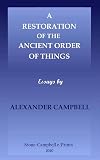
A Restoration of the Ancient Order of Things: Essays by Alexander Campbell (affiliate link) is a collection of two series of articles written by Campbell in The Christian Baptist: the show more “Ancient Order of Things,” and “The Ancient Gospel.”
In these series of articles one is able to discern the fundamental posture of the appeal to the ancient order of things, to encourage the faith and practices of the church today to be based in what God established through the apostles in the first century. Campbell primarily focuses on the organization of the church, “universal” and “local,” as well as the acts of the assembly. Likewise, Campbell considers the means by which one comes to saving faith in Jesus, and the role of baptism therein, especially in light of the prevalent practices in Protestantism in the early nineteenth century.
For those who have spent any considerable amount of time in churches of Christ there will not be much new here. I could not help but notice was the focus on church governance and functioning as well as the continual appeal and emphasis upon “reason” and the use of reason to come to an understanding of these matters, very much reinforcing the observations of Richard Hughes regarding Campbell and what he emphasized.
Such appeals to reason and consideration of church governance and functioning are not inherently wrong, but it does say much about the times and the people involved. My one major critique would be in the assumption/presumption Campbell maintained regarding the expectation of one consistent model of church functioning/governance: I fear he imposed that level of uniformity upon the text when the text itself manifests greater diversity. It’s a good reminder for us to allow the apostles to tell us more than we wish to impose upon them in terms of our categorizations, structures, and what we insist must be the way of things.
Nevertheless, this collection of essays is a good compilation and distillation of the restorationist appeal to the ancient order of things in the early nineteenth century. show less
A Restoration of the Ancient Order of Things: Essays by Alexander Campbell (affiliate link) is a collection of two series of articles written by Campbell in The Christian Baptist: the show more “Ancient Order of Things,” and “The Ancient Gospel.”
In these series of articles one is able to discern the fundamental posture of the appeal to the ancient order of things, to encourage the faith and practices of the church today to be based in what God established through the apostles in the first century. Campbell primarily focuses on the organization of the church, “universal” and “local,” as well as the acts of the assembly. Likewise, Campbell considers the means by which one comes to saving faith in Jesus, and the role of baptism therein, especially in light of the prevalent practices in Protestantism in the early nineteenth century.
For those who have spent any considerable amount of time in churches of Christ there will not be much new here. I could not help but notice was the focus on church governance and functioning as well as the continual appeal and emphasis upon “reason” and the use of reason to come to an understanding of these matters, very much reinforcing the observations of Richard Hughes regarding Campbell and what he emphasized.
Such appeals to reason and consideration of church governance and functioning are not inherently wrong, but it does say much about the times and the people involved. My one major critique would be in the assumption/presumption Campbell maintained regarding the expectation of one consistent model of church functioning/governance: I fear he imposed that level of uniformity upon the text when the text itself manifests greater diversity. It’s a good reminder for us to allow the apostles to tell us more than we wish to impose upon them in terms of our categorizations, structures, and what we insist must be the way of things.
Nevertheless, this collection of essays is a good compilation and distillation of the restorationist appeal to the ancient order of things in the early nineteenth century. show less

Together with a Brief Memoir of Mrs. Jane Campbell
You May Also Like


Associated Authors
Statistics
- Works
- 117
- Also by
- 5
- Members
- 1,271
- Popularity
- #20,173
- Rating
- 4.2
- Reviews
- 2
- ISBNs
- 87
- Languages
- 2
- Favorited
- 1


