
J. H. Parry (1) (1914–1982)
Author of The Age of Reconnaissance: Discovery, Exploration, and Settlement, 1450-1650
For other authors named J. H. Parry, see the disambiguation page.
Works by J. H. Parry
The Age of Reconnaissance: Discovery, Exploration, and Settlement, 1450-1650 (1963) 272 copies, 2 reviews
Establishment of the European Hegemony: 1415-1715; Trade and Exploration in the Age of the Renaissance (Harper, No. TB 1045) (1961) 145 copies, 2 reviews
Trade and Dominion: The European Overseas Empires in the Eighteenth Century (1971) 72 copies, 1 review
The Discovery of the Sea: An Illustrated History of Men, Ships and the Sea in the 15th and 16th Centuries (1974) 60 copies, 1 review
Associated Works
Colonial America: Essays in Politics and Social Development (1983) — Contributor, some editions — 177 copies, 1 review
The Cambridge Economic History of Europe, Volume 4: The Economy of Expanding Europe in the Sixteenth and Seventeenth Century (1967) — Contributor — 38 copies, 1 review
Tagged
Common Knowledge
- Legal name
- Parry, John Horace
- Birthdate
- 1914-04-26
- Date of death
- 1982-08-25
- Gender
- male
- Education
- University of Cambridge (Clare College)
- Occupations
- historian
- Organizations
- Royal Navy
Harvard University - Awards and honors
- Order of the British Empire (Officer)
Order of St Michael and St George (Companion) - Nationality
- UK (birth)
- Birthplace
- Handsworth, Birmingham, England, UK
- Places of residence
- Handsworth, England, UK
Cambridge, Massachusetts, USA - Place of death
- Cambridge, Massachusetts, USA
- Associated Place (for map)
- UK
Members
Reviews
'THE AGE OF RECONNAISSANCE: DISCOVERY, EXPLORATION AND SETTLEMENT, 1450-1650 (HISTORY OF CIVILISATION)' by J. H. Parry

This is a wonderfully broad survey of European exploration and colonization between the fifteenth and seventeenth centuries. One of the general conclusions of this book is that European adventurers were motivated far more by hopes of economic gain than by geographic or scientific curiosity. Its overarching theme is therefore conquest in the name of trade, but the narrative also branches out to a multitude of other topics, such as proselytization, forced and voluntary migrations, government show more and even the theoretical justifications for conquest and conversion (in Spanish colonies in particular).
I particularly liked the opening chapter which clearly explains the political and technological reasons for the limitations of European geographic knowledge prior to the 15th century. Travel by land eastward was difficult and dangerous, while ships could only cover the Mediterranean ocean. The author seems to have had a particular fondness for naval history, as he goes into great detail in describing the evolution of ships and navigation methods which enabled Europeans to start exploring the big oceans. He closes the book by emphasizing that the world known to Europeans by the middle of the seventeenth century was still mostly a world of coastlines.
One strength of this book is that it reveals the mixed motives of explorers, conquistadores, traders, colonists, royalty and their colonial representatives in this age. They rarely viewed discovery as an aim in itself, as some modern historians are accustomed to do. Conquest was mostly profitable, but fortunes changed swiftly and there were many exploratory and colonial dead ends. European monarchies frequently lost interest and influence in their colonies when wars and revolutions at home required urgent attention. The seeds of colonial independence were planted in this period, but how independence eventually came about is a story for another book.
Another positive is that this book treats eastward and westward reconnaissance almost evenly. The westward story gets a bit more attention, but this is clearly justified because strong political organizations in Asia prevented eastward travelers from controlling anything more than seaborne trade. European undertakings on the American continent were far more pervasive and consequential. Overall this book is a very useful complement to internal European history in these centuries. European reconnaissance had a substantial impact not only on the places where Europeans came ashore, but on Europe itself. show less
I particularly liked the opening chapter which clearly explains the political and technological reasons for the limitations of European geographic knowledge prior to the 15th century. Travel by land eastward was difficult and dangerous, while ships could only cover the Mediterranean ocean. The author seems to have had a particular fondness for naval history, as he goes into great detail in describing the evolution of ships and navigation methods which enabled Europeans to start exploring the big oceans. He closes the book by emphasizing that the world known to Europeans by the middle of the seventeenth century was still mostly a world of coastlines.
One strength of this book is that it reveals the mixed motives of explorers, conquistadores, traders, colonists, royalty and their colonial representatives in this age. They rarely viewed discovery as an aim in itself, as some modern historians are accustomed to do. Conquest was mostly profitable, but fortunes changed swiftly and there were many exploratory and colonial dead ends. European monarchies frequently lost interest and influence in their colonies when wars and revolutions at home required urgent attention. The seeds of colonial independence were planted in this period, but how independence eventually came about is a story for another book.
Another positive is that this book treats eastward and westward reconnaissance almost evenly. The westward story gets a bit more attention, but this is clearly justified because strong political organizations in Asia prevented eastward travelers from controlling anything more than seaborne trade. European undertakings on the American continent were far more pervasive and consequential. Overall this book is a very useful complement to internal European history in these centuries. European reconnaissance had a substantial impact not only on the places where Europeans came ashore, but on Europe itself. show less
Establishment of the European Hegemony: 1415-1715; Trade and Exploration in the Age of the Renaissance (Harper, No. TB 1045) by J. H. Parry

Dated – originally published 1949 with second and third editions in 1959 and 1966. I expected something like Guns, Germs, and Steel, but The Establishment of the European Hegemony is more about conflicts between European nations over the New World and southeast Asia rather than conflicts between Europeans and natives.
Author J.H. Parry starts his explanation with Prince Henry the Navigator and his nautical school, arguing that improvements in charts, shipbuilding and naval gunnery got the show more Europeans started on global conquest. This is also an exception to the main theme of conflict between Europeans, discussing the Portuguese inroads on native Indian states (for more on that, see The Last Crusade)
However, once all the European powers are into the act, Parry’s story is about battles between English, Dutch, French, Portuguese, and Spanish. There’s some interesting discussion of national characteristics. One of Parry’s observations is that all the nations but the English had their colonies under fairly strict control of the national government back in Europe (the English tried to this this as well, but with less success). The English also paid much less attention to religious purity; the Spanish and French insisted that colonial settlers be good Catholics. The Dutch and French looked to making a profit off colonial ventures; the Spanish were concerned with saving souls.
Parry’s discussion of the slave trade is dispassionate. He notes the paradox in the Spanish colonies; the Spanish government was solicitous for the welfare of natives, but not for imported slaves, explaining that the natives were considered subjects of the Crown of Spain and therefore had some civil rights, but slaves were legally purchased commodities. (See The Rise of the Spanish American Empire) Of interest is the Spanish rigid adherence to Mercantilist economic theory; all slave cargoes had to be shipped from a Spanish port – meaning that they had to be taken from Africa to Spain, then back across the Atlantic. Since this was a perishable cargo, the trade went to English, French and Dutch smugglers rather than Spanish ships. Parry also makes a claim I hadn’t heard before; that a lot of overcrowding on slave ships was due to contractors in Africa adding their own cargo for personal profit; I suppose a slave dealer in (for example) Bristol could answer objections of inhumanity by showing that his ships theoretically had adequate space, food, and water – but his factors on the African coast would add their own illicit cargo. I don’t know to what extent this is true.
A worthwhile read with some interesting insights. No illustrations, and all the references are old. show less
Author J.H. Parry starts his explanation with Prince Henry the Navigator and his nautical school, arguing that improvements in charts, shipbuilding and naval gunnery got the show more Europeans started on global conquest. This is also an exception to the main theme of conflict between Europeans, discussing the Portuguese inroads on native Indian states (for more on that, see The Last Crusade)
However, once all the European powers are into the act, Parry’s story is about battles between English, Dutch, French, Portuguese, and Spanish. There’s some interesting discussion of national characteristics. One of Parry’s observations is that all the nations but the English had their colonies under fairly strict control of the national government back in Europe (the English tried to this this as well, but with less success). The English also paid much less attention to religious purity; the Spanish and French insisted that colonial settlers be good Catholics. The Dutch and French looked to making a profit off colonial ventures; the Spanish were concerned with saving souls.
Parry’s discussion of the slave trade is dispassionate. He notes the paradox in the Spanish colonies; the Spanish government was solicitous for the welfare of natives, but not for imported slaves, explaining that the natives were considered subjects of the Crown of Spain and therefore had some civil rights, but slaves were legally purchased commodities. (See The Rise of the Spanish American Empire) Of interest is the Spanish rigid adherence to Mercantilist economic theory; all slave cargoes had to be shipped from a Spanish port – meaning that they had to be taken from Africa to Spain, then back across the Atlantic. Since this was a perishable cargo, the trade went to English, French and Dutch smugglers rather than Spanish ships. Parry also makes a claim I hadn’t heard before; that a lot of overcrowding on slave ships was due to contractors in Africa adding their own cargo for personal profit; I suppose a slave dealer in (for example) Bristol could answer objections of inhumanity by showing that his ships theoretically had adequate space, food, and water – but his factors on the African coast would add their own illicit cargo. I don’t know to what extent this is true.
A worthwhile read with some interesting insights. No illustrations, and all the references are old. show less
Phoenix: Trade & Dominion: The European Oversea Empires in the Eighteenth Century (Phoenix Press) by J. H. Parry

I had previously read The Age of Reconnaissance by this author, which I thought was really good. I was expecting this book to be equally educational, but it fell a good way short of those hopes. The first problem, as I see it, is that this book only deals with one century, the eighteenth. This seems to have led the author away from the panoramic historical views of the Age of Reconnaissance, and closer to minute historical trivialities. The second problem is that the emphasis lies a bit too show more much on England for my taste. Perhaps this is to some extent justified because England rose to global prominence in this century, but the author adopts an unfortunate habit of discussing the actions of various famous English personages in far too much detail. The intended audience of this book seems to be very much British.
Still, this book can only be blamed for an excessively national vantage point in comparison to The Age of Reconnaissance. In comparison to the average book on colonial history, its scope certainly is very general and broad. There were many sections which I enjoyed reading. The author can write a good narrative, even though he at times veers into a bit too much detail. In conclusion, this is probably a great book for British readers who want to study global colonial history in the eighteenth century. And it is a reasonably good book even for other readers interested in the period, but they may have to skip some sections where the author starts to wax poetic about the deeds and personalities of "Pitt the elder" or Cornwallis. show less
Still, this book can only be blamed for an excessively national vantage point in comparison to The Age of Reconnaissance. In comparison to the average book on colonial history, its scope certainly is very general and broad. There were many sections which I enjoyed reading. The author can write a good narrative, even though he at times veers into a bit too much detail. In conclusion, this is probably a great book for British readers who want to study global colonial history in the eighteenth century. And it is a reasonably good book even for other readers interested in the period, but they may have to skip some sections where the author starts to wax poetic about the deeds and personalities of "Pitt the elder" or Cornwallis. show less
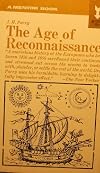
The Age of Reconnaissance, as J. H. Parry has so aptly named it, was the period during which Europe discovered the rest of the world. It began with Henry the Navigator and the Portuguese voyages in the mid-fifteenth century and ended 250 years later when the "Reconnaissance" was all but complete. Dr. Parry examines the inducements--political, economic, religious--to overseas enterprises at the time, and analyzes the nature and problems of the various European settlements in the new lands.
Lists
Awards

You May Also Like


Associated Authors
Statistics
- Works
- 13
- Also by
- 3
- Members
- 1,048
- Popularity
- #24,587
- Rating
- 3.8
- Reviews
- 15
- ISBNs
- 62
- Languages
- 5
- Favorited
- 1