
H. Allen Smith (1) (1907–1976)
Author of Low Man on a Totem Pole
For other authors named H. Allen Smith, see the disambiguation page.
Works by H. Allen Smith
Associated Works
Tagged
Common Knowledge
- Legal name
- Smith, Harry Allen
- Birthdate
- 1907-12-19
- Date of death
- 1976-02-24
- Gender
- male
- Occupations
- journalist
screenwriter - Organizations
- Denver Post
United Press
New York World-Telegram - Nationality
- USA
- Birthplace
- McLeansboro, Illinois, USA
- Places of residence
- McLeansboro, Illinois, USA
San Francisco, California, USA - Place of death
- San Francisco, California, USA
- Associated Place (for map)
- California, USA
Members
Reviews
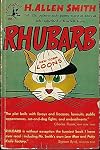
Rhubarb: baseball term for a violent and noisy altercation. Also the name of a large, yellow cat, with maximum attitude, who has inherited the New York Loons, a professional baseball team, along with Thaddeus Whitcomb Banner’s entire fortune.
Banner was an eccentric millionaire who adopted Rhubarb because he liked the cat’s pugnacious attitude.
Eric Yaeger, Banner’s press secretary, is appointed Rhubarb’s guardian. Turns out Yaeger is one of very few people Rhubarb can stand and he show more finds he really has his hands full.
Convincing the New York Loons that the cat is a good luck charm and will help in winning games, is just one item on Yaeger’s list of to-dos. There is the matter of promoting the cat and the team to the public and the matter of dealing with Myra, Banner’s disinherited daughter. She files a lawsuit to invalidate the will and get the millions left. There is also a plot to have the cat killed for the money.
Written in 1946 by H. Allen Smith, it is a series of non-stop mad-cap actions, with a cast of zany characters. Definitely a fun read!! show less
Banner was an eccentric millionaire who adopted Rhubarb because he liked the cat’s pugnacious attitude.
Eric Yaeger, Banner’s press secretary, is appointed Rhubarb’s guardian. Turns out Yaeger is one of very few people Rhubarb can stand and he show more finds he really has his hands full.
Convincing the New York Loons that the cat is a good luck charm and will help in winning games, is just one item on Yaeger’s list of to-dos. There is the matter of promoting the cat and the team to the public and the matter of dealing with Myra, Banner’s disinherited daughter. She files a lawsuit to invalidate the will and get the millions left. There is also a plot to have the cat killed for the money.
Written in 1946 by H. Allen Smith, it is a series of non-stop mad-cap actions, with a cast of zany characters. Definitely a fun read!! show less
How to write without knowing nothing; a book largely concerned with the use and misuse of language at home and abroad by H. Allen Smith
I enjoyed this one about as much as I expected to! It’s essentially a collection of short essays and diatribes about the perils of writing, amusing slips of the tongue, odd turns of phrase, and the quirks of the publishing world, and it’s pitch-perfect humour writing in a lot of ways—bit of exaggeration, bit of irony, bit of nudge-nudge-wink-wink, and a fair bit that elicited giggling.
But! And this is a reasonably big ‘but’, this book came out in the early 1960s, and I went into it show more knowing that. When celebrities and locations pop up, and they do, I only recognized them maybe half the time, and some of the topics are decidedly of their era. Talk shows? Yes, we still have those. But I lost track of how much time Smith spends on baseball radio announcers and their funny ol’-time ways of talking.
And that’s not even the worst of the datedness; if you’re not a male WASP, there’s going to be at least one moment of cringe. Those radio announcers? Southern. Phonetic dialogue that reads like a minstrel play and/or a dig at the Irish? Check. Obligatory joke about women who can’t read maps? You betcha. It’s never intended meanly, but it’s all still there, and it’s why a book I largely enjoyed otherwise is getting a “fine” rating.
That aside, though, this was a fun and interesting read. I was surprised in that way I often am with older books, that life really hasn’t changed that much. People still comment about the same stuff, still promote their books the same way, still expect the same things, and so on. Even the way we write humour books is the same! Right now to, apparently, the write-in lists so that enough of Smith’s regular readers feel recognized. And the reprints of writing from elsewhere.
(Okay, so the lists of malapropisms did get a little tiring….)
There’s no doubt that Smith knew his craft, though. He’s good with funny turns of phrase, and keeping everything just SFW enough for a middle-class audience, and has some nicely cynical opinions about why people are Like That. He’s also good at writing prose that reads like a story he’s telling in a corner of a party, comic timing and all, and giving a good comedic rant, and like I said, he did have me laughing to some extent through a lot of it.
Essentially, this was about what I wanted when I read it, and delivered what I thought it would. I learned a bit about Smith’s era, laughed at his descriptions of people and circumstances, and, bad jokes aside, enjoyed my time reading. Liked it, didn’t love it, can’t ethically recommend it.
6/10
Contains: a lot of ideas about gender, class, race, and ethnicity that would absolutely not fly today, and some parodies of dialects and accents related to same. Also a lot of baseball. show less
But! And this is a reasonably big ‘but’, this book came out in the early 1960s, and I went into it show more knowing that. When celebrities and locations pop up, and they do, I only recognized them maybe half the time, and some of the topics are decidedly of their era. Talk shows? Yes, we still have those. But I lost track of how much time Smith spends on baseball radio announcers and their funny ol’-time ways of talking.
And that’s not even the worst of the datedness; if you’re not a male WASP, there’s going to be at least one moment of cringe. Those radio announcers? Southern. Phonetic dialogue that reads like a minstrel play and/or a dig at the Irish? Check. Obligatory joke about women who can’t read maps? You betcha. It’s never intended meanly, but it’s all still there, and it’s why a book I largely enjoyed otherwise is getting a “fine” rating.
That aside, though, this was a fun and interesting read. I was surprised in that way I often am with older books, that life really hasn’t changed that much. People still comment about the same stuff, still promote their books the same way, still expect the same things, and so on. Even the way we write humour books is the same! Right now to, apparently, the write-in lists so that enough of Smith’s regular readers feel recognized. And the reprints of writing from elsewhere.
(Okay, so the lists of malapropisms did get a little tiring….)
There’s no doubt that Smith knew his craft, though. He’s good with funny turns of phrase, and keeping everything just SFW enough for a middle-class audience, and has some nicely cynical opinions about why people are Like That. He’s also good at writing prose that reads like a story he’s telling in a corner of a party, comic timing and all, and giving a good comedic rant, and like I said, he did have me laughing to some extent through a lot of it.
Essentially, this was about what I wanted when I read it, and delivered what I thought it would. I learned a bit about Smith’s era, laughed at his descriptions of people and circumstances, and, bad jokes aside, enjoyed my time reading. Liked it, didn’t love it, can’t ethically recommend it.
6/10
Contains: a lot of ideas about gender, class, race, and ethnicity that would absolutely not fly today, and some parodies of dialects and accents related to same. Also a lot of baseball. show less

A delightful collection of the best children's writing from the U.S. and Canada as of 1956. Smith proves an apt editor for the wise words of these kiddos, adding his own clever insight to contextualise their literary works but never attempting to outshine them. Personally, my favourite entry is a child writing about their father:
One can only hope to attain a love—and a writing show more style—so pure. show less
He is a farmer. He smells like a cow and when I smell that cow in the house I know Pop is home and I am glad.
One can only hope to attain a love—and a writing show more style—so pure. show less
How to Write Without Knowing Nothing: A Book Largely Concerned with the Use and Misuse of Language at Home and Abroad by H. Allen Smith
A rough guide to writing grammatical English, from the American point of view.. It seems to have been quite useful as a guide to me. However, the useful bits are dispersed among humorous essays about malapropisms and the bad habits of radio announcers of the 1950's.
Lists
Awards

You May Also Like


Associated Authors
Statistics
- Works
- 42
- Also by
- 7
- Members
- 1,092
- Popularity
- #23,527
- Rating
- 3.6
- Reviews
- 21
- ISBNs
- 32
- Languages
- 2
- Favorited
- 3