

Stephanie Burgis
Author of Kat, Incorrigible
About the Author
Image credit: Author photo from official website https://www.stephanieburgis.com/about-me/
Series
Works by Stephanie Burgis
The Boy who Learned to Dream: A Short Story in the World of The Dragon with a Chocolate Heart (2023) 5 copies
Fierce Company 5 copies
The Dragon with an Unbearable Family 3 copies
Girl in Boots 2 copies
Locked Doors 2 copies
Christmas at Kraken Castle 2 copies
By The Light Of The Dark 2 copies
Accident of Birth 2 copies
The Harwood Spellbook 1 copy
A Waltz of Sinister Import 1 copy
Crow 1 copy
Behind the Rules 1 copy
The Andrassii Agreement 1 copy
Spells for Home 1 copy
Marking Time [short story] 1 copy
Foxwoman 1 copy
Associated Works
Willful Impropriety: 13 Tales of Society, Scandal, and Romance (2012) — Contributor — 87 copies, 4 reviews
Consolation Songs: Optimistic Speculative Fiction for a Time of Pandemic (2020) — Contributor — 35 copies, 3 reviews
Tagged
Common Knowledge
- Canonical name
- Burgis, Stephanie
- Birthdate
- 1977
- Gender
- female
- Education
- Clarion West (2001)
- Occupations
- fantasy writer
- Organizations
- Science Fiction and Fantasy Writers of America
- Relationships
- Samphire, Patrick (husband)
- Nationality
- USA
UK - Birthplace
- East Lansing, Michigan, USA
- Places of residence
- Wales, UK
- Associated Place (for map)
- East Lansing, Michigan, USA
Members
Reviews

{First of prequel +3 Harwood Spellbook series; fantasy, YA}
In a parallel universe where women are the politicians who rule Angland and magic is the preserve of gentlemen Cassandra Harwood has fought hard to forego following in her mother’s brilliant political footsteps and be accepted instead to the Great Library to study magic.
The story opens four months after, having graduated at the top of her class, she has made a tragic mistake that cost her all her magic and caused her to break off show more her engagement with Lord Wrexham. She finds herself talked into attending a house party with her brother and sister-in-law for the winter solstice even though she knows Wrexham will be attending too.
They arrive in the teeth of a snowstorm which the weather wizards had predicted wouldn’t start for several days, which is unusual even for such an imprecise art. And then Cassandra finds herself trapped by a rash promise which makes her realise she has even more to lose than she thought she had lost already if she doesn’t fulfill it by the solstice.
I liked the obvious affection between Cassandra and her brother and her sister-in-law and the romance was sweet and believable rather than spur-of-the-moment. Her romantic interest was tall, dark, handsome - and sensitive; that was one reason I enjoyed the story since Regency rakes usually lack that last quality. Burgis also turns the accepted norms of traditional Regency romances (of gender, race and so on) on their heads in the course of the first six chapters without rubbing your nose in it.
Enjoyed this one. Fun, light and sweet. Well crafted; but I did get impatient waiting to find out what exactly Cassandra had done to lose her magic.
4.5 stars ***** show less
In a parallel universe where women are the politicians who rule Angland and magic is the preserve of gentlemen Cassandra Harwood has fought hard to forego following in her mother’s brilliant political footsteps and be accepted instead to the Great Library to study magic.
The story opens four months after, having graduated at the top of her class, she has made a tragic mistake that cost her all her magic and caused her to break off show more her engagement with Lord Wrexham. She finds herself talked into attending a house party with her brother and sister-in-law for the winter solstice even though she knows Wrexham will be attending too.
“I should think,” she said now, as if idly, “that you would wish to show everyone how little notice you take of any gossip. After all, if we refuse this invitation, you know everyone will say it was because you were too afraid to see Wrexham again.”
My teeth ground together. “I am not afraid of seeing Wrexham.”
“Well, I know that,” Amy said, looking as smug as a cat licking up fresh cream. “But does he?”
Well. It isn’t that I don’t know when I’m being managed. But there are some possibilities that cannot be borne. And the thought of my ex-fiancé’s dark eyebrows rising in his most fiendishly supercilious look at the news of my cowardly refusal…
I drummed my fingers against the table, searching for a way out.
Behind my brother’s outspread newspaper, an apparently disembodied voice spoke. “Better leave early,” my brother said. “It’s meant to snow next week, according to the weather wizards.”
They arrive in the teeth of a snowstorm which the weather wizards had predicted wouldn’t start for several days, which is unusual even for such an imprecise art. And then Cassandra finds herself trapped by a rash promise which makes her realise she has even more to lose than she thought she had lost already if she doesn’t fulfill it by the solstice.
I liked the obvious affection between Cassandra and her brother and her sister-in-law and the romance was sweet and believable rather than spur-of-the-moment. Her romantic interest was tall, dark, handsome - and sensitive; that was one reason I enjoyed the story since Regency rakes usually lack that last quality. Burgis also turns the accepted norms of traditional Regency romances (of gender, race and so on) on their heads in the course of the first six chapters without rubbing your nose in it.
Enjoyed this one. Fun, light and sweet. Well crafted; but I did get impatient waiting to find out what exactly Cassandra had done to lose her magic.
4.5 stars ***** show less

Cassandra Harwood is the only woman to have studied magic at the Great Library. While her magical career has ended disastrously, she’s determined to keep challenging the idea that magic is the domain of men. But not everyone wants her college for young women to succeed. As staff and students arrive, Cassandra has to deal with thorny nightmares, an unfairly-overworked husband. a government inspection and a malicious fey disturbance.
This is a story about challenging the status quo, and show more about the importance of having others -- family and community -- who can support you. Cassandra still struggles with feeling that she has to fight her battles alone, especially when she realises how pursuing her dreams has affected the career opportunities of those she loves.
I really liked the way Thornbound portrays Cassandra’s marriage. They disagree, compromise and acknowledge when they could do better. Most importantly, they both want what’s best for each other and they work through things together.
Thornbound is a delightful sequel. I loved this and my only complaint isn’t really a complaint -- I wanted more.
The cover is lovely, too.
(I received an ARC in exchange for an honest review.)
I can do this, no matter what they think, I told myself firmly. This time, I will not let myself fail.
For the sake of my loyal, loving sister-in-law, who had risked so much to support me in this venture...
For the sake of all those brilliant, talented girls whom the Great Library stubbornly refused to train...
And yes, for my own sake, too, because—despite everything I had feared after the loss of my magic, and despite the haunting whispers of those dreams—I was neither helpless nor broken after all.
...And if anyone from the Boudiccate insulted Amy on this visit, I would simply have to murder them. That was all. show less
This is a story about challenging the status quo, and show more about the importance of having others -- family and community -- who can support you. Cassandra still struggles with feeling that she has to fight her battles alone, especially when she realises how pursuing her dreams has affected the career opportunities of those she loves.
I really liked the way Thornbound portrays Cassandra’s marriage. They disagree, compromise and acknowledge when they could do better. Most importantly, they both want what’s best for each other and they work through things together.
Thornbound is a delightful sequel. I loved this and my only complaint isn’t really a complaint -- I wanted more.
The cover is lovely, too.
(I received an ARC in exchange for an honest review.)
I can do this, no matter what they think, I told myself firmly. This time, I will not let myself fail.
For the sake of my loyal, loving sister-in-law, who had risked so much to support me in this venture...
For the sake of all those brilliant, talented girls whom the Great Library stubbornly refused to train...
And yes, for my own sake, too, because—despite everything I had feared after the loss of my magic, and despite the haunting whispers of those dreams—I was neither helpless nor broken after all.
...And if anyone from the Boudiccate insulted Amy on this visit, I would simply have to murder them. That was all. show less
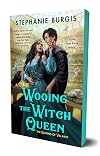
I loved Wooing the Witch Queen. The two characters hooked me immediately: Felix is an archduke who’s been a pawn for his abusive family. He hears them complaining about the horrible witch queen in the neighboring kingdom and flees to her castle. When he arrives, Queen Saskia mistakenly thinks he is the dark wizard she advertised for, and he goes along with it and accepts the job of organizing her library.
Saskia meanwhile has freed her kingdom from her cruel, usurping uncle and just wants show more to be alone in her lab, making more magical protections, but is forced to continuously deal with threats, which she believes are coming from the neighboring archduke who supports her uncle, whom she has sworn to kill.
The story has plenty going on in the outside world, but all the action is in the castle as these two get to know each other, among a found family of the castle staff. The romance is a slow burn with each thinking the other is off-limits, and Felix hiding his identity. Saskia has two witch allies who are set up to be heroines of the sequels, but the ending here is complete. show less
Saskia meanwhile has freed her kingdom from her cruel, usurping uncle and just wants show more to be alone in her lab, making more magical protections, but is forced to continuously deal with threats, which she believes are coming from the neighboring archduke who supports her uncle, whom she has sworn to kill.
The story has plenty going on in the outside world, but all the action is in the castle as these two get to know each other, among a found family of the castle staff. The romance is a slow burn with each thinking the other is off-limits, and Felix hiding his identity. Saskia has two witch allies who are set up to be heroines of the sequels, but the ending here is complete. show less

I received this book from Pyr through Edelweiss, in exchange for an honest review: my thanks to them both for the opportunity to read this novel.
If I enjoyed Stephanie Burgis’ previous book, Masks and Shadows, this one went well beyond any expectations I had, after my first encounter with this writer. Congress of Secrets is far richer and multi-faceted than its predecessor and I enjoyed it very much, as the levels of tension and intrigue kept me glued to the pages until the end. The story show more is set a few decades after the events of Masks and Shadows, and follows new characters, although there is a passing mention of Marie Dommaier, the young maid-turned-opera singer, who seems to have become very famous and whose role appears to be the handing of the narrative baton to the new players.
Caroline Wyndham, a wealthy English widow, hides a secret: she was born Karolina Vögl, daughter of a Viennese printer arrested by the secret police twenty-five years previously for his illegal anti-establishment pamphlets. Karolina herself was a prisoner of Count Pergen, the head of the secret police, who held her – and other equally forgotten victims – as a subject for his experiments in dark magic and alchemy for several years. She is now back in Vienna, with the pretext of following the Congress being held on the wake of Napoleon Bonaparte’s defeat: her real goal is to find a way to free her father, the only one of Pergen’s inmates still to be released.
Michael Steinhüller is a professional con artist, and his latest scheme involves passing himself as a dispossessed Russian noble come to Vienna to obtain reparations for the losses suffered during Bonaparte’s campaigns of conquest. He’s no stranger to Caroline, either, since he was her father’s apprentice when the police came to arrest them all, and her last image of him – and Michael’s recurring shameful memory – is of Michael running for his life as the printer’s shop was torched. When he meets Karolina/Caroline again, the past threatens to infringe on their respective plans and to intrude with uncomfortable memories and unspoken feelings.
Around these two main characters moves a number of either fictional or historical figures, making once more this novel a rich tale that intrigues with its core story and stimulates curiosity toward the events being depicted: if Peter Riesenbeck, the leader of an acting troupe traveling to Vienna in search of success and fame, is an imaginary construct, and the unwitting lynchpin around which part of the drama unfolds, there are also some very real people moving across the stage and weaving seamlessly between reality and fantasy. There is Emperor Francis and the dark secrets he shares with evil Count Pergen, another all too true figure from the past; or we encounter famous politicians as Talleyrand and Metternich; or again my favorite among the secondary players, the Prince de Ligne, who I discovered was a flesh-and-blood person, widely known for his wit and his scorn of political expedience: his friendship with Caroline and his avuncular curiosity toward her, and the mystery she represents, is one of the highlights of the story.
Of course much revolves around Caroline and Michael’s meeting, the emotional undercurrents of their past and present and the misunderstandings that threaten to drive them further apart: once more I commend Ms. Burgis for not placing the romance at the center of the story, but using it simply as part of the plot, leaving the daring schemes of the two under the spotlight. Caroline herself is an intriguing character: like her virtual “sister” Charlotte von Steinbeck in Masks and Shadows, she works within the era’s social conventions, but manages to wield whatever power she can muster with skill and courage, driven by the need to free her father and the guilt she feels for the long years she was forced to abandon him to his destiny. Caroline is no innocent – her truncated childhood saw to that in no small measure – and she’s not an angel either, able as she is to employ her feminine wiles to advantage, but at the same time her past experiences and the deals she had to make have not hardened her completely, and she retains a core of vulnerability that gives her personality a delightful complexity.
The magic elements of the novel are just as intriguing – and frightening: the darkness that inhabits count Pergen and allows him to draw energies from his victims, shifting them to himself or other recipients not unlike a blood transfusion, seems to have a connection with the dark, formless shapes that we saw in Masks and Shadows, and maybe is a sort of evolution of that entity, or a side manifestation. Much is left to the imagination and not explained completely (something I approve of) and the very insubstantial nature of the phenomenon is what makes it so terrifying and believable, especially in the final scenes of the unfolding drama.
If the story seems to end with a somewhat easy "and they lived happily thereafter", it does so in a very satisfactory way - and after the horror and anguish visited on the characters for most of the time, I think they deserve it, and so do the readers. The added value in this novel, even more than in its predecessor, lies in the curiosity that the author manages to instigate in her audience about the historical period in which the action is set, and in the real-life figures presented there. As always, a book that makes me think, besides its entertainment value, is a good one.
Very, very highly recommended.
Originally posted at SPACE and SORCERY BLOG show less
If I enjoyed Stephanie Burgis’ previous book, Masks and Shadows, this one went well beyond any expectations I had, after my first encounter with this writer. Congress of Secrets is far richer and multi-faceted than its predecessor and I enjoyed it very much, as the levels of tension and intrigue kept me glued to the pages until the end. The story show more is set a few decades after the events of Masks and Shadows, and follows new characters, although there is a passing mention of Marie Dommaier, the young maid-turned-opera singer, who seems to have become very famous and whose role appears to be the handing of the narrative baton to the new players.
Caroline Wyndham, a wealthy English widow, hides a secret: she was born Karolina Vögl, daughter of a Viennese printer arrested by the secret police twenty-five years previously for his illegal anti-establishment pamphlets. Karolina herself was a prisoner of Count Pergen, the head of the secret police, who held her – and other equally forgotten victims – as a subject for his experiments in dark magic and alchemy for several years. She is now back in Vienna, with the pretext of following the Congress being held on the wake of Napoleon Bonaparte’s defeat: her real goal is to find a way to free her father, the only one of Pergen’s inmates still to be released.
Michael Steinhüller is a professional con artist, and his latest scheme involves passing himself as a dispossessed Russian noble come to Vienna to obtain reparations for the losses suffered during Bonaparte’s campaigns of conquest. He’s no stranger to Caroline, either, since he was her father’s apprentice when the police came to arrest them all, and her last image of him – and Michael’s recurring shameful memory – is of Michael running for his life as the printer’s shop was torched. When he meets Karolina/Caroline again, the past threatens to infringe on their respective plans and to intrude with uncomfortable memories and unspoken feelings.
Around these two main characters moves a number of either fictional or historical figures, making once more this novel a rich tale that intrigues with its core story and stimulates curiosity toward the events being depicted: if Peter Riesenbeck, the leader of an acting troupe traveling to Vienna in search of success and fame, is an imaginary construct, and the unwitting lynchpin around which part of the drama unfolds, there are also some very real people moving across the stage and weaving seamlessly between reality and fantasy. There is Emperor Francis and the dark secrets he shares with evil Count Pergen, another all too true figure from the past; or we encounter famous politicians as Talleyrand and Metternich; or again my favorite among the secondary players, the Prince de Ligne, who I discovered was a flesh-and-blood person, widely known for his wit and his scorn of political expedience: his friendship with Caroline and his avuncular curiosity toward her, and the mystery she represents, is one of the highlights of the story.
Of course much revolves around Caroline and Michael’s meeting, the emotional undercurrents of their past and present and the misunderstandings that threaten to drive them further apart: once more I commend Ms. Burgis for not placing the romance at the center of the story, but using it simply as part of the plot, leaving the daring schemes of the two under the spotlight. Caroline herself is an intriguing character: like her virtual “sister” Charlotte von Steinbeck in Masks and Shadows, she works within the era’s social conventions, but manages to wield whatever power she can muster with skill and courage, driven by the need to free her father and the guilt she feels for the long years she was forced to abandon him to his destiny. Caroline is no innocent – her truncated childhood saw to that in no small measure – and she’s not an angel either, able as she is to employ her feminine wiles to advantage, but at the same time her past experiences and the deals she had to make have not hardened her completely, and she retains a core of vulnerability that gives her personality a delightful complexity.
The magic elements of the novel are just as intriguing – and frightening: the darkness that inhabits count Pergen and allows him to draw energies from his victims, shifting them to himself or other recipients not unlike a blood transfusion, seems to have a connection with the dark, formless shapes that we saw in Masks and Shadows, and maybe is a sort of evolution of that entity, or a side manifestation. Much is left to the imagination and not explained completely (something I approve of) and the very insubstantial nature of the phenomenon is what makes it so terrifying and believable, especially in the final scenes of the unfolding drama.
If the story seems to end with a somewhat easy "and they lived happily thereafter", it does so in a very satisfactory way - and after the horror and anguish visited on the characters for most of the time, I think they deserve it, and so do the readers. The added value in this novel, even more than in its predecessor, lies in the curiosity that the author manages to instigate in her audience about the historical period in which the action is set, and in the real-life figures presented there. As always, a book that makes me think, besides its entertainment value, is a good one.
Very, very highly recommended.
Originally posted at SPACE and SORCERY BLOG show less
Lists
Sonlight Books (1)
Awards


You May Also Like


Associated Authors
Statistics
- Works
- 72
- Also by
- 20
- Members
- 3,326
- Popularity
- #7,689
- Rating
- 3.8
- Reviews
- 242
- ISBNs
- 156
- Languages
- 5
- Favorited
- 2