

John Stone (2) (1936–2008)
Author of On Doctoring: New, Revised and Expanded Third Edition
For other authors named John Stone, see the disambiguation page.
About the Author
John Stone is the author of the poetry volumes The Smell of Matches, In All This Rain, Renaming the Streets, and Where Water Begins; and the essay collection In the Country of Hearts: Journeys in the Art of Medicine. Now professor of medicine (cardiology) emeritus at Emory University School of show more Medicine, he was for nineteen years director of admissions and associate dean at the school show less
Works by John Stone
Associated Works
Tagged
Common Knowledge
- Birthdate
- 1936-02-07
- Date of death
- 2008-11-06
- Gender
- male
- Education
- Washington University (St. Louis) (MD)
- Occupations
- physician
professor of cardiology
poet - Organizations
- Emory University School of Medicine
- Awards and honors
- Georgia Writers Hall of Fame
- Nationality
- USA
- Birthplace
- Jackson, Mississippi, USA
- Place of death
- Atlanta, Georgia, USA
- Associated Place (for map)
- USA
Members
Reviews

"In the Country of Hearts, Journeys in the Art of Medicine" by Dr. John Stone is a collection of stories of people with illnesses being brought back to health and happiness by extraordinary doctors discovering new ways to heal sick people. If that were all it was, it would be a collection of stories that would make you feel good for a short time and then disappear from your memory. These stories endure because of that something extra that John Stone adds to these stories. He says in his show more introduction that each of us is born with two hearts. "One is the literal heart, the fist- sized pumping one that looms like a ghost on the chest X ray. The other heart is a metaphorical one, one that pumps no blood at all........ I encountered it early on-everyone does-long before I studied cardiology."
The blue baby is the first story in the book. John Stone tells of Jeremy who is almost two year’s old coming before him at the Emory clinic. Jeremy's condition is called tetralogy of Fallot, the most common cause of the so-called blue baby. The cause is a narrowing of an artery to the lungs and a defect, a hole, in the wall that divides the right and left ventricles. Stone gives a lucid account of flying from Georgia to the Mayo Clinic twenty-five years ago with a small child in worst condition than Jeremy and needing the surgery that he could not get in Georgia. The surgery at the Mayo Clinic was successful and he fully recovered. A paragraph later and Jeremy is in the surgery room with Emory surgeons as they bypass his heart and repair the dime sized defect with a patch made of Dacron sewn into the surrounding heart muscle. Jeremy's temperature is raised and his heart begins to beat again. For a few moments you are in the operating room as the surgeons work on Jeremy and Dr. Stone watches over your shoulder and gives you a running commentary. Three weeks later Stone sees Jeremy at the clinic where he is eating well and breathing easy. In five short pages we have witnessed two miracles and can not wait for more. These stories are page turners in a way no Tom Clancy thriller could ever be.
John Stone's writing reminds me of another physician scientist, Dr. Lewis Thomas, who wrote "The Lives of a Cell" and "The Medusa and the Snail", essays on nature and the human condition. Where Lewis Thomas described the medical advances of his time and compared them with the geniuses of the world's elite, John Stone describes the medical advances of this day and compares them with the poetic language of the common man's heart. He has the talent to write in words about the deepest desire of the human heart to love others and to love helping others by making them well. He understands that this is more about changing people's thoughts than about changing their chemical illnesses. show less
The blue baby is the first story in the book. John Stone tells of Jeremy who is almost two year’s old coming before him at the Emory clinic. Jeremy's condition is called tetralogy of Fallot, the most common cause of the so-called blue baby. The cause is a narrowing of an artery to the lungs and a defect, a hole, in the wall that divides the right and left ventricles. Stone gives a lucid account of flying from Georgia to the Mayo Clinic twenty-five years ago with a small child in worst condition than Jeremy and needing the surgery that he could not get in Georgia. The surgery at the Mayo Clinic was successful and he fully recovered. A paragraph later and Jeremy is in the surgery room with Emory surgeons as they bypass his heart and repair the dime sized defect with a patch made of Dacron sewn into the surrounding heart muscle. Jeremy's temperature is raised and his heart begins to beat again. For a few moments you are in the operating room as the surgeons work on Jeremy and Dr. Stone watches over your shoulder and gives you a running commentary. Three weeks later Stone sees Jeremy at the clinic where he is eating well and breathing easy. In five short pages we have witnessed two miracles and can not wait for more. These stories are page turners in a way no Tom Clancy thriller could ever be.
John Stone's writing reminds me of another physician scientist, Dr. Lewis Thomas, who wrote "The Lives of a Cell" and "The Medusa and the Snail", essays on nature and the human condition. Where Lewis Thomas described the medical advances of his time and compared them with the geniuses of the world's elite, John Stone describes the medical advances of this day and compares them with the poetic language of the common man's heart. He has the talent to write in words about the deepest desire of the human heart to love others and to love helping others by making them well. He understands that this is more about changing people's thoughts than about changing their chemical illnesses. show less
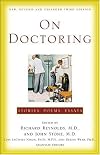
Some homespun, a la' [b:All Creatures Great and Small|32085|All Creatures Great and Small (All Creatures Great and Small, #1-2)|James Herriot|https://i.gr-assets.com/images/S/compressed.photo.goodreads.com/books/1393644607l/32085._SX50_.jpg|69329306]. Most [L]iterary. More than not about death and dying, not joy. Despite cover, I don't remember any young children. Adequate back matter.
I do appreciate the inclusion of 'Wanting to Die' by [a:May Sarton|13166|May show more Sarton|https://images.gr-assets.com/authors/1413742677p2/13166.jpg]. And 'The Last Decision' by [a:Maya Angelou|3503|Maya Angelou|https://images.gr-assets.com/authors/1379017377p2/3503.jpg]. And [a:Jenny Joseph|146517|Jenny Joseph|https://images.gr-assets.com/authors/1399524716p2/146517.jpg]'s 'Warning' (When I am an old woman I shall wear purple....).
I am going to try to read more by Sarton and by the co-editor, John Stone. show less
I do appreciate the inclusion of 'Wanting to Die' by [a:May Sarton|13166|May show more Sarton|https://images.gr-assets.com/authors/1413742677p2/13166.jpg]. And 'The Last Decision' by [a:Maya Angelou|3503|Maya Angelou|https://images.gr-assets.com/authors/1379017377p2/3503.jpg]. And [a:Jenny Joseph|146517|Jenny Joseph|https://images.gr-assets.com/authors/1399524716p2/146517.jpg]'s 'Warning' (When I am an old woman I shall wear purple....).
I am going to try to read more by Sarton and by the co-editor, John Stone. show less

Wide sampling of literary material dealing with health, medicine and doctors' assistence.
You May Also Like


Associated Authors
Statistics
- Works
- 8
- Also by
- 4
- Members
- 503
- Popularity
- #49,234
- Rating
- 4.0
- Reviews
- 4
- ISBNs
- 74