
David Lloyd (4) (1950–)
Author of V for Vendetta
For other authors named David Lloyd, see the disambiguation page.
About the Author
Image credit: David Lloyd, author of Kickback, signing at the Dark Horse Comics booth at New York Comic Con 2008, photo by Lampbane
Series
Works by David Lloyd
John Constantine, Hellblazer Vol. 02: The Devil You Know (2011) — Illustrator — 507 copies, 8 reviews
Hulk Annual 1981 2 copies
V pour Vendetta 1 copy
Quatermass 2 : Enemy from Space : The science horror classic as a graphic novel (1978) — Illustrator — 1 copy
Associated Works
9-11: The World's Finest Comic Book Writers & Artists Tell Stories to Remember (2002) — Illustrator — 256 copies, 1 review
John Constantine, Hellblazer: The Family Man (2008) — Illustrator, some editions — 130 copies, 2 reviews
The Big Book of Little Criminals: 63 True Tales of the World's Most Incompetent Jailbirds! (1996) — Illustrator — 102 copies
Tagged
Common Knowledge
- Birthdate
- 1950
- Gender
- male
- Nationality
- UK
- Birthplace
- London, England, UK
- Associated Place (for map)
- England, UK
Members
Reviews
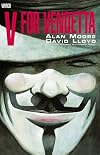
I've been on a spree of fantastic graphic novels for the past few months. I guess it had to end sometime.
I loved Watchmen. While I took issue with Moore's treatment of women in that work, I also found it to be gripping, subversive, and smart storytelling. I was willing to overlook that lapse in narrative judgement and delve into more of Moore's work. I was intrigued by his crazy beard and anarchist attitude.
Well, call my curiosity satisfied. I could not ignore the misogyny in V for Vendetta. show more The novel has a philosophical and political tone, with lots of obscure puns and Yeats quotes, but under that guise is a deep distrust and dislike for women. The novel's treatment of Evey Hammond, the protagonist, for example, is abhorrent. V, the terrorist hero, kidnaps, sexually assaults, and tortures Evey in order to groom her as his protege. And he does it for "love." She passively remains in captivity, and then becomes thankful for her torture-induced "awakening" into "freedom." There's also a weird scene where V slut shames a statue.
Ugh. show less
I loved Watchmen. While I took issue with Moore's treatment of women in that work, I also found it to be gripping, subversive, and smart storytelling. I was willing to overlook that lapse in narrative judgement and delve into more of Moore's work. I was intrigued by his crazy beard and anarchist attitude.
Well, call my curiosity satisfied. I could not ignore the misogyny in V for Vendetta. show more The novel has a philosophical and political tone, with lots of obscure puns and Yeats quotes, but under that guise is a deep distrust and dislike for women. The novel's treatment of Evey Hammond, the protagonist, for example, is abhorrent. V, the terrorist hero, kidnaps, sexually assaults, and tortures Evey in order to groom her as his protege. And he does it for "love." She passively remains in captivity, and then becomes thankful for her torture-induced "awakening" into "freedom." There's also a weird scene where V slut shames a statue.
Ugh. show less

The classic V for Vendetta, found atop many 'best of' graphic novel lists, is a dark, muddled work of raw energy. Its genius cuts through like a lighthouse—often a confusing fog and then, there it is, brilliance.
Given all the praise heaped on V for Vendetta, I was not impressed at first. I had to let the story age in my mind a while before I started to respect it, and this goes as much for its art as well as the message. Referencing Moore's other great work, I'm still partial to Watchmen show more over V, but just by a little. Both illustrate a dark side of humanity that I dare to hope is a product of its time. The optimist in me wants to believe that our world outlook has improved since then. show less
Given all the praise heaped on V for Vendetta, I was not impressed at first. I had to let the story age in my mind a while before I started to respect it, and this goes as much for its art as well as the message. Referencing Moore's other great work, I'm still partial to Watchmen show more over V, but just by a little. Both illustrate a dark side of humanity that I dare to hope is a product of its time. The optimist in me wants to believe that our world outlook has improved since then. show less
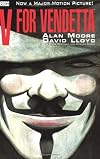
Admittedly, I am a latecomer to the cult of Alan Moore. I was barely aware of him back in the late 80s/early 90s, and other than Killing Joke, my introduction to him was actually in the superb D.R. and Quinch series for 2000 A.D. I missed out on the original releases of his Swamp Thing run, V for Vendetta, and The Watchmen.
Later, I rediscovered Moore with The League of Extraordinary Gentlemen. I was already a fan of Kevin O'Neill from his work on Marshal Law (which is still one of my show more all-time favorite comics and fantastic satire), so I immediately jumped on the new series. Over the years, I've slowly been winding my way back through Moore's definitive work, viewing it for the first time with a somewhat different perspective than most who read the comics upon initial release.
While not the best of Alan Moore's work (The Watchmen, The League of Extraordinary Gentlemen and Killing Joke are far better tales), V for Vendetta still stands up as an amazing piece of comic book art after all these years. Many of the political and social themes (as well as David Lloyd's artwork) may not seem that revolutionary now (or for literature in general), but one has to view the series like a Black Flag album or a painting from Joan Miró. Compared to other releases of that time (and in many cases of the ensuing decades), it stands well above the competition.
I do tend to agree with Moore that the series works much better in its original colorless incarnation, was serialized in Warrior magazine in the UK during the 1980s. The concept of the stark, black and white artwork used to tell a tale of endless moral gray areas works so perfectly. And in many ways, it sub-references the original pulp mystery origins of the series when Moore and Lloyd thought it would be set in the 1930s gangster era. The lackluster coloring by DC Comics, who published the series here in the U.S. under their Vertigo imprint, almost detracts from the story.
But up until this time, there had never been a comic series like V for Vendetta. This was the comic book equivalent of Swift’s “A Modest Proposal,” offering up a satirical and dystopian viewpoint that masks a very serious political argument. Moore and Lloyd were reacting to Thatcherite Britain, parodying its more grotesque sins including xenophobia and ruling by conformity.
In addition, the countless literary allusions, the use of iambic pentameter for V’s dialogue, and the unflinching portrayal of a society that is falling apart at its very core is still head and shoulders above most comic storytelling.
One fact hit me reading all these years later: there isn’t a single hero in V for Vendetta. No one is heroic, not even V. While his anarchist quest could be regarded as noble, it still results in murder and ultimately the complete destruction of British society (holding to the idea that the old society must be destroyed so a new one can be built in its place). Other than Judge Dredd or the Punisher, there was nothing this grim and cynical in comic storytelling of the 1980s and early 90s. It took guts for Moore to craft such a storyline and to do it with such a creative and artistic flourish. Even if you disagree with Moore’s viewpoint, you are dragged into his political arguments, forced to take sides, much like the characters trapped in the storyline, are left to question your own pre-determined moral judgments. That is the mark of a great storyteller. show less
Later, I rediscovered Moore with The League of Extraordinary Gentlemen. I was already a fan of Kevin O'Neill from his work on Marshal Law (which is still one of my show more all-time favorite comics and fantastic satire), so I immediately jumped on the new series. Over the years, I've slowly been winding my way back through Moore's definitive work, viewing it for the first time with a somewhat different perspective than most who read the comics upon initial release.
While not the best of Alan Moore's work (The Watchmen, The League of Extraordinary Gentlemen and Killing Joke are far better tales), V for Vendetta still stands up as an amazing piece of comic book art after all these years. Many of the political and social themes (as well as David Lloyd's artwork) may not seem that revolutionary now (or for literature in general), but one has to view the series like a Black Flag album or a painting from Joan Miró. Compared to other releases of that time (and in many cases of the ensuing decades), it stands well above the competition.
I do tend to agree with Moore that the series works much better in its original colorless incarnation, was serialized in Warrior magazine in the UK during the 1980s. The concept of the stark, black and white artwork used to tell a tale of endless moral gray areas works so perfectly. And in many ways, it sub-references the original pulp mystery origins of the series when Moore and Lloyd thought it would be set in the 1930s gangster era. The lackluster coloring by DC Comics, who published the series here in the U.S. under their Vertigo imprint, almost detracts from the story.
But up until this time, there had never been a comic series like V for Vendetta. This was the comic book equivalent of Swift’s “A Modest Proposal,” offering up a satirical and dystopian viewpoint that masks a very serious political argument. Moore and Lloyd were reacting to Thatcherite Britain, parodying its more grotesque sins including xenophobia and ruling by conformity.
In addition, the countless literary allusions, the use of iambic pentameter for V’s dialogue, and the unflinching portrayal of a society that is falling apart at its very core is still head and shoulders above most comic storytelling.
One fact hit me reading all these years later: there isn’t a single hero in V for Vendetta. No one is heroic, not even V. While his anarchist quest could be regarded as noble, it still results in murder and ultimately the complete destruction of British society (holding to the idea that the old society must be destroyed so a new one can be built in its place). Other than Judge Dredd or the Punisher, there was nothing this grim and cynical in comic storytelling of the 1980s and early 90s. It took guts for Moore to craft such a storyline and to do it with such a creative and artistic flourish. Even if you disagree with Moore’s viewpoint, you are dragged into his political arguments, forced to take sides, much like the characters trapped in the storyline, are left to question your own pre-determined moral judgments. That is the mark of a great storyteller. show less

"V for Vendetta" is one of the few movies that, in these days of crowded shelves and almost infinite digital storage, I chose to own a physical copy of. It is beautifully shot, perfectly cast and boldly told. It is that rare thing, a movie that dares to be true to its intent, even at the risk of being unpopular. The result is a cult classic.
Take a look at the trailer below to get a feel for what I mean.
[youtube https://www.youtube.com/watch?v=VCzfxcVrxfE&w=560&h=315]
I first saw it in the show more cinema in 2006 and found it startling and inspiring. At the time I was more transfixed by how well a comic (graphic novel for all you who just groaned) could be brought to the screen rather than by the political message. I saw the anti-fascist stance as obvious and necessary but the idea of fascism gripping the UK so firmly seemed like an exaggeration to make a point.
This year, for Bonfire Night, I decided to do something new. I read the "novelisation" of the movie or, rather, I listened to the audiobook, expertly narrated by Simon Vance.
I've always avoided novelisations. The word itself is ugly and the literary snob in me, which is quite happy to watch movies adapted from books, was instinctively scornful of reading novels adapted from movies.
As usual, my literary snob was an idiot. If I had come to this novel without seeing the movie, I would have been praising the quality of the writing and the structure of the story. It's well-written, faithful to the movie but enhancing it in ways that are appropriate to the novel form. I recommend it to you.
Listening to the audiobook in 2018, twelve years after seeing the movie, Britain as a fascist state no longer felt like an exaggeration to make a point. It felt like a possibility that we are only a few missteps away from. The mechanics of the manipulation of the media, the creation of enemies of the people, the appeal to national pride in a mostly-mythical glorious past, the exploitation of the fear and hatred of the foreign and the different all felt too contemporary to be dismissed.
V, the hero of this story, is not a nice man. Not a man you'd want to make friends with or even spend time with. When I first saw the movie I was horrified by his treatment of Evie, who he shapes into a weapon of sorts.
Now, I begin to understand that there may be times when we all need someone like V to remind us that our governments should be more afraid of us than we are of them. show less
Take a look at the trailer below to get a feel for what I mean.
[youtube https://www.youtube.com/watch?v=VCzfxcVrxfE&w=560&h=315]
I first saw it in the show more cinema in 2006 and found it startling and inspiring. At the time I was more transfixed by how well a comic (graphic novel for all you who just groaned) could be brought to the screen rather than by the political message. I saw the anti-fascist stance as obvious and necessary but the idea of fascism gripping the UK so firmly seemed like an exaggeration to make a point.
This year, for Bonfire Night, I decided to do something new. I read the "novelisation" of the movie or, rather, I listened to the audiobook, expertly narrated by Simon Vance.
I've always avoided novelisations. The word itself is ugly and the literary snob in me, which is quite happy to watch movies adapted from books, was instinctively scornful of reading novels adapted from movies.
As usual, my literary snob was an idiot. If I had come to this novel without seeing the movie, I would have been praising the quality of the writing and the structure of the story. It's well-written, faithful to the movie but enhancing it in ways that are appropriate to the novel form. I recommend it to you.
Listening to the audiobook in 2018, twelve years after seeing the movie, Britain as a fascist state no longer felt like an exaggeration to make a point. It felt like a possibility that we are only a few missteps away from. The mechanics of the manipulation of the media, the creation of enemies of the people, the appeal to national pride in a mostly-mythical glorious past, the exploitation of the fear and hatred of the foreign and the different all felt too contemporary to be dismissed.
V, the hero of this story, is not a nice man. Not a man you'd want to make friends with or even spend time with. When I first saw the movie I was horrified by his treatment of Evie, who he shapes into a weapon of sorts.
Now, I begin to understand that there may be times when we all need someone like V to remind us that our governments should be more afraid of us than we are of them. show less
Lists
Awards


You May Also Like


Associated Authors
Statistics
- Works
- 41
- Also by
- 35
- Members
- 13,499
- Popularity
- #1,719
- Rating
- 4.1
- Reviews
- 251
- ISBNs
- 388
- Languages
- 20
- Favorited
- 3