
Robert Henryson
Author of The Testament of Cresseid & Seven Fables
About the Author
Scottish poet Robert Henryson lived in the 15th century. Little is known about his life, but his poetry suggests that he may have been a lawyer and teacher, perhaps teaching at the Benedictine Abbey at Dunfermline. Henryson's greatest works are The Testament of Cresseid, a sequel to Chaucer's show more Troilus and Criseyde, and The Morall Fabills of Esope the Phyrgian, a collection of works based on Aesop's fables. (Bowker Author Biography) show less
Image credit: Robert Henryson as portrayed in the Abbot House, Dunfermline [source: Kim Traynor via Wikipedia]
Series
Works by Robert Henryson
“The Cock and the Jasper” 1 copy
Associated Works
Tagged
Common Knowledge
- Canonical name
- Henryson, Robert
- Other names
- Henrysoun, Robert
- Birthdate
- 1425 (circa)
- Date of death
- 1500 (circa)
- Gender
- male
- Occupations
- poet
rhetorician - Short biography
- "There is no record of when or where Henryson was born or educated. The earliest found unconfirmed reference to him occurs on 10 September 1462, when a man of his name with license to teach is on record as having taken a post in the recently founded University of Glasgow. If this was the poet, as is usually assumed, then the citation indicates that he had completed studies in both arts and canon law." (Wikipedia). Other works give his assumed date of birth as c.1425.
- Nationality
- UK
- Places of residence
- Dunfermline, Fife, Scotland
- Associated Place (for map)
- Dunfermline, Fife, Scotland
Members
Reviews
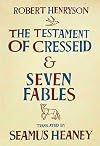
A convenient assembly of the Testament along with some of the fables, with the original Middle Scots texts on the verso pages. I give the book itself only 2**, however, and perhaps I'm being a bit parsimonious, but I dislike the quality of Heaney's translations. Going from Middle Scots (a fifteenth century dialect of Middle English, not the Gaelic of the highlands) to modern English should be easier than going from Chaucer's century-older dialect into modern English; but Heaney gets too show more creative and does not adhere to the strict rhyme that he should have employed to mirror Henryson's rhyme royal.
And really, all you need to read Henryson is a decent marginal (or footnoted, but not inconveniently endnoted) glossary of unfamiliar vocabulary and occasional unfamiliar syntactic structures. Do that and Henryson is no more difficult a read than Wuthering Heights with its Yorkshire dialect of Heathcliff's servant Joseph.
Heaney's translation did the service of popularizing Henryson to a degree with modern readers. But if you want to read Henryson, find a text (not that hard to find, and Heaney makes reference to such in his introduction) of Henryson in the original with the appropriate glossing.
Note that I've known the Testament for over half-a-century, going back to my college days. In fact, I used to have a running debate (very friendly) with Villanova University's medieval English lit professor, Joe Reino, as to the greatest Troilus story after Chaucer's. We both agreed that Shakespeare's play was one of his weaker, but Professor Reino chose Boccaccio's Il Filostrato second while I went with Henryson (but, in fairness, not knowing Italian then or now, making a judgment based solely on a prose translation of Il Filostrato). I'd never gotten around to any of the fables, however, so this volume was a useful Henryson supplement for me.
Incidentally, there's also an opera by William Walton dating back to the 1950s which I got a CD of many years ago. If I can't find it, I might get hold of another copy on eBay or Abe, though I don't have all that fond a recollection of the opera and it doesn't seem to have a lot of popularity today.
2** to Heaney, though to Henryson himself (in my opinion, the greatest Scottish poet, surpassing Burns) I'd give 5*****. show less
And really, all you need to read Henryson is a decent marginal (or footnoted, but not inconveniently endnoted) glossary of unfamiliar vocabulary and occasional unfamiliar syntactic structures. Do that and Henryson is no more difficult a read than Wuthering Heights with its Yorkshire dialect of Heathcliff's servant Joseph.
Heaney's translation did the service of popularizing Henryson to a degree with modern readers. But if you want to read Henryson, find a text (not that hard to find, and Heaney makes reference to such in his introduction) of Henryson in the original with the appropriate glossing.
Note that I've known the Testament for over half-a-century, going back to my college days. In fact, I used to have a running debate (very friendly) with Villanova University's medieval English lit professor, Joe Reino, as to the greatest Troilus story after Chaucer's. We both agreed that Shakespeare's play was one of his weaker, but Professor Reino chose Boccaccio's Il Filostrato second while I went with Henryson (but, in fairness, not knowing Italian then or now, making a judgment based solely on a prose translation of Il Filostrato). I'd never gotten around to any of the fables, however, so this volume was a useful Henryson supplement for me.
Incidentally, there's also an opera by William Walton dating back to the 1950s which I got a CD of many years ago. If I can't find it, I might get hold of another copy on eBay or Abe, though I don't have all that fond a recollection of the opera and it doesn't seem to have a lot of popularity today.
2** to Heaney, though to Henryson himself (in my opinion, the greatest Scottish poet, surpassing Burns) I'd give 5*****. show less
Henryson is one of the "Scottish Chaucerians" of the fifteenth century, best known for his version of Aesop's fables (including a delightful version of the country mouse and the city mouse) and the Testament of Cressid --an alternative ending for Chaucer's Troilus and Cressida, in which Cressida is stricken with leprosy for her infidelity to Troilus, and he seeing the leper is faintly reminded of Cressid and gives her alms, and she dies. Rather emotionally satisfying for those who pity show more Troilus in the original version, though perhaps anti-feminist. This book also includes a number of shorter works divided into those with stronger and weaker attributions --their presence makes this more complete than most other versions of Henryson available. show less

Reprint. Orig. publ. London : Kegan Paul, Trench, Trübner & Co., 1901
Awards

You May Also Like


Associated Authors
Statistics
- Works
- 17
- Also by
- 3
- Members
- 383
- Popularity
- #63,100
- Rating
- 4.1
- Reviews
- 3
- ISBNs
- 32
- Languages
- 3
- Favorited
- 2