

Saul A. Kripke (1940–2022)
Author of Naming and Necessity
About the Author
Born in Bay Shore, New York, the son of a rabbi (Myer Samuel) and a writer (Dorothy Karp), Saul Kripke demonstrated his genius to his startled parents when he was only 3 years old. He not only drew the logical consequences of ordinary beliefs, but also solved intricate problems in mathematics. As a show more child prodigy, he was presented by his father to distinguished mathematicians and philosophers, who were overwhelmed by his talents. His father introduced him at the age of 15 to a group of eminent mathematicians, headed by Haskell B. Curry. From his debut grew his first published article, "A Completeness Theorem in Modal Logic," which appeared in the Journal of Symbolic Logic. Kripke's boyhood genius did not flicker out in the 1960s, when he studied at Harvard, Oxford, Princeton and Rockefeller University or, more accurately, when he worked independently at these institutions and had occasional contact with his surroundings. His academic training was unique. He ascended directly to full professorships, without ever earning a doctorate. In fact, his highest academic degree was a B.A. from Harvard University, which he received in 1962. Kripkenever earned a doctorate, because no academician could be found to teach him. Consequently, the universities let him alone and admitted him to their faculties when he said he was ready. Slow to publish his lectures, Kripke nonetheless released a few articles, which he published exclusively in technical journals of philosophy and mathematics. So far his work has extended the boundaries of the most abstruse field of analytic philosophy, modal logic. He is esteemed for having invented the quantitative formulations of modality and for having opened up the ontological territory of possible worlds. At the age of 36, he was appointed James McCosh Professor of Philosophy at Princeton University. Kripke's awards include a Fulbright Fellowship (1962), Guggenheim Fellowship (1968), and a Fellowship from the American Council of Learned Societies (1981). His work, esoteric as it may seem to a public acquainted with such "social" philosophers as John Dewey or Jean-Paul Sartre, has created new fields in mathematical set theory and modal logic, which will generate Ph.D. theses for years to come. (Bowker Author Biography) show less
Image credit: Prof. Saul A. Kripke. Photo credit: Robert P. Matthews, 1983 (photo courtesy of Princeton University)
Series
Works by Saul A. Kripke
Outline of a theory of truth 3 copies
Associated Works
Tagged
Common Knowledge
- Legal name
- Kripke, Saul Aaron
- Birthdate
- 1940-11-13
- Date of death
- 2022-09-15
- Gender
- male
- Education
- Harvard University
- Occupations
- philosopher
university professor - Organizations
- CUNY Graduate Center
Princeton University - Awards and honors
- Rolf Schock Prize (Logic and Philosophy, 2001)
- Relationships
- Kripke, Dorothy Karp (parent)
Kripke, Myer S. (parent)
Gilbert, Margaret (former spouse)
Lear, Jonathan (student) - Cause of death
- pancreatic cancer
- Nationality
- USA
- Birthplace
- Bay Shore, Long Island, New York, USA
- Place of death
- Plainsboro, New Jersey, USA
- Associated Place (for map)
- USA
Members
Reviews
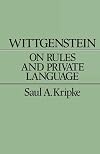
Kripke’s book addresses a topic in Wittgenstein’s thinking that is central to all of his thinking, difficult to ferret out from the text, and maybe even more difficult to analyze, evaluate, and potentially accept as valid.
There are several critical pieces to Kripke’s interpretation. I’m going to concentrate on one of them, which we could call Wittgenstein’s re-understanding of what it is to “mean” something, such as when we “mean” the standard rule of addition when adding show more two numbers. The re-understanding is a turn from a representationalist or “picture” view of meaning and truth (as in Wittgenstein’s Tractatus) to a much more pragmatic view in the Investigations.
But before getting to that, Kripke makes some other important claims about the interpretation of the Investigations. In particular, he claims that Wittgenstein’s treatments of sensations and of mathematics in the Investigations (and elsewhere) are something like instances of a more general argument, one about rule-following. In fact, Kripke focuses his discussion on remarks that precede what is normally regarded as “the private language argument.” Kripke thinks that, once we understand Wittgenstein’s remarks on rule-following, what he has to say about private language will be much more readily understood.
Wittgenstein’s discussion of rule following discloses a paradox, by Kripke’s reading. Kripke describes the paradox using addition as the subject rule. If I am asked to add 68 + 57, I presumably employ a rule for the “plus” operation, and I respond with the correct answer, 125. Let’s assume that that particular addition is one I just happen never to have made before (if for some reason I know that I have, Kripke could, on Wittgenstein’s behalf, just use a different example — since I haven’t performed every addition of two numbers, there would be one I haven’t performed before).
Now Kripke imagines a skeptic enters the conversation. The imagined skeptic says, “No, the correct answer is 5.”
How do I know the answer isn’t 5? Seems simple — I appeal to the rule for “plus” (e.g., a rule that involves counting out a set of marks equal to each number to be added, and then counting out the total marks of the two sets). But the skeptic can say that in fact, the proper rule at work is different, that, while what I’ve cited is fine for other additions, in the particular case of 68 + 57, the answer is 5. Thus he appeals to a rule that Kripke calls “quus,” one in which we proceed as we normally do and expect, but in the particular case of 68 + 57, we should respond with 5.
I might respond to the skeptic that that is not the rule I have always followed, that whenever I’ve added numbers in the past, I’ve followed the “plus” rule, not the “quus” rule. But of course our past behavior in adding numbers is just as consistent with the quus rule as the plus rule, since we’ve never added 68 + 57 before. Both give the same result for all but this one instance.
I then respond that, no, in this case as in past cases, i had in mind, when I added the two numbers, the plus rule, not the quus rule. It was the plus rule that I “meant” to employ.
What is my evidence for that?
This is an appeal to Wittgenstein’s repeated question, what is it to mean something when you say it or think it? Is “meaning something” an additional action of some sort, a behavioral or mental action?
And of course I can’t actually supply any evidence of such an action of “meaning” the plus rule. Introspection doesn’t reveal any mental act of meaning the rule, and nothing in my behavior accompanied my reporting my result that indicated what rule I was following. For all we can tell from the evidence, for all I can tell, I was just as likely employing the quus rule.
So my claim to know the correct answer to be 125 rather than 5 seems undermined. Yet I know it is the correct answer, just without apparent justification. Without justification, and without any evidence of following any rule at all, how did I arrive at what we think of as the correct answer? Hence the apparent paradox.
Among the responses Wittgenstein considers, and Kripke recounts, is that there is a special felt mental state or sensation of “meaning” the plus rule or any other rule, and that we experience that state or feeling when we employ the rule. Of course, much of the skeptical argument already laid out will address that supposition — how would we know that feeling to be the feeling of meaning plus as opposed to meaning quus?
The importance of that “special feeling” response to the paradox isn’t so much that it is a strong response as that, as so often in Wittgenstein’s thought, it’s the philosophically intuitive one. Of course meaning something is an action, and associated with it is some mental experience of the action. And Wittgenstein, Kripke rightly stresses, is not a behaviorist — he doesn’t deny the existence of mental experiences. But he asks the critical question — how do I know that whatever I experience in my mind is one of meaning plus (as opposed to meaning quus)?
That sets the problem. Kripke presents it as formally analogous to Hume’s skeptical argument regarding causality, that we never actually perceive a causal relation between two events, despite that we commonly (and correctly) regard claims of causal connections between events as valid.
So how does Kripke think Wittgenstein resolves the paradox? The response Kripke ascribes to Wittgenstein is also Humean in form — a “skeptical response.”
Kripke’s account leans significantly on his understanding of Wittgenstein’s change in views on language from the Tractatus to the Philosophical Investigations. In the Tractatus, sentences were pictures (or representations) of states of affairs — facts. And they derived their meaning from their “truth conditions,” the facts that must be the case in order for the sentence to be true. Such a sentence as, “I meant the plus function when I added the numbers” is then a sentence that, to be true and meaningful, must picture some fact. The paradox however reveals that there just is no such fact.
By contrast to the Tractatus view, according to Kripke’s reading of the Investigations, Wittgenstein has staked out a new account of language and meaning, displacing the Tractatus account. Here is Kripke’s statement of this new account:
“Wittgenstein replaces the question, ‘What must be the case for this sentence to be true?’ by two others: first, ‘Under what conditions may this form of words be appropriately asserted (or denied)?’; second, given an answer to the first question, ‘What is the role, and the utility, in our lives of our practice of asserting (or denying) the form of words under these conditions?’"
I don’t think the two questions are independent of one another. The first is meant to place a sentence in a social context — sentences are things said by people to other people (and sometimes to oneself, of course), and the question is, when is it appropriate (or as Kripke says in other formulations, when is it justified) to do that?
Outside the social context, we could just say it is appropriate when it is “true,” meaning when it accurately pictures the facts. Kripke means instead to call for a justification in social terms, when is it appropriate to speak the sentence to others?
We could call Wittgenstein’s argument, under Kripke’s reconstruction of it, an argument for re-understanding what it is to mean something, or what it means to follow a rule at all. The re-understanding displaces the idea of there being a mental fact referred to and puts in its place a pragmatic, community context and a process of community agreement and correction.
If I’m learning arithmetic, and I keep giving incorrect responses, by community-accepted standards, I’ll get corrected. And I’ll go on practicing until I give consistently correct responses, at which point my teacher, as a member of the community can say that I understand, am following, and mean the addition rule when I add numbers.
As an aside, notice how Vygotskyian this view of what it is to learn arithmetic or other sorts of things is. Despite the apparent abstract character of mathematics, according to this account, learning arithmetic is very explicitly a matter of learning to become a member of a community.
There’s a lot we could say about that pragmatic re-understanding. Does it apply to all cases of “meaning” something? Does it actually displace the "fact" conception of truth, or does it only layer in something else in its place, leaving the factually true and the pragmatic as separate concerns? Is Kripke's reading consistent with Wittgenstein's admonishment that "human agreement" does not "decide what is true and false" (§241 in the Investigations)?
I will say I’m attracted to the social, community aspects of Kripke’s interpretation. I think Wittgenstein's views on meaning, truth, and knowledge are critically social, embedded in community contexts. And I do think that the “private language argument” exhibits that thinking, although I sometimes feel the draw of a more abstractly logical account as well.
Rather than try to go into all of those questions and controversies, I want to go back to Kripke’s central discussion, the addition example relating to following a rule. That will help get at the pragmatic strategy he attributes to Wittgenstein and how helpful it may or may not be.
(I know this is a long review, so if you’re tired of it, you’re excused! I'm done with exposition -- the rest is some thoughts of my own.)
Kripke’s interpretation depends on replacing truth conditions with pragmatic justification. Is there a difference between being justified in saying of someone (or even of oneself?) that they are following a rule and the fact whether or not they are following the rule?
Go back to the plus/quus example. Suppose, as with Kripke, someone agrees with me and others in the community on additions until one day he doesn’t. Do we then say that he is no longer following the rule or do we say that we’ve just discovered that he never was following it? And why would we say one rather than the other? Is there a fact at issue?
Take a different example. Suppose I’m talking with a friend about movies we like and don’t like. We agree on our judgements of 20 movies, a pretty remarkable consistency that makes us think that we are following the same criteria, whatever they may be (and of course we may not be able to spell them out explicitly). Then, on the 21st movie, we disagree radically. Would we say that one of us is now following different criteria, or would we say that we actually had different criteria all along?
We might say, in the same spirit of saying that “meaning plus” doesn’t refer to a fact that in these cases of subsequent disagreement there is no fact by which to answer my question of whether we were both following the same rule, or the same criteria, and one of us has now changed, or that we weren’t really following the same rule, or the same criteria, all along. Giving up that supposed fact would then just be part of our re-understanding what it is to follow a rule (or follow criteria).
It would be odd to do so, but I’m not saying it wouldn’t be right to do so. I don’t know.
I’m also a little puzzled, under the re-understanding, what to make of my predilection to answer differently in the two scenarios. In the case where someone’s responses to addition problems deviates, I’m tempted to say he has changed the rule he is following. In the case where my friend’s judgements of movies deviates from mine, I’m tempted to say we’ve discovered a difference that was there all along.
Maybe the two cases are relevantly disanalogous. The addition is rule-governed, while the judgements of movies are not -- they are individual acts of aesthetic judgement. Rules are deterministic -- there's no wiggle room in addition. Movie judgements are looser, less determined by criteria or standards. But that goes to the heart of the matter. What is it that determines the addition, and how is it different from what more loosely guides the judgement? Wittgenstein's questioning leaves us at a loss to say what the difference is.
We might say that, again in the spirit of the re-understanding, that there is no fact distinguishing the two, but instead some consideration of how we go forward from a disagreement, or something similarly pragmatic and maybe community-oriented. Then it’s just pragmatics all the way down. If so, there are going to be more consequences (after all, Rorty wrote a book called Consequences of Pragmatism).
This is the draw of pragmatism, but there is a conflicting draw toward the idea that there must be a fact of the matter. An easy way to characterize the difference between Kripke’s addition example and my movie example would be to give in to the temptation to say that there is a fact to the matter, and to say that we are judging the two cases differently because the facts are different. Surely the differing judgements in the two cases relate to different facts?
I don’t know the answer. But I guess I’m happy that I have the question. show less
There are several critical pieces to Kripke’s interpretation. I’m going to concentrate on one of them, which we could call Wittgenstein’s re-understanding of what it is to “mean” something, such as when we “mean” the standard rule of addition when adding show more two numbers. The re-understanding is a turn from a representationalist or “picture” view of meaning and truth (as in Wittgenstein’s Tractatus) to a much more pragmatic view in the Investigations.
But before getting to that, Kripke makes some other important claims about the interpretation of the Investigations. In particular, he claims that Wittgenstein’s treatments of sensations and of mathematics in the Investigations (and elsewhere) are something like instances of a more general argument, one about rule-following. In fact, Kripke focuses his discussion on remarks that precede what is normally regarded as “the private language argument.” Kripke thinks that, once we understand Wittgenstein’s remarks on rule-following, what he has to say about private language will be much more readily understood.
Wittgenstein’s discussion of rule following discloses a paradox, by Kripke’s reading. Kripke describes the paradox using addition as the subject rule. If I am asked to add 68 + 57, I presumably employ a rule for the “plus” operation, and I respond with the correct answer, 125. Let’s assume that that particular addition is one I just happen never to have made before (if for some reason I know that I have, Kripke could, on Wittgenstein’s behalf, just use a different example — since I haven’t performed every addition of two numbers, there would be one I haven’t performed before).
Now Kripke imagines a skeptic enters the conversation. The imagined skeptic says, “No, the correct answer is 5.”
How do I know the answer isn’t 5? Seems simple — I appeal to the rule for “plus” (e.g., a rule that involves counting out a set of marks equal to each number to be added, and then counting out the total marks of the two sets). But the skeptic can say that in fact, the proper rule at work is different, that, while what I’ve cited is fine for other additions, in the particular case of 68 + 57, the answer is 5. Thus he appeals to a rule that Kripke calls “quus,” one in which we proceed as we normally do and expect, but in the particular case of 68 + 57, we should respond with 5.
I might respond to the skeptic that that is not the rule I have always followed, that whenever I’ve added numbers in the past, I’ve followed the “plus” rule, not the “quus” rule. But of course our past behavior in adding numbers is just as consistent with the quus rule as the plus rule, since we’ve never added 68 + 57 before. Both give the same result for all but this one instance.
I then respond that, no, in this case as in past cases, i had in mind, when I added the two numbers, the plus rule, not the quus rule. It was the plus rule that I “meant” to employ.
What is my evidence for that?
This is an appeal to Wittgenstein’s repeated question, what is it to mean something when you say it or think it? Is “meaning something” an additional action of some sort, a behavioral or mental action?
And of course I can’t actually supply any evidence of such an action of “meaning” the plus rule. Introspection doesn’t reveal any mental act of meaning the rule, and nothing in my behavior accompanied my reporting my result that indicated what rule I was following. For all we can tell from the evidence, for all I can tell, I was just as likely employing the quus rule.
So my claim to know the correct answer to be 125 rather than 5 seems undermined. Yet I know it is the correct answer, just without apparent justification. Without justification, and without any evidence of following any rule at all, how did I arrive at what we think of as the correct answer? Hence the apparent paradox.
Among the responses Wittgenstein considers, and Kripke recounts, is that there is a special felt mental state or sensation of “meaning” the plus rule or any other rule, and that we experience that state or feeling when we employ the rule. Of course, much of the skeptical argument already laid out will address that supposition — how would we know that feeling to be the feeling of meaning plus as opposed to meaning quus?
The importance of that “special feeling” response to the paradox isn’t so much that it is a strong response as that, as so often in Wittgenstein’s thought, it’s the philosophically intuitive one. Of course meaning something is an action, and associated with it is some mental experience of the action. And Wittgenstein, Kripke rightly stresses, is not a behaviorist — he doesn’t deny the existence of mental experiences. But he asks the critical question — how do I know that whatever I experience in my mind is one of meaning plus (as opposed to meaning quus)?
That sets the problem. Kripke presents it as formally analogous to Hume’s skeptical argument regarding causality, that we never actually perceive a causal relation between two events, despite that we commonly (and correctly) regard claims of causal connections between events as valid.
So how does Kripke think Wittgenstein resolves the paradox? The response Kripke ascribes to Wittgenstein is also Humean in form — a “skeptical response.”
Kripke’s account leans significantly on his understanding of Wittgenstein’s change in views on language from the Tractatus to the Philosophical Investigations. In the Tractatus, sentences were pictures (or representations) of states of affairs — facts. And they derived their meaning from their “truth conditions,” the facts that must be the case in order for the sentence to be true. Such a sentence as, “I meant the plus function when I added the numbers” is then a sentence that, to be true and meaningful, must picture some fact. The paradox however reveals that there just is no such fact.
By contrast to the Tractatus view, according to Kripke’s reading of the Investigations, Wittgenstein has staked out a new account of language and meaning, displacing the Tractatus account. Here is Kripke’s statement of this new account:
“Wittgenstein replaces the question, ‘What must be the case for this sentence to be true?’ by two others: first, ‘Under what conditions may this form of words be appropriately asserted (or denied)?’; second, given an answer to the first question, ‘What is the role, and the utility, in our lives of our practice of asserting (or denying) the form of words under these conditions?’"
I don’t think the two questions are independent of one another. The first is meant to place a sentence in a social context — sentences are things said by people to other people (and sometimes to oneself, of course), and the question is, when is it appropriate (or as Kripke says in other formulations, when is it justified) to do that?
Outside the social context, we could just say it is appropriate when it is “true,” meaning when it accurately pictures the facts. Kripke means instead to call for a justification in social terms, when is it appropriate to speak the sentence to others?
We could call Wittgenstein’s argument, under Kripke’s reconstruction of it, an argument for re-understanding what it is to mean something, or what it means to follow a rule at all. The re-understanding displaces the idea of there being a mental fact referred to and puts in its place a pragmatic, community context and a process of community agreement and correction.
If I’m learning arithmetic, and I keep giving incorrect responses, by community-accepted standards, I’ll get corrected. And I’ll go on practicing until I give consistently correct responses, at which point my teacher, as a member of the community can say that I understand, am following, and mean the addition rule when I add numbers.
As an aside, notice how Vygotskyian this view of what it is to learn arithmetic or other sorts of things is. Despite the apparent abstract character of mathematics, according to this account, learning arithmetic is very explicitly a matter of learning to become a member of a community.
There’s a lot we could say about that pragmatic re-understanding. Does it apply to all cases of “meaning” something? Does it actually displace the "fact" conception of truth, or does it only layer in something else in its place, leaving the factually true and the pragmatic as separate concerns? Is Kripke's reading consistent with Wittgenstein's admonishment that "human agreement" does not "decide what is true and false" (§241 in the Investigations)?
I will say I’m attracted to the social, community aspects of Kripke’s interpretation. I think Wittgenstein's views on meaning, truth, and knowledge are critically social, embedded in community contexts. And I do think that the “private language argument” exhibits that thinking, although I sometimes feel the draw of a more abstractly logical account as well.
Rather than try to go into all of those questions and controversies, I want to go back to Kripke’s central discussion, the addition example relating to following a rule. That will help get at the pragmatic strategy he attributes to Wittgenstein and how helpful it may or may not be.
(I know this is a long review, so if you’re tired of it, you’re excused! I'm done with exposition -- the rest is some thoughts of my own.)
Kripke’s interpretation depends on replacing truth conditions with pragmatic justification. Is there a difference between being justified in saying of someone (or even of oneself?) that they are following a rule and the fact whether or not they are following the rule?
Go back to the plus/quus example. Suppose, as with Kripke, someone agrees with me and others in the community on additions until one day he doesn’t. Do we then say that he is no longer following the rule or do we say that we’ve just discovered that he never was following it? And why would we say one rather than the other? Is there a fact at issue?
Take a different example. Suppose I’m talking with a friend about movies we like and don’t like. We agree on our judgements of 20 movies, a pretty remarkable consistency that makes us think that we are following the same criteria, whatever they may be (and of course we may not be able to spell them out explicitly). Then, on the 21st movie, we disagree radically. Would we say that one of us is now following different criteria, or would we say that we actually had different criteria all along?
We might say, in the same spirit of saying that “meaning plus” doesn’t refer to a fact that in these cases of subsequent disagreement there is no fact by which to answer my question of whether we were both following the same rule, or the same criteria, and one of us has now changed, or that we weren’t really following the same rule, or the same criteria, all along. Giving up that supposed fact would then just be part of our re-understanding what it is to follow a rule (or follow criteria).
It would be odd to do so, but I’m not saying it wouldn’t be right to do so. I don’t know.
I’m also a little puzzled, under the re-understanding, what to make of my predilection to answer differently in the two scenarios. In the case where someone’s responses to addition problems deviates, I’m tempted to say he has changed the rule he is following. In the case where my friend’s judgements of movies deviates from mine, I’m tempted to say we’ve discovered a difference that was there all along.
Maybe the two cases are relevantly disanalogous. The addition is rule-governed, while the judgements of movies are not -- they are individual acts of aesthetic judgement. Rules are deterministic -- there's no wiggle room in addition. Movie judgements are looser, less determined by criteria or standards. But that goes to the heart of the matter. What is it that determines the addition, and how is it different from what more loosely guides the judgement? Wittgenstein's questioning leaves us at a loss to say what the difference is.
We might say that, again in the spirit of the re-understanding, that there is no fact distinguishing the two, but instead some consideration of how we go forward from a disagreement, or something similarly pragmatic and maybe community-oriented. Then it’s just pragmatics all the way down. If so, there are going to be more consequences (after all, Rorty wrote a book called Consequences of Pragmatism).
This is the draw of pragmatism, but there is a conflicting draw toward the idea that there must be a fact of the matter. An easy way to characterize the difference between Kripke’s addition example and my movie example would be to give in to the temptation to say that there is a fact to the matter, and to say that we are judging the two cases differently because the facts are different. Surely the differing judgements in the two cases relate to different facts?
I don’t know the answer. But I guess I’m happy that I have the question. show less
This is, and should be, a classic in philosophy. It is a rebirth of metaphysics, which was killed of by the logical positivists. It demonstrates the necessity and shows the metaphysical problems in a world that has undergone the revolution of modern science and gives solutions to them that other philosophers will not have thought of. It demystifices possible world semantics and introduces rigid designation, it also breaks the link between necessity and a prioricism that gradually had become show more unconceivable to question in the history of philosophy.
I believe, his metaphysical results are very relevant to philosophy of mind, which is my main interest. But his ability to question previous philosophical tradition in metaphysics is missing in his philosophy of mind (specifically a Cartesian outlook). This is not just a question of that I disagree with him as he seems oblivious to obvious counter-arguments. Philosophy of mind must have changed so radically between this book was published 45 years ago and when I first studied it 20 years ago. show less
I believe, his metaphysical results are very relevant to philosophy of mind, which is my main interest. But his ability to question previous philosophical tradition in metaphysics is missing in his philosophy of mind (specifically a Cartesian outlook). This is not just a question of that I disagree with him as he seems oblivious to obvious counter-arguments. Philosophy of mind must have changed so radically between this book was published 45 years ago and when I first studied it 20 years ago. show less
This series of lectures is best passed over by anyone not thoroughly interested in the picayune quibbles and splitting of imaginary hairs that dominates modern academic metaphysics. Although, if you happen to enjoy non-sequiturs, category errors, equivocation of terms, or a dogged determination to draw ridiculous conclusions from implausible premises, then you might find some mild amusement in this book - though, to be honest, it doesn't score quite as well in any of those categories as show more certain works by David Lewis. show less

"A Completeness Theorem in Modal Logic" (1959) written when he was a teenager, were on modal logic. A 1970 Princeton lecture series, published in book form in 1980 as Naming and Necessity, is considered one of the most important philosophical works of the 20th century.
Lists
Awards


You May Also Like


Associated Authors
Statistics
- Works
- 7
- Also by
- 5
- Members
- 1,683
- Popularity
- #15,271
- Rating
- 4.1
- Reviews
- 8
- ISBNs
- 47
- Languages
- 10
- Favorited
- 6