

A. L. Morton (1903–1987)
Author of A People's History of England
About the Author
Image credit: from Marxists Internet Archive
Works by A. L. Morton
Freedom in arms : a selection of Leveller writings (1975) — Editor; Introduction — 41 copies, 1 review
Az angol nép torténete I. 1 copy
Associated Works
Three Works by William Morris : A Dream of John Ball / The Pilgrims of Hope / News from Nowhere (1968) — Introduction — 74 copies, 3 reviews
Tagged
Common Knowledge
- Legal name
- Morton, Arthur Leslie
- Birthdate
- 1903
- Date of death
- 1987
- Gender
- male
- Education
- University of Cambridge
- Occupations
- historian
Chair of the Historians Group of the Communist Party of Great Britain
schoolteacher
editorial board member, Daily Worker - Organizations
- Communist Party of Great Britain
Communist Party Historians Group
Summerhill (school)
Daily Worker
William Morris Society (founding member) - Nationality
- UK
- Birthplace
- Suffolk, England, UK
- Place of death
- Clare, Suffolk, England
- Map Location
- UK
Members
Reviews

Reading this book was rather fascinating for two reasons. Firstly, because it analyses English utopian literature from the 14th century to the beginning of the 20th. Secondly, because it is such a product of its time - it was published in 1952 and the author is an avowed Marxist. This colours the whole structure of the book, as Morton sees the validity of utopian visions in terms of how closely they reflect notions of class struggle, socialism, and communism. The influence steadily increases show more throughout the book, until the end when Morton states that utopian literature is no longer needed because the USSR has achieved a real utopia. There is a dark irony to reading this, really, knowing with the benefit of hindsight that Stalin’s Russia was more of a brutal dystopia. Interestingly, the term dystopia is not used here, as it is a much more recent innovation than utopia and seems only to have been popularised recently. ‘anti-’ and ‘negative’ utopias are instead referred to.
The initial chapters were thus helpful for what they told me about the time being written about, whereas the latter told me far more about the time when this book was written. From the former, I’d pick out the interesting comparison between Swift’s [b:Gulliver's Travels|7733|Gulliver's Travels|Jonathan Swift|https://images.gr-assets.com/books/1427829692s/7733.jpg|2394716] and Defoe’s [b:Robinson Crusoe|2932|Robinson Crusoe|Daniel Defoe|https://images.gr-assets.com/books/1403180114s/2932.jpg|604666]. The discussion of William Morris and [b:News from Nowhere|189746|News from Nowhere|William Morris|https://images.gr-assets.com/books/1172550120s/189746.jpg|13352231] is rather hagiographic, however. On the other hand, the author has little respect for H.G. Wells and his slew of utopias, which apparently display a lack of ‘any scientific understanding of society’. In the final chapter, it becomes clear that to the author all utopian literature is either tending towards a Marxist conception of history or is completely wrong. This is obviously a very different conception to today’s idea of utopian literature and why it exists, as Marxism has lost all of its influence on the social sciences (and neoliberalism has apparently taken its place). I was surprised by the savaging given to [b:1984|5470|1984|George Orwell|https://images.gr-assets.com/books/1348990566s/5470.jpg|153313], probably the best known dystopian novel. It is described as, ‘the frankest reaction, a determination to resist the “actual realisation” of Utopia, a deep conviction that we must cling to all existing institutions, however corrupt, since any change can only be for the worse’. This strikes me as an inaccurate reading, as well as an unfair one. Orwell was a socialist, but appeared to have lost any faith in the USSR’s communist regime during the Spanish Civil War. (There’s a really interesting radio programme about this on iPlayer, actually.) Morton’s narrow conception of 20th century utopian literature sees no purpose to the dystopias that we know see as prescient warnings - especially [b:1984|5470|1984|George Orwell|https://images.gr-assets.com/books/1348990566s/5470.jpg|153313] and [b:Brave New World|5129|Brave New World|Aldous Huxley|https://images.gr-assets.com/books/1433092908s/5129.jpg|3204877]. Morton accuses both of containing a fear of the working class, whereas I’d call it more of an ambivalence. Neither book has much empathy for them, but both display in different ways how the poor majority can be systematically manipulated and repressed. It's also worth noting that each writer's fiction is assumed to be a direct reflection of their personal politics.
This book is a historical document, both for helpfully summarising older utopian writing that isn’t easy to get hold of, and for demonstrating a particular understanding of utopia based on Marxism. The historical narrative is of a continual progress towards the glorious utopia of communism - it’s sad to realise that this hope turned into horrific totalitarian oppression. Moreover, we have no such hopeful narrative today. At one point Morton dismisses liberalism as useless and out-dated, whereas today neoliberalism is such a dominant ideology that we barely notice it. The collapse of the USSR provoked such an outpouring of Fukuyama-type triumphalism that socialist notions of utopia have yet to recover. Literature instead abounds with dystopias, warning of terrible things to come. show less
The initial chapters were thus helpful for what they told me about the time being written about, whereas the latter told me far more about the time when this book was written. From the former, I’d pick out the interesting comparison between Swift’s [b:Gulliver's Travels|7733|Gulliver's Travels|Jonathan Swift|https://images.gr-assets.com/books/1427829692s/7733.jpg|2394716] and Defoe’s [b:Robinson Crusoe|2932|Robinson Crusoe|Daniel Defoe|https://images.gr-assets.com/books/1403180114s/2932.jpg|604666]. The discussion of William Morris and [b:News from Nowhere|189746|News from Nowhere|William Morris|https://images.gr-assets.com/books/1172550120s/189746.jpg|13352231] is rather hagiographic, however. On the other hand, the author has little respect for H.G. Wells and his slew of utopias, which apparently display a lack of ‘any scientific understanding of society’. In the final chapter, it becomes clear that to the author all utopian literature is either tending towards a Marxist conception of history or is completely wrong. This is obviously a very different conception to today’s idea of utopian literature and why it exists, as Marxism has lost all of its influence on the social sciences (and neoliberalism has apparently taken its place). I was surprised by the savaging given to [b:1984|5470|1984|George Orwell|https://images.gr-assets.com/books/1348990566s/5470.jpg|153313], probably the best known dystopian novel. It is described as, ‘the frankest reaction, a determination to resist the “actual realisation” of Utopia, a deep conviction that we must cling to all existing institutions, however corrupt, since any change can only be for the worse’. This strikes me as an inaccurate reading, as well as an unfair one. Orwell was a socialist, but appeared to have lost any faith in the USSR’s communist regime during the Spanish Civil War. (There’s a really interesting radio programme about this on iPlayer, actually.) Morton’s narrow conception of 20th century utopian literature sees no purpose to the dystopias that we know see as prescient warnings - especially [b:1984|5470|1984|George Orwell|https://images.gr-assets.com/books/1348990566s/5470.jpg|153313] and [b:Brave New World|5129|Brave New World|Aldous Huxley|https://images.gr-assets.com/books/1433092908s/5129.jpg|3204877]. Morton accuses both of containing a fear of the working class, whereas I’d call it more of an ambivalence. Neither book has much empathy for them, but both display in different ways how the poor majority can be systematically manipulated and repressed. It's also worth noting that each writer's fiction is assumed to be a direct reflection of their personal politics.
This book is a historical document, both for helpfully summarising older utopian writing that isn’t easy to get hold of, and for demonstrating a particular understanding of utopia based on Marxism. The historical narrative is of a continual progress towards the glorious utopia of communism - it’s sad to realise that this hope turned into horrific totalitarian oppression. Moreover, we have no such hopeful narrative today. At one point Morton dismisses liberalism as useless and out-dated, whereas today neoliberalism is such a dominant ideology that we barely notice it. The collapse of the USSR provoked such an outpouring of Fukuyama-type triumphalism that socialist notions of utopia have yet to recover. Literature instead abounds with dystopias, warning of terrible things to come. show less

This review of the history of England was unexpectedly rich and insightful. Morton in his epilogue says that the book is not so much history as an exercise in historical interpretation. It is complex and ambitious and for me was a facinating overview of the economic and political forces that created Britain up to modern times. In a little over 500 pages, this book provides a densely packed summary from the pre-Roman tribes to the early 20th century.
I was initially looking for an overview of show more British history from a common person’s point of view, like Colin James’ excellent Cambridge Illustrated History of France. Although Morton’t book touches on the lives of common people, it’s focus is more to create an understanding for readers who are common people so that they can understand the forces that shape their lives. It does not dwell on detail much but focuses on the broad social, political, economic and technological forces as they were understood by a left-leaning historian writing in the 1930s. Morton sees history as a continuous process of change and class struggle, not as an abstract movement but as people struggling to gain class interests that are important in their everyday lives. When talking about the shift from agricultural and craft production to the early phases of the industrial revolution, for example, he shows how trading and transportation technology created markets for factory products, but also how working people resisted through organized rebellions over centuries as well as through their individual attempts to protect their livelihoods.
Although well grounded in historical fact, Morton does not hold back his opinions and he can be quite witty in his descriptions, which makes the density of the text easier to work through.
I suspect Morton’s interpretation is open to some dispute and updating, but he provides an understanding of why British society was shaped the way it was, such as why the Romans entered Britain (to prevent their suporting the Gauls) and eventually left; how feudalism worked in the middle ages, but gave way to centralized political structures; how Oliver Cromwell’s New Model Army changed contemporary warfare and politics; and how privatization of the commons led to both the exploitation and the growth of the industrial working class. I can imagine this book being a text for a working class discussion group, easily providing enough points in each chapter to stimulate an evening’s education sessions for a year. In fact, this is not a quick read – it took me months to read it because there is so much in each chapter that I wanted to absorb each section before moving on to the next. There’s too much in each brief section to quickly read and move on. It’s well worth the time, though.
As a Canadian, we learn some highlights of English history, such as the Magna Carta and the Reformation. We get little detail, however, and less understanding. (We don’t learn that the Magna Carta was ignored and largely irrelevant until it suited bourgeious ideology in the struggle against the Stuarts, when it was brought out of storage and revered.) Although this book doesn’t cover the last half of the last century, it does give a basis for an understanding that goes far beyond historical facts. It added a great deal to my recent vacation in Britain, notwithstanding that it ends in the period leading up to the cataclysm of the Second World War. show less
I was initially looking for an overview of show more British history from a common person’s point of view, like Colin James’ excellent Cambridge Illustrated History of France. Although Morton’t book touches on the lives of common people, it’s focus is more to create an understanding for readers who are common people so that they can understand the forces that shape their lives. It does not dwell on detail much but focuses on the broad social, political, economic and technological forces as they were understood by a left-leaning historian writing in the 1930s. Morton sees history as a continuous process of change and class struggle, not as an abstract movement but as people struggling to gain class interests that are important in their everyday lives. When talking about the shift from agricultural and craft production to the early phases of the industrial revolution, for example, he shows how trading and transportation technology created markets for factory products, but also how working people resisted through organized rebellions over centuries as well as through their individual attempts to protect their livelihoods.
Although well grounded in historical fact, Morton does not hold back his opinions and he can be quite witty in his descriptions, which makes the density of the text easier to work through.
I suspect Morton’s interpretation is open to some dispute and updating, but he provides an understanding of why British society was shaped the way it was, such as why the Romans entered Britain (to prevent their suporting the Gauls) and eventually left; how feudalism worked in the middle ages, but gave way to centralized political structures; how Oliver Cromwell’s New Model Army changed contemporary warfare and politics; and how privatization of the commons led to both the exploitation and the growth of the industrial working class. I can imagine this book being a text for a working class discussion group, easily providing enough points in each chapter to stimulate an evening’s education sessions for a year. In fact, this is not a quick read – it took me months to read it because there is so much in each chapter that I wanted to absorb each section before moving on to the next. There’s too much in each brief section to quickly read and move on. It’s well worth the time, though.
As a Canadian, we learn some highlights of English history, such as the Magna Carta and the Reformation. We get little detail, however, and less understanding. (We don’t learn that the Magna Carta was ignored and largely irrelevant until it suited bourgeious ideology in the struggle against the Stuarts, when it was brought out of storage and revered.) Although this book doesn’t cover the last half of the last century, it does give a basis for an understanding that goes far beyond historical facts. It added a great deal to my recent vacation in Britain, notwithstanding that it ends in the period leading up to the cataclysm of the Second World War. show less
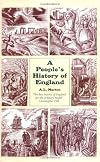
This classic work lays out the main outlines and most important turning points of British history - from the point of view of the ordinary people - in a clear and jargon-free style. Fascinating for the general reader and the historian alike, A People's History of England - which has been continuously in print for more than fifty years - is the indispensable work on the subject.

You May Also Like


Associated Authors
Statistics
- Works
- 19
- Also by
- 4
- Members
- 355
- Popularity
- #67,467
- Rating
- 4.1
- Reviews
- 4
- ISBNs
- 32
- Languages
- 2